

Steve Willis is a Washington state-based creator who has been self-publishing his own particular brand of strange and surreal comics out of the Pacific Northwest of the United States since 1973. In 1983, Willis published The Tragedy of Morty, Prince of Denmarke, a set of five (8 1/2 × 7, a bit wider than A5) volumes serializing his adaptation of Shakespeare’s Hamlet, starring his own cast of characters with a contemporary bent.
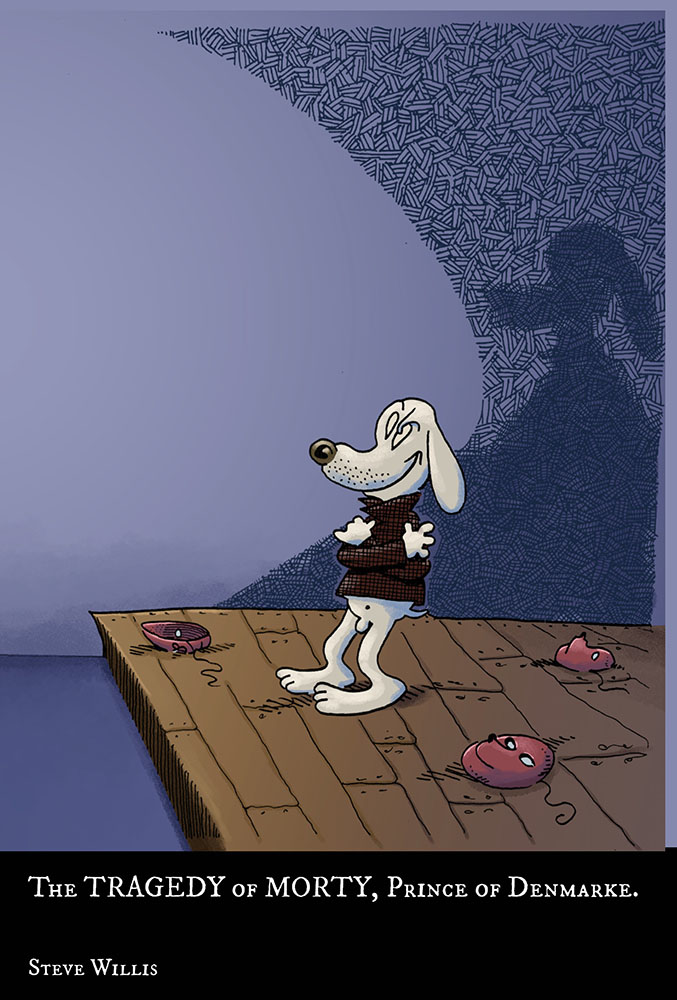
There have been many Willis self-published editions of this early minicomic graphic novel, followed by a 2020 edition of the series from Jeff Wood and Pseudo Comics. That brings us to the present edition from Tom Fellrath of Phoenix Productions, who has reformatted the Pseudo Comics five book-set into the first ever single-volume edition of Willis’s longest single comics story. The overall package holds together very well in this thick print-on-demand paperback format, the high quality newsprint-like paper stock is quite appropriate to the photocopied minicomic origins of this Willis book. We don’t do a lot of tactile reviews, but it just feels right!
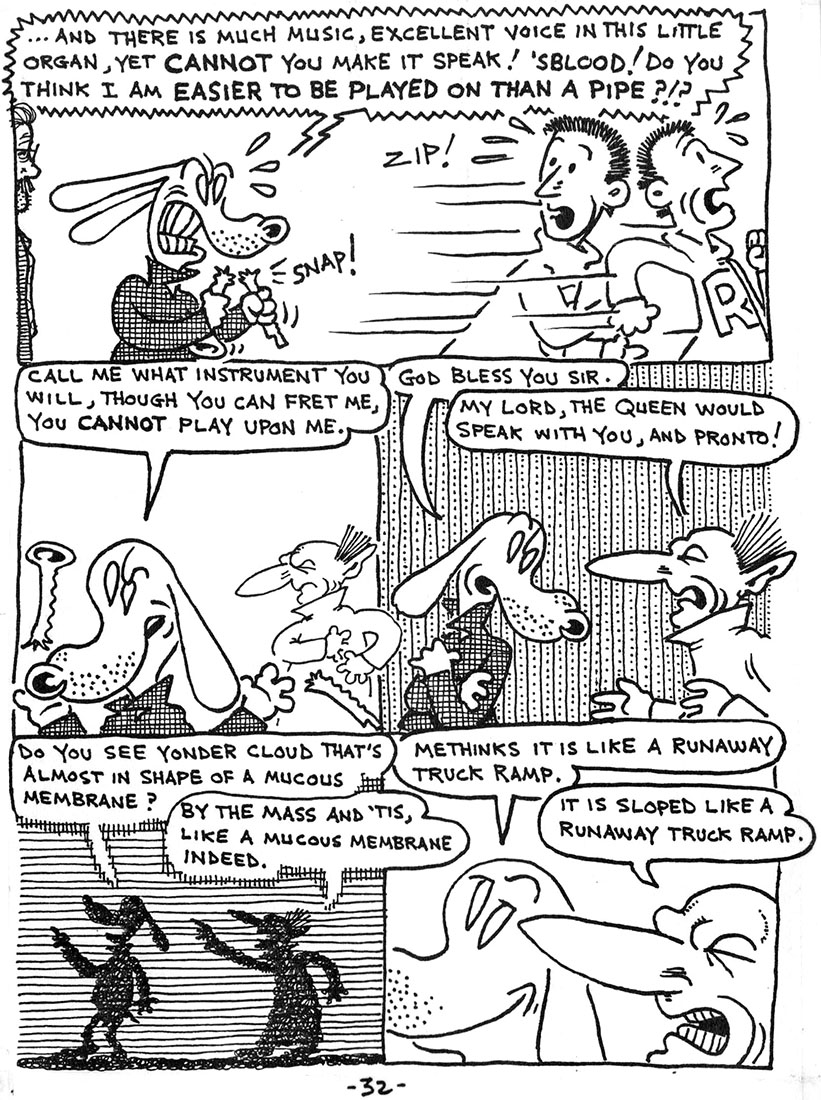
In The Tragedy of Morty, all the original characters of Hamlet are replaced with a seemingly random assortment of Willis original characters, classic comic strip characters, and the odd assortment of humans and anthropomorphic denizens. Hamlet is recast as Willis’s (grudgingly) signature character, Morty the Dog. His best friend and confidante, Horatio, is played by Willis stand-in Arnie Wormwood. “Ofeelya” is, inexplicably, the mute comic strip character Henry (with a wig!). And Rosecrantz and Guildenstern are cast as identical humans, renamed Roseyhead and Goldenass (you can tell them apart by the large “R” and “G” on the front of their shirts). This silliness of populating the cast with different characters serves to heighten the nonsensical nature Willis is going for. As, rather than a poorly thought out parody of Hamlet punctuated with cheap gags, Willis is aiming for something different. Here we find, within the framework of Hamlet, Willis allowing the voices of this disparate cast to organically seize the original play and take the narrative into wild tangents of imagination that are a specialty of this creator.
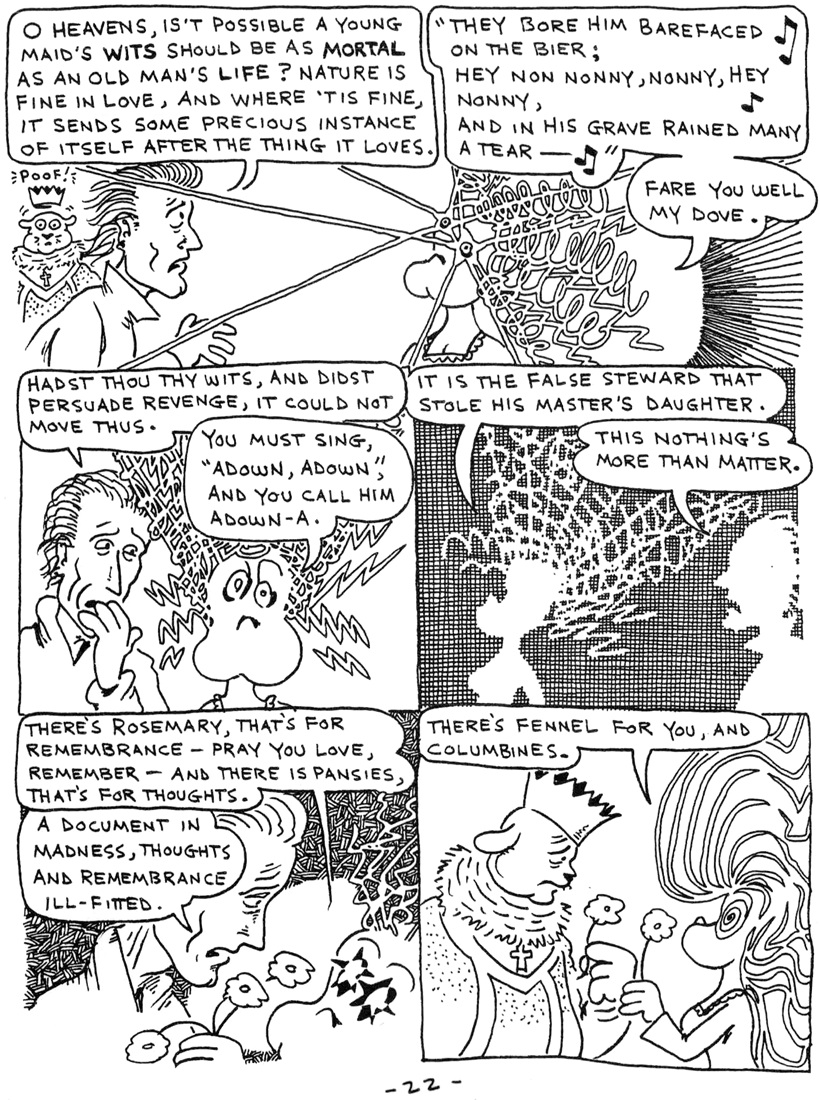
Willis has stuck very tightly to the structure and plot of Shakespeare’s Hamlet. All the Acts and Scenes are recouped from the original Shakespeare, with most of the famous dialogue filtered through with contemporary idioms on which Willis builds his own parallel narrative. A few instances: Where in the original you get Polonius agreeing with Hamlet that he too sees a camel, weasel, and whale in the clouds. Willis has the rather large-nosed Phelonius agreeing with Morty/Hamlet that he sees a mucous membrane, truck ramp, and Slim Whitman’s profile. Complete non-sequiturs that throw you out of the hyper drama of the original. Later, when “Ofeelya” meets with the King and Queen as her mental health deteriorates, Willis mixes and matches original and his own song lyrics with a decidedly psychedelic look for her as her mind crumbles. Horrifying but with enough of a lighthearted touch to make the scene over in Willis’s own vision. Inch by inch like this, Willis remakes the venerable play into his own personal platform for what he sees beyond Shakespeare’s words.
Willis’s art, as mentioned above, goes in many directions throughout the 180+ pages he takes to adapt Hamlet into The Tragedy of Morty, be it abstract, surreal, or using any and all cartoon tropes at his disposal. The consistent six-panel grid can barely contain all the drawing Willis fits in every panel. There is so much shading, hatching, and texture in every panel. A favorite part of this early style of Willis is how he draws “energy” patterns, what I refer to above as psychedelic, where characters or lettering seem to emanate light or energy. All this is never too dense, and the narrative moves along very seamlessly.
Thanks to Tom Fellrath for putting these rare minicomics into a single volume available virtually worldwide. Steve Willis has never sought the spotlight (whereas some of his contemporaries at Evergreen State College, like Matt Groening, Lynda Barry, or Charles Burns, have gone on to become better known), so it’s great to see his work finally gain some permanence outside of his preferred minicomic format. As for whether the Bard is rolling in his grave after this brilliantly unique interpretation of Hamlet, there’s obviously a lot of love for the source material that comes through every panel!
Steve Willis (W/A) • Phoenix Productions, $25.00
Reviewed by Gary Usher