

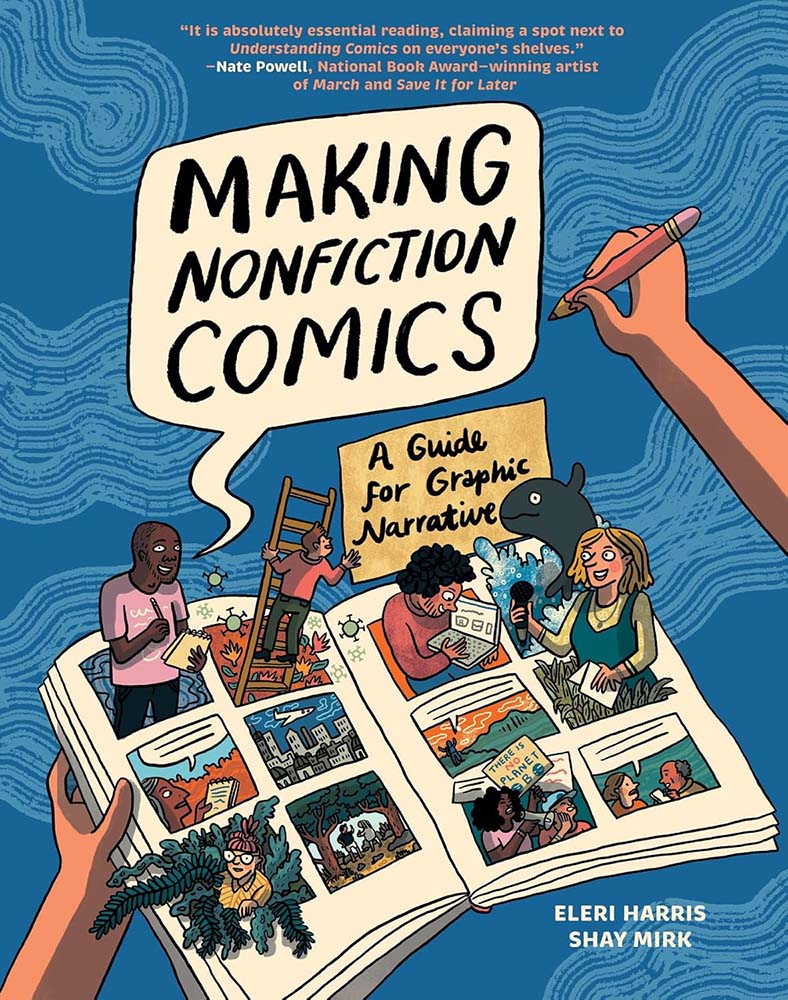
Eleri Harris and Shay Mirk are “award–winning graphic journalists and long-time editors of the critically acclaimed graphic journalism site, The Nib”, and Making Nonfiction Comics is described in the blurb as “the perfect field guide to graphic journalism”. It’s a rich resource for anyone interested in that field, with chapters on ‘Research’, ‘Interviewing’, ‘Graphic reportage’, and ‘Data, science and graphic medicine’.
There’s a chapter on ‘Personal narratives’, but these are also set in a journalistic context: “How does your personal experience illuminate something bigger? Research expands each artist’s story out beyond the walls of their own little house.” Shay Mirk is non-binary, and has produced comics on gender expression, but they make it clear that they were always keen to put their personal experience into a wider context: “I explained how my feelings were shaped by societal systems… Quoting people other than myself – poets, scholars, activists! – immensely strengthened my comics.”
Mirk’s approach is thus less about the vividness and uniqueness of a personal experience, and more about how that experience can be used to represent and unlock wider issues. It’s a thoroughly honourable perspective, but it’s only one particular style of personal narrative. The more “confessional” style, which focuses more on the personal experiences and feelings of the narrator, isn’t really dealt with here.
In their introductory chapter, the authors state that “This is not a book about drawing or technique” and “We don’t delve much into comics theory or criticism” – “Our goal is to empower people with the tools you need to make your own nonfiction comics”. Making Nonfiction Comics certainly does give you a good idea of the different stages and processes a comic can go through on its way to publication – the ideas stage, writing a script, the different drafts (pencils and thumbnails), layout, inking, timetabling and editing. But its strongest suit is graphic journalism.
There are lots of details about interviewing people: draw them while you’re interviewing them – take photographs too, especially as a resource for background details – explain why you want to talk to them, and show them samples of your work – either record the conversation, or note down their words along with your drawings – try to show them gesturing or interacting, rather than just as static “talking heads” – etc. There are even useful discussions of how to draw different ethnicities without stereotyping them.
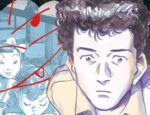
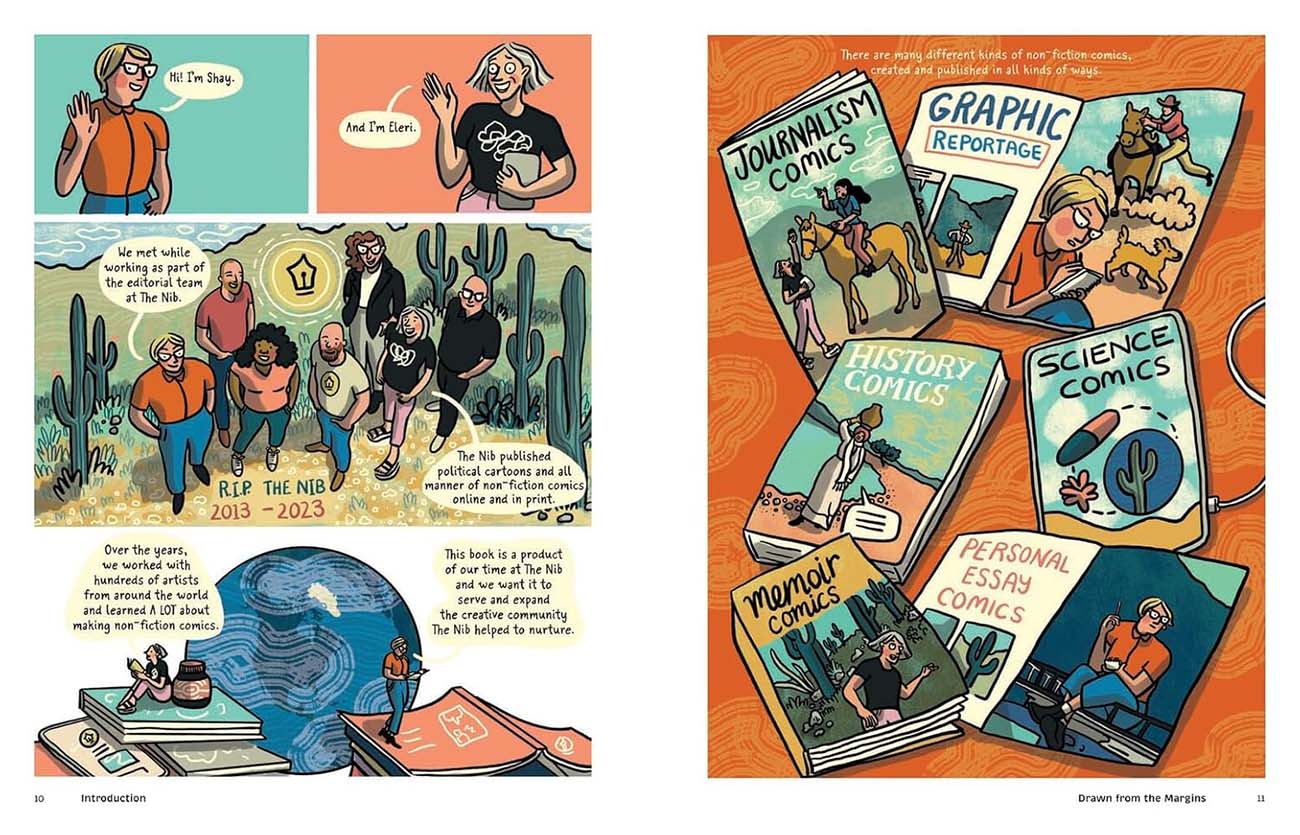
Each chapter of Making Nonfiction Comics tackles its subject in comic form; and at the end of each comic section we are also given two or three text interviews with nonfiction comic book authors, illustrated with panels from their work. The book as a whole, therefore, is very text-heavy: a typical chapter will consist of maybe sixteen pages of comic followed by eight pages of interviews. The interviews do slow the book down and make it feel heavier and denser, but they also contain some of its most fascinating insights.
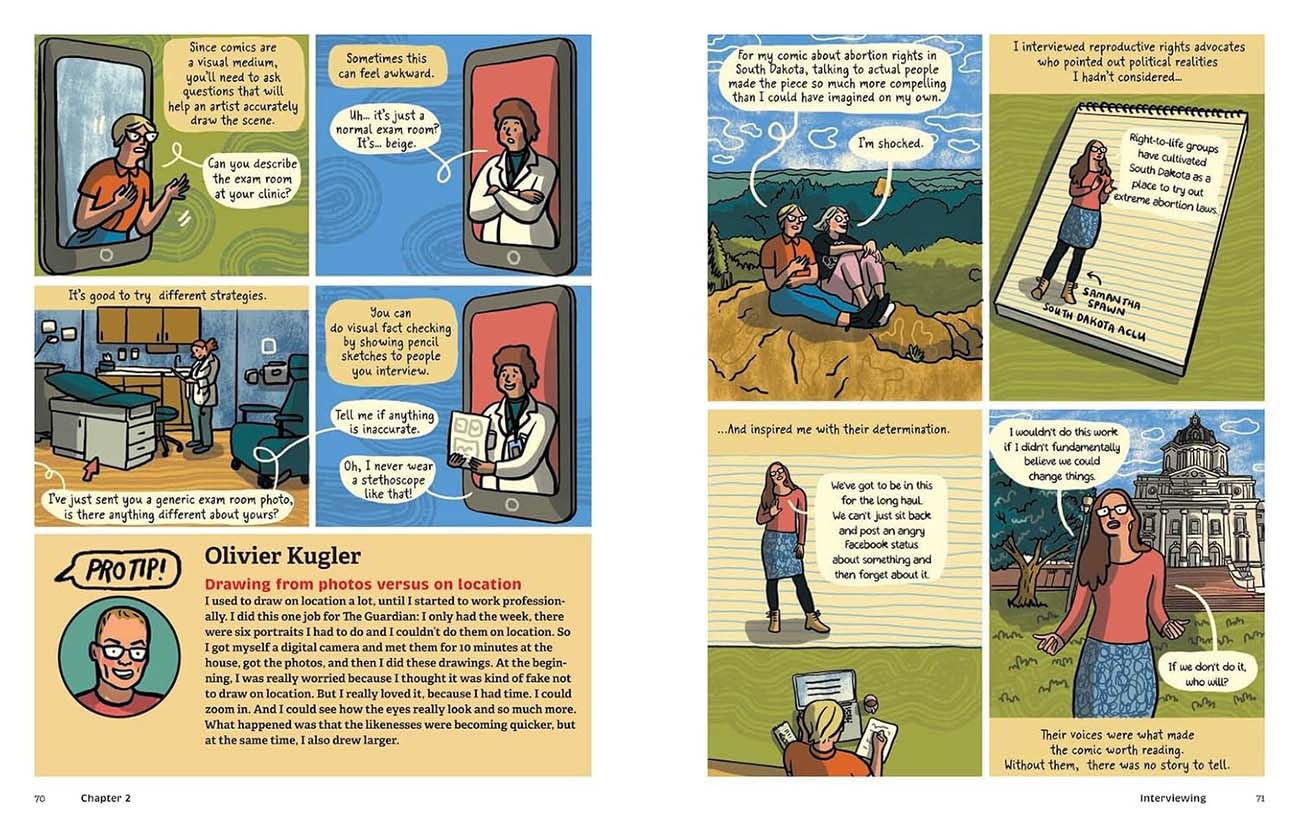
Even the comic pages are crammed with text, though: speech bubbles, thought bubbles, captions, coloured labels, diagrams, plus ‘Pro Tips’ here and there.
The comic sections illustrate their subjects by mocking up stories: for example the chapter on ‘Research’ mocks up a story about beached whales, in order to show how this might be researched and then presented; the chapter on ‘Graphic Reportage’ mocks up a story about climate protests; ‘Writing Comics’ mocks up a story about St Bernard rescue dogs; and ‘Editing’ is illustrated by a story about an Australian sheep called Chris, who was famous for the huge amount of wool he produced. As these examples show, the authors are clearly left-leaning and concerned about big social and environmental issues – but they’ve also got their share of whimsy, and the Chris the Sheep story in particular is enlivened by a lot of humour (including some dreadful puns).
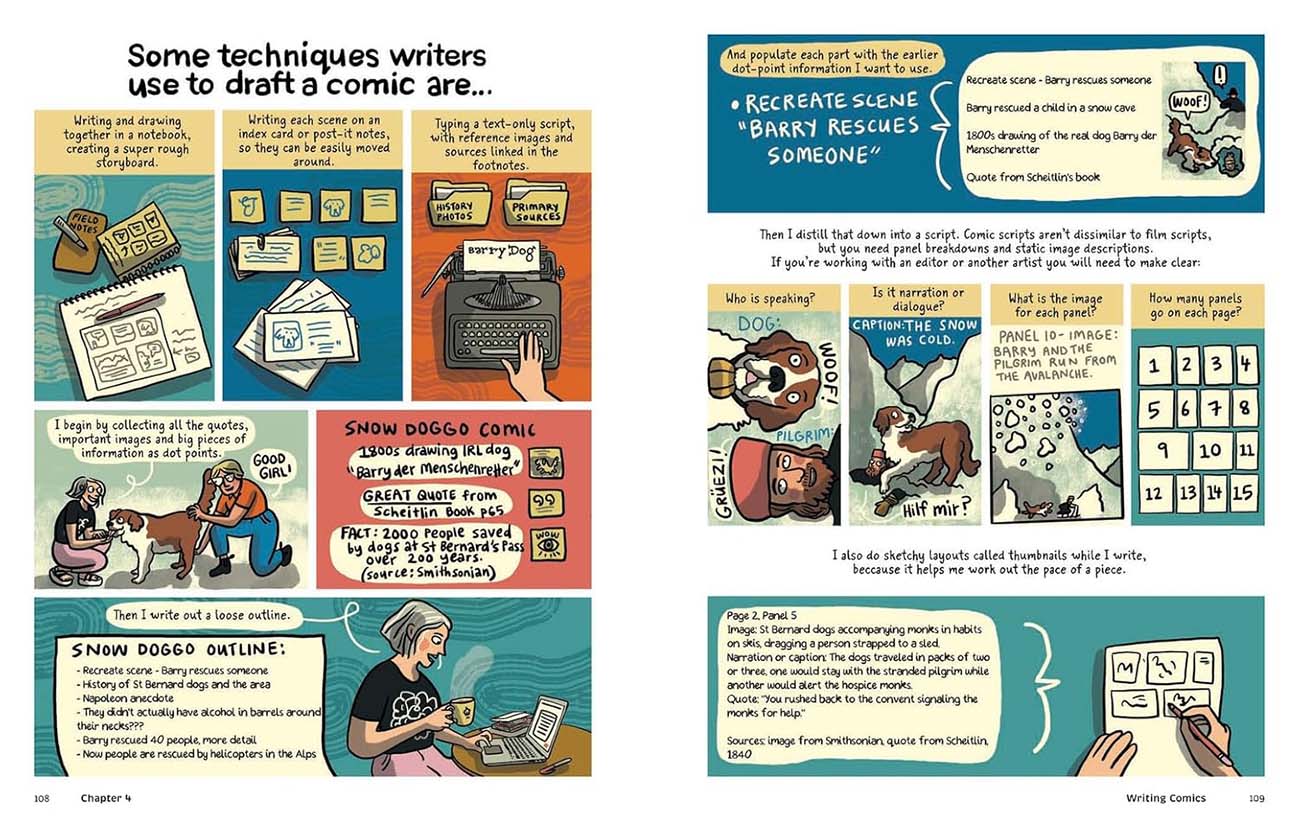
The style of drawing is always clear and lively; Mirk and Harris put cartoon versions of themselves into the comics; despite being crammed full of text, the pages are always well laid out and never look cluttered; and the authors make great use of colour to augment their page designs. Overall it’s a really thorough and absorbing guide, and particularly useful for anyone interested in graphic journalism.
Eleri Harris and Shay Mirk (W/A) • Abrams, $29.99
Review by Edward Picot