



Ahead of the upcoming Small Press Vs. AI panel at Caption the festival’s Event Manager Amy Letts has written the following piece on the aims of the panel and the issues it looks to address. For more on Caption visit the site here. And don’t forget you can read Broken Frontier’s own zero tolerance to Gen AI policy here and read our resource list of comics on the subject here.
Caption Comics Festival nails their colours to the mast – Down with Gen-AI!
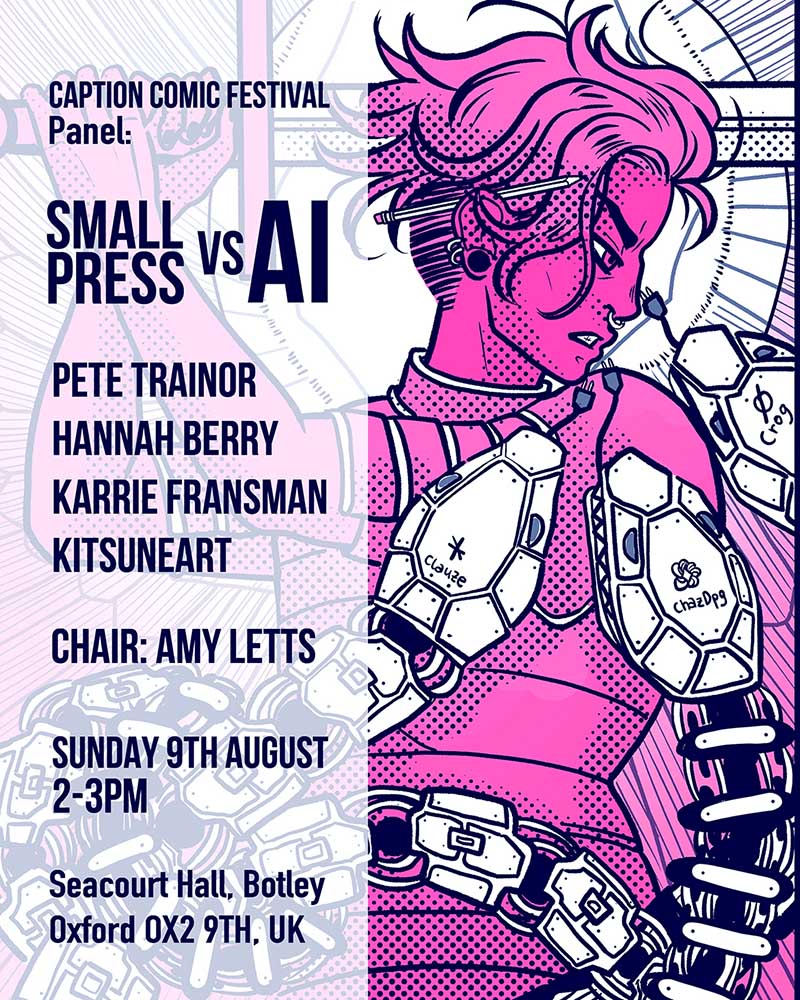
Poster by Lucia/KitsuneArt
Caption Comics Festival is running a “Small Press Versus AI” Panel on Sunday the 9th of August to discuss the impact of generative AI on creatives, and help them to protect their work.
The panel is comprised of Pete Trainor, Hannah Berry, Karrie Fransman and KitsuneArt, with Amy Letts chairing.
Amy Letts, event manager of Caption Comics Festival, isn’t shy about sharing her point-of-view:
Affected personally
“250 of my artworks, that I know of, have been used to train generative-AI. These were scraped off my own website where I have clear copyright notices. I wasn’t asked or compensated. Art is a personal and vulnerable process. I feel absolutely violated.”
Lost and confused, Amy’s reaction was to go analogue. She stopped updating her webcomic and instead plans to stick to physical comics and zines, at least for the time being. It’s reignited her interest in hand-made books.
“I’m interested in seeing how other artists have reacted, and particularly creative responses, to Gen-AI. The tech bros say “adapt or die” and I say artists are very good at adapting! We won’t let the arts die.”
The “Small Press Versus AI” Panel is important because generative AI is something that is heavily affecting the creative community. This is an opportunity for them to come together and show that creatives are not powerless, stand up for the right to control their own work, and fight the unfair competition that is making them go up against illegal derivatives of their own work.
Ethics
Several AI companies have been prosecuted for unethically sourced data, including direct piracy, and a recent lawsuit for commercial espionage. Training is done by the exploitation of human labour – underpaid, overworked gig workers. They are tested on the general public with little regard for potential harms such as AI-psychosis. Despite this the industry is estimated to be approximately 1.65 trillion in debt. There’s a big impact on the environment from data centres, which, given the fact we may need to ‘get used’ to forest fires, cannot be borne!
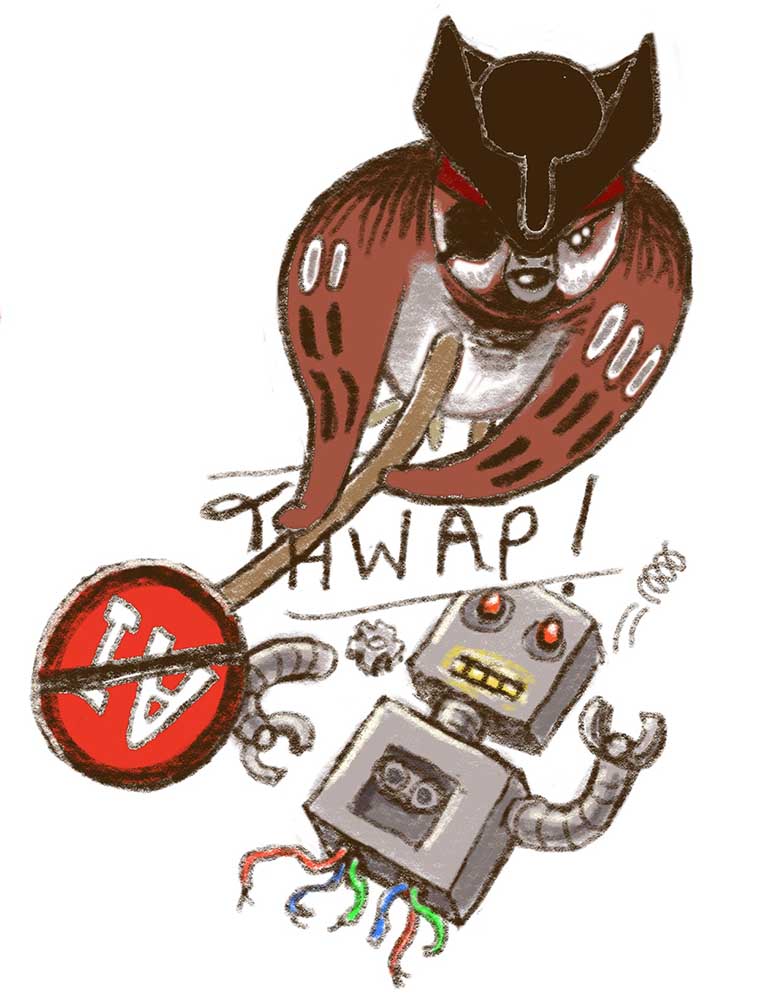
Caption Jack versus AI by Amy Letts
Illegal?
AI companies argue that ‘the biggest art heist in history’ is legal because it is Fair Use, largely based on the clause of being ‘transformative.’ Whilst some of the outputs may be transformative, that cannot be applied to all of them, especially ‘overfitting’ (where the AI produces a direct copy of the data it was trained on) or obvious derivatives (estimated at 60-80% of its output).
Furthermore, in UK law, Fair Use does not exist, we have Fair Dealings instead, which has a narrower scope. Fair Dealings provides exceptions for research, education and news reporting, none of which would seem to describe commercial AI. The effect of damage to the market of the original work is also considered. Under UK law computer programs that use artworks, even ‘under the hood’, are supposed to license those artworks.
The Report on Copyright and Artificial Intelligence (March 2026) suggests that in future AI companies will need to be transparent about their training data, and license copyrighted works.
Not just artists
Because artists are having their livelihoods threatened, we complain more about AI image theft, but it affects ordinary people as well. Family photos are as readily added to ‘the pile’. You might not only lose control of your own images but your own likeness! Family members and children are also at risk. Scammers love these tools, creating deepfakes to mislead, and women have become targets of AI-generated, non-consensual sexual images.
Protection
One of the aims of the “Small Press Versus AI” Panel at Caption Comics Festival is to educate creatives on how they can protect their work.
In the UK, at least, you can opt-out of your content being used for AI training, but it is permitted by default on most platforms. There are a few platforms, such as Cara, who do not allow AI at all. If using your own website you can edit the robots.txt to discourage crawlers. (Alas, there’s no way to be 100% sure your opt-out will be respected). Very technical folk build anti-AI tar pits and labyrinths to get AI-crawlers ‘stuck.’
Nightshade and Glaze (in that order) have evidence to show they work as image protection, provided you can tolerate a little distortion. There are new protective tools being developed such as Artsheild, Mist and Anti-dreambooth.
Slop
Gen-AI outputs have been termed ‘slop’ and there has been a general backlash against it. This year students at Boston University booed a visiting speaker for praising AI.
Unlike genuine art where every mark is made with consideration and intention, AI-produced images (and writing) come across as shallow and inauthentic. Because it is quick to produce in high quantity with minimal effort it has been flooding the internet with low-quality content, and feels like pollution. Many are misleading and manipulative, such as fake products, or political posts showing events that never happened. Gen-AI works using probability, guessing the most likely output for a prompt, meaning that it leans towards the common and average. Since it is always seeking new data and AI-generated images are plentiful, it has become an Ouroboros and is eating itself.
Caption Comic Festival stands by creativity that is original, innovative and, most of all, human. “Tech companies are trying to persuade people their own skills are not good enough, and never will be. I worry this will stop new creators from trying. Yet everything their technology is built on comes from humans. The truth is their product isn’t something you need, especially not for creativity! Your stick figure comic is a million times better than AI slop.”
Caption Comics Festival is running in Oxford on the 8th-9th of August. Get tickets at https://captionfestival.co.uk/
The AI Panel takes place on Sunday at 2pm
Article by Amy Letts





Impossible to disagree with any of this. I do wonder if we need to go further and involve other areas of work to have any hope of holding back the tide. In comics it isn’t just art that is impacted. As a small press editor I am fairly certain that at least one script I have been sent is the work of AI. And the news that Take a Break magazine will now have all of their fiction produced by AI is a sign that all forms of art are in danger. Outside of the arts, AI is now going to impact a whole lot of areas. In finance, my previous area of work, AI has removed humans from credit decisions, increasing profit to the max, but increasing risky loans and leaving more customers vulnerable to life changing debt. The ethics that did exist with the friendly but very boring bank manager have gone. The same is true in many areas. To the rest of society the impact of AI on artists and writers is small change. To have a hope of turning the tide for comics we need to join with everything else to make sure that the technology is used in a pro-human way and not to feed the bank accounts of a small cadre of billionaires
100% agree! We all need to come together and fight it at all levels and in all areas!