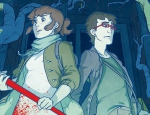


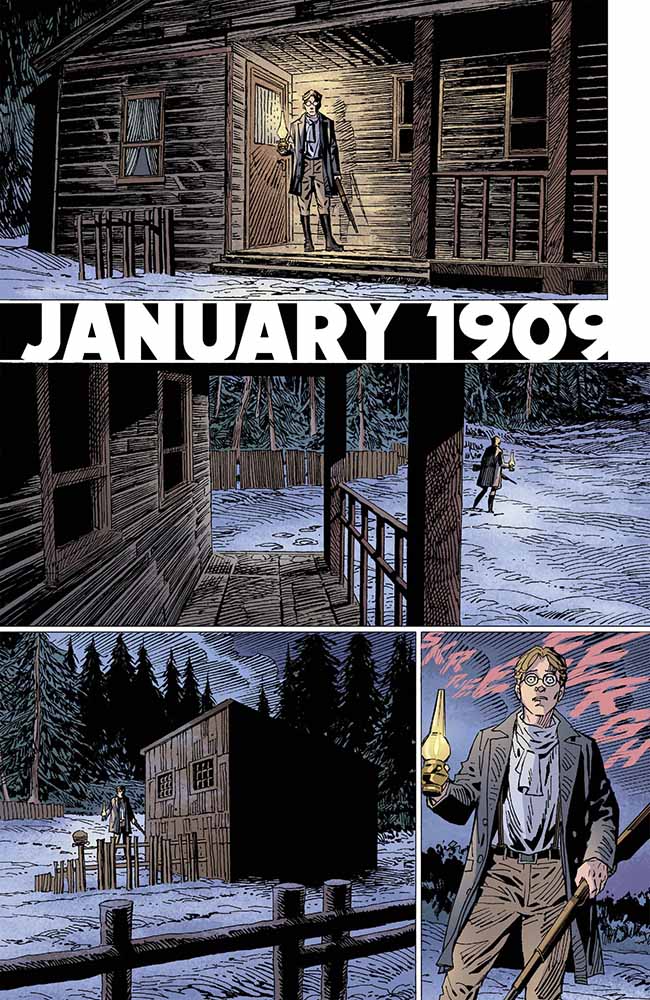
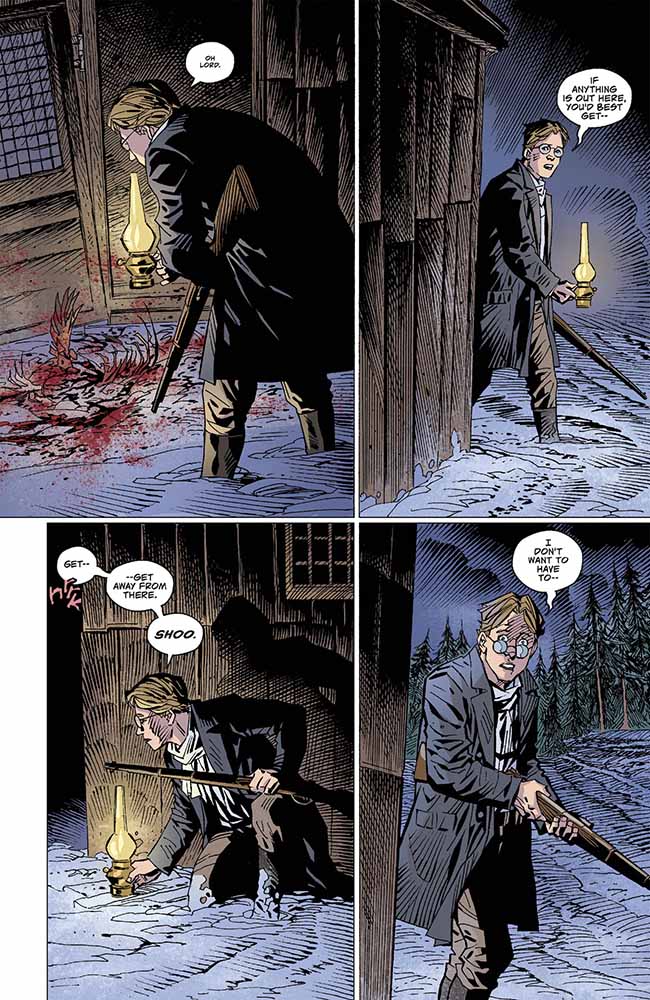
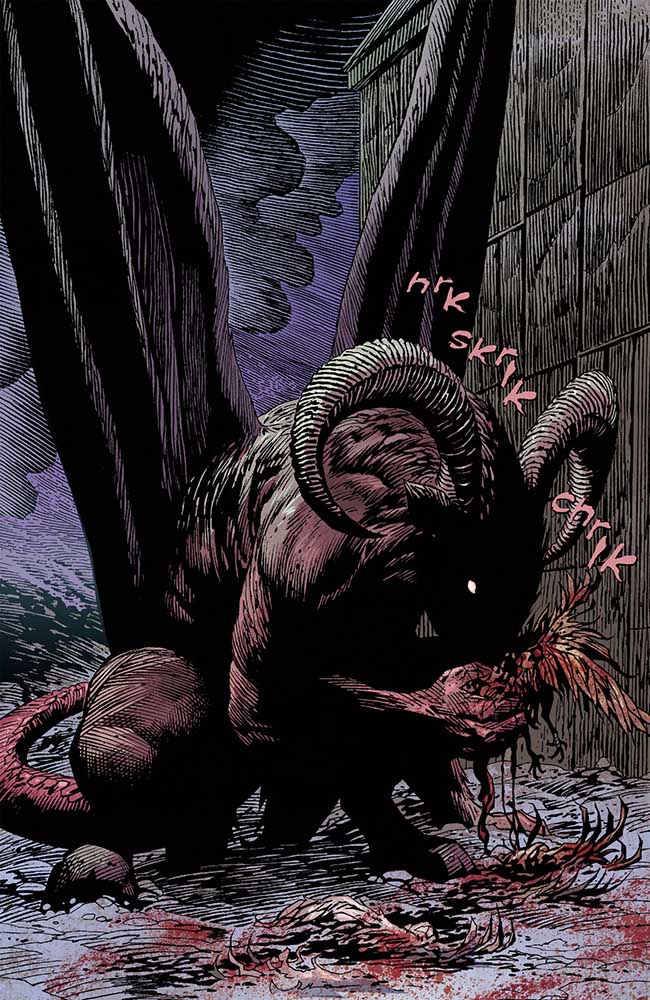
1909. A bespectacled young man, Henry Naughton, has recently returned from the city, following his father’s death, to stay with his mother and younger brother on the family farm in South Jersey. He is woken by screeching noises in the night. When he goes out to check, he finds the scattered remains of slaughtered chickens, and thinks he glimpses something with curved horns and bat wings, which flies off into the trees before he can get a proper look. In town the next day, he sees reports in the local paper about a creature called the Leeds Devil.
He sets himself to investigate further – and we are flashed back to 1735. A woman called Deborah Leeds is giving birth to her thirteenth child, and the birth is so painful that she curses it: “Let this one be a devil!” The child is born with a tail, and escapes up the chimney.
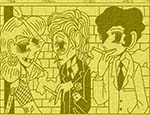
Naughton goes to visit a local antiquarian, who provides him with more background detail about the Leeds family. The family patriarch was Daniel Leeds, a prominent pro-British landowner and almanack-publisher, who was unpopular with both his Quaker neighbours and his rival almanack-publisher Benjamin Franklin. Part of the reason for his unpopularity with the Quakers was that he was keen on the occult, and included occultist references in his publications. When he died, his almanack business was taken over by his son Titan, who continued the feud with Benjamin Franklin, to such an extent that Franklin even published a prediction of Titan’s death, and then insisted on referring to him as a ghost when the date went by without him expiring.
The folk story on which Let This One Be a Devil is based is a matter of record. There really was a slew of “sightings” reported in the local papers in 1909. The Leeds Devil is also known as the Jersey Devil, and is said to inhabit Pine Barrens in South Jersey. Whether it gets its name from the Leeds family or from Leeds Point, a place in Pine Barrens, is subject to debate – but the details recounted in this collection about Daniel and Titan Leeds pretty much tally with what you can find online, on Wikipedia amongst other places.
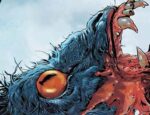
This historical background gives Let This One Be a Devil an almost documentary feel at times. It generally maintains an ambiguous line about whether the Leeds Devil actually exists, but it shows us the effects of rumour and hysteria on the South Jersey community: “I heard the Devil swooped right down on a trolley car in Haddon Heights… I heard it landed in the middle of a social club… I heard it lifted a whole cow in its claws…” There is also some clever art showing us the Devil in various guises, according to different accounts of its appearance, and different animals on which “sightings” may have been based – amongst them a kangaroo equipped with false wings and horns, which was apparently exhibited as the Devil by a freakshow “museum” in Philadelphia.
When we move away from the documentary stuff, the narrative feels thinner. The Henry Naughton story-strand plays out through a conflict between Henry and his younger brother Roy, who resents him coming back from the city and interfering on the farm. Roy is supposed to represent the toughness, insularity and resentfulness of uneducated backwoods life, but his snarls of “Why don’t you go back to the city? You don’t belong here” soon get repetitive.
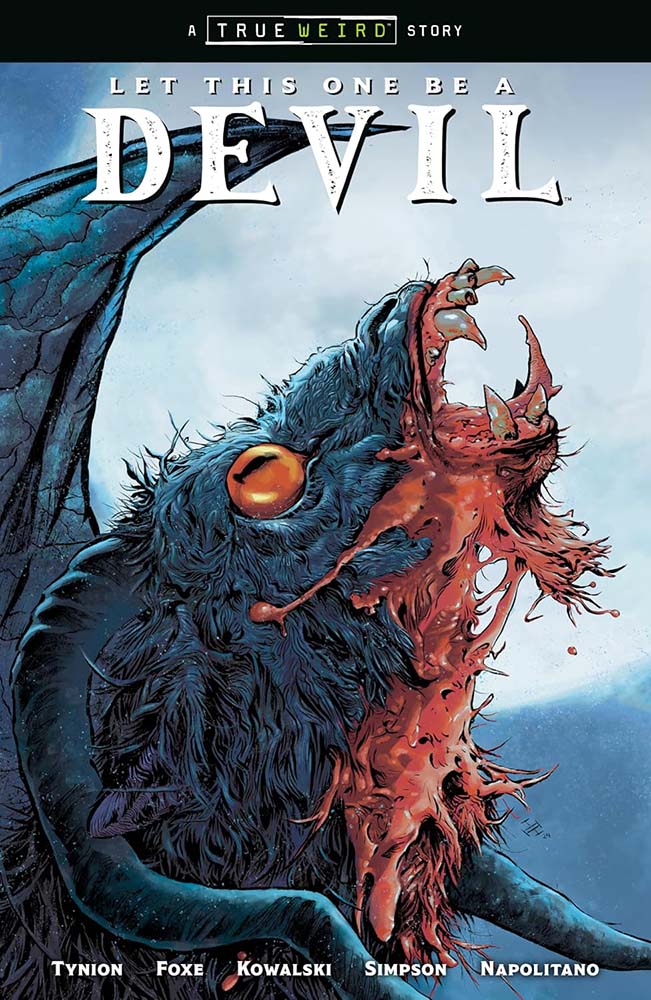
Despite this caveat, Let This One Be a Devil is well worth reading. It isn’t particularly horrifying (in fact it’s billed on the front cover as a “True Weird Story”), but it’s an intriguing look at a genuine American folk tale and its origins.
James Tynion IV & Steve Foxe (W) Piotr Kowalski (A), Brad Simpson (C), Tom Napolitano (L), Gavin Fullerton, Max Fiumara (CA) • Dark Horse Comics, $24.99
Review by Edward Picot