

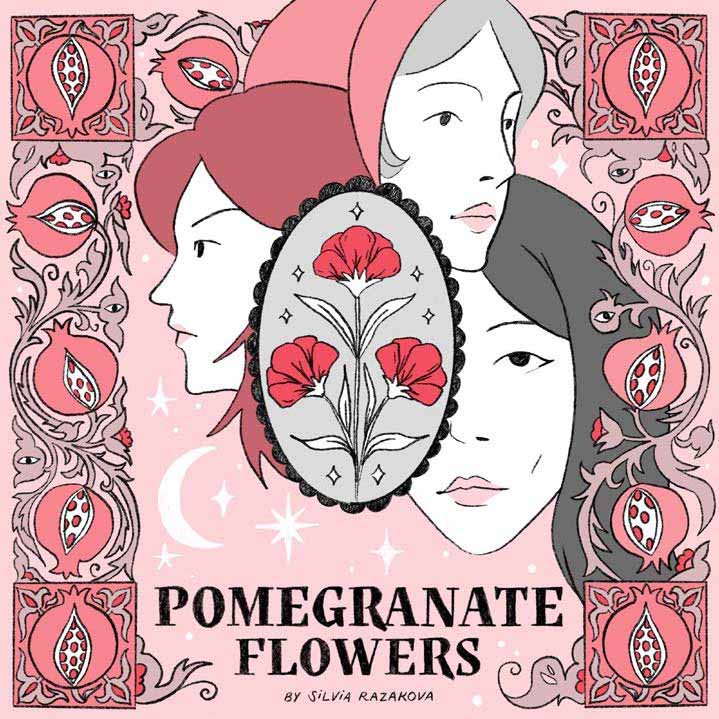
Pomegranate Flowers runs on the trigger association between memories. I re-read this piece many times and slowly, I could start to connect one moment’s meaning to another, even if they were pages away. Controlling the space that long stretches of time creates is Silvia Razakova’s strength. The linear narrative is dense: three generations of women affected by exile each share their history over coffee.
Yet re-reads are like strolls. They’re easy to take, straightforward. Diving into a flashback sets the reader up with the necessary context of the family being Crimean Tartars and their exiling during World War Two. Eventually, the mother comes along, and with her comes events that happened in her life, until we end with the daughter’s life, current as of 2021. Transitions of flashback to kitchen-table dialogue keep the pain of exile present.
Razakova is plain about the exile. Quotes around Gorbachev’s “pardon” in the 80s make it frank – this uprooting was illogical to begin with, and this attempt at repair more so. My favorite parallel in the piece is that each of the three women get a moment of resignation about the exile, each shaped by their timely proximity. While I would imagine some stories would choose vivid imagery to dig into details of pain, these are memories. Details such as forgotten stories, charred land and gold in the garments are revealed in narrated dialogue paired with the piece’s simple art style of pictorial representation. Thus, the story evokes the process of recall, including that removal involved when you have to remember something instead of being in it.
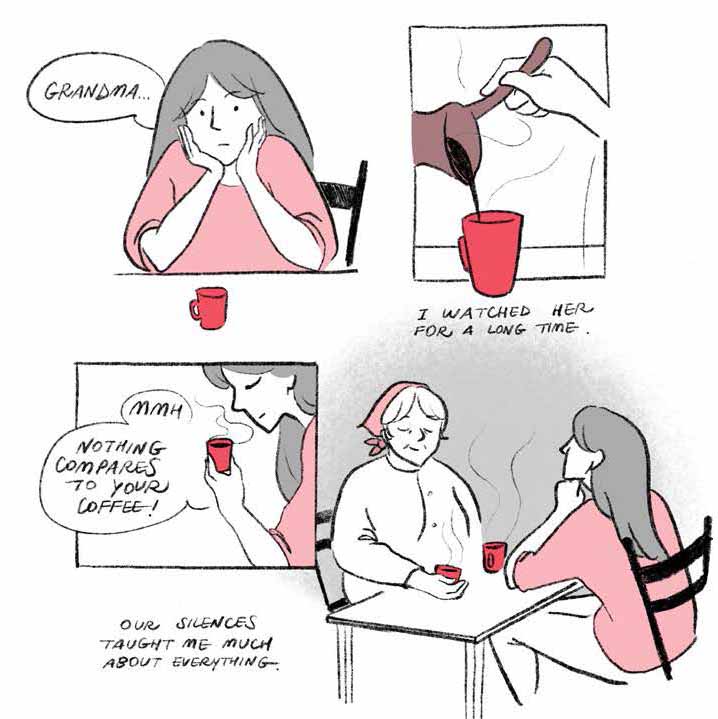
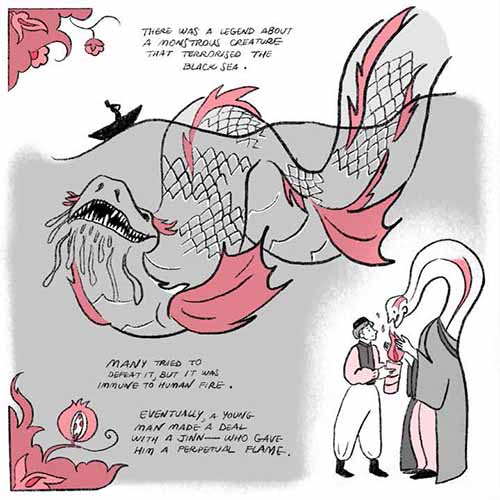
Another way Razakova mimics memory visually as well is in open panels, in the haziness of remembrance in fuzzy-edged monochrome backgrounds. (While open paneling probably isn’t commentary on the concept of borders, pomegrante flowers do flourish in the corners on folklore pages.)
Because the scale that the comic operates in is vast, Razakova does not place parallels next to each other. Only by traversing the memories can a reader draw one moment’s meaning next to another. In practice, each time I re-read, different moments felt new, now connected to the past or future. For example, the “curse” of relationship strife is mentioned near the beginning by the grandmother, and it only resurfaces by name the very end. If one is paying attention, (say on a re-read), Razakova shows each of the women’s relationships with each falling short of understanding exile. This subtle, organic pacing as opposed to immediate heavy-handiness makes Pomegranate Flowers worth picking up.
Life is rationale-sparse but Pomegranate Flowers makes it make sense with careful pacing and frank dialogue. Published by Onion Press, Pomegranate Flowers can be picked up printed in two color risograph on their website.
Siliva Razakova (W,A) • Onion Press, £15.00
Review by Andrea Magbual