

There are many names throughout literature that are known as ‘the greats’: Dickens, George Eliot, Mary Shelley, and countless others. And amongst them sits one of the most radical female writers of her time, Jane Austen. While many readers can easily reel off Austen’s bibliography (particularly the more famous entries like Sense and Sensibility and Pride and Prejudice) when it comes to Jane herself, we often draw a bit of a blank. Sure, she was an impressive writer, and it was no mean feat to be an established author AND a woman in that period. But outside of that? We don’t know much. This is what Kate Evans’s Patchwork, published by Verso Books, seeks to remedy. Patchwork is a bold graphic reimagining of Jane Austen’s life, one which, refreshingly, refuses to simply present her as a tidy literary icon.
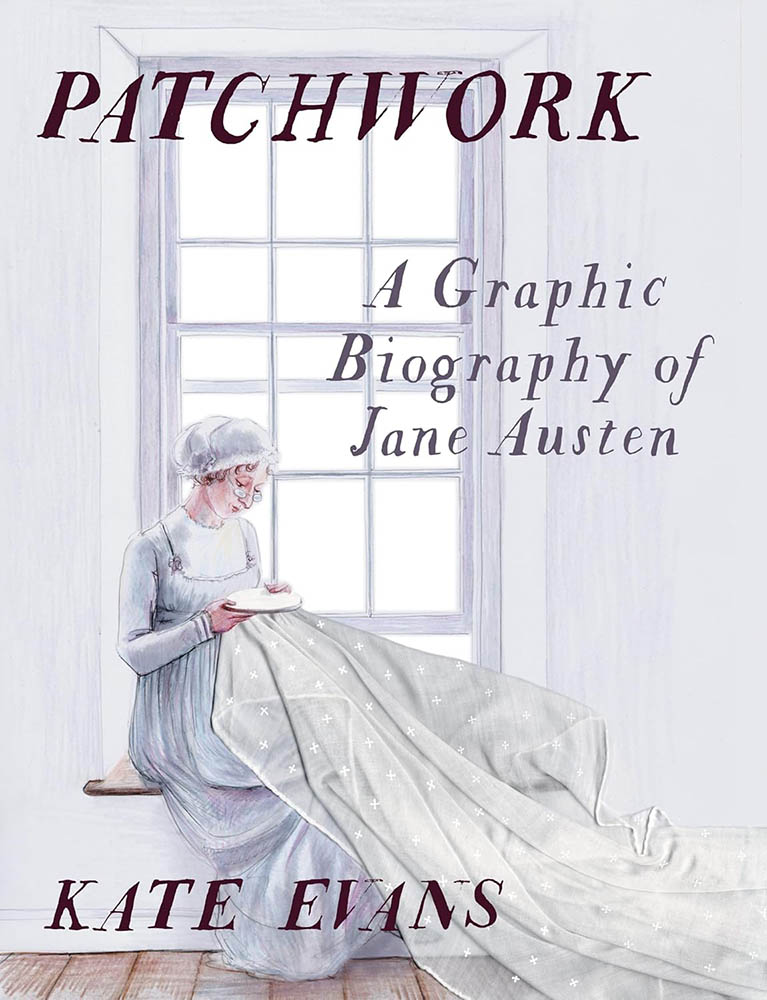
At the centre of the narrative of Patchwork is a patchwork quilt Austen made in her later years (painstakingly stitched together with skill, patience, and care). Evans uses slivers of fabric from the quilt as narrative devices through which Austen’s life is told. Her novels, personal history, and social context of Regency England are teased apart and sewn back together, allowing readers a glimpse of the woman behind the stories. From the outset, Evans is clear that the historical record surrounding Austen is decidedly threadbare (pun intended). Playing knowingly on this fact, she aims to “patchwork” a life together using Austen’s own words, novels, poems, and surviving letters.
The opening pages of Patchwork depict snow falling softly, paired with similarly gentle, warming prose: “Snow blankets Steventon Rectory. Frost traces patterns on the window panes.” It is here that we meet baby Jane Austen, only minutes old, her mother exhausted, and her sister Cassandra already devoted. But the moment is fleeting. We do not linger. The narrative moves swiftly onward, jumping to the next significant moment, and then the next, marked by the snip of scissors and the tumble of fabric diamonds: “We are making diamonds, compressed carbon, sparkling crystals, formed from the hard facts we know of Jane Austen’s life. Snip snip.”
From here, the story unfolds in fragments rather than straightforwardly. Baptisms, schooling, deaths, displacements, and domestic upheavals are rendered as patchwork pieces, stitched loosely together. Evans’s refusal to smooth over the gaps, both in her quilt and in Austen’s life, feels deliberate. She resists the temptation to mythologise Austen into a neat, legible heroine, instead allowing silences, absences and flaws to remain visible. It is a stark reminder that women’s lives, particularly those of the eighteenth century, are so often preserved only in scraps and footnotes, if they are preserved at all.
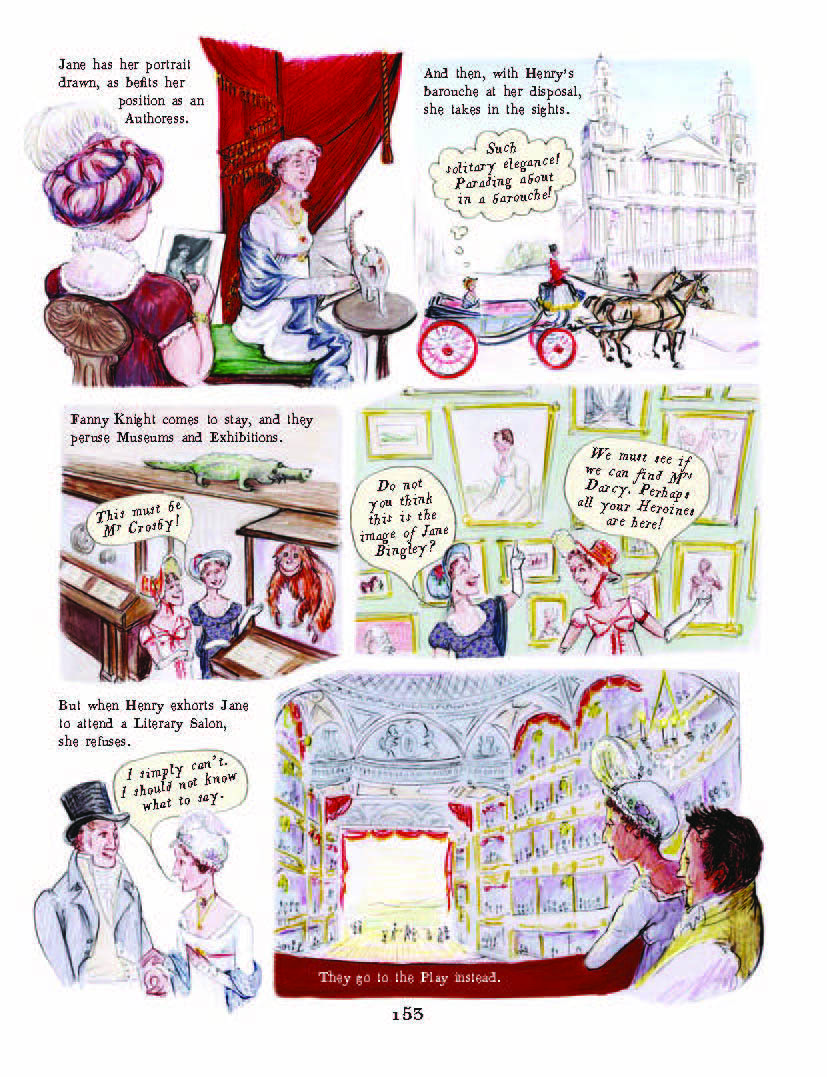
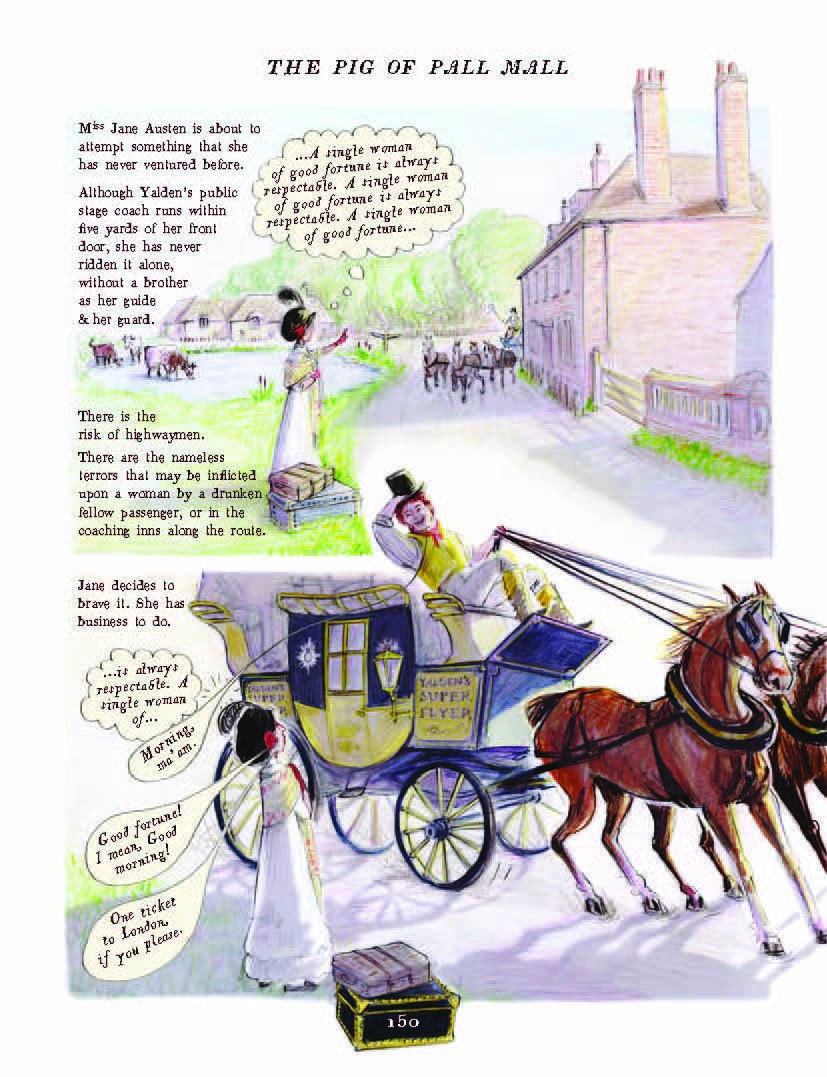
Visually, Patchwork mirrors this approach through a purposely fragmented style. Page layouts break apart into diamond-like panels that echo the quilt itself, rather than conforming to traditional square or rectangular comic frames. Text often floats independently of images, drifting across the page or tucked quietly into corners, with shifts in font, size, and spacing. This visual looseness allows Evans to collapse years into a single spread or linger on moments of emotional intensity without narrative clutter. The colour palette is muted and clearly inspired by textiles; creams, indigos, soft reds, browns, and faded greens are lovingly reminiscent of the natural dyes and fabrics of eighteenth-century domestic life.
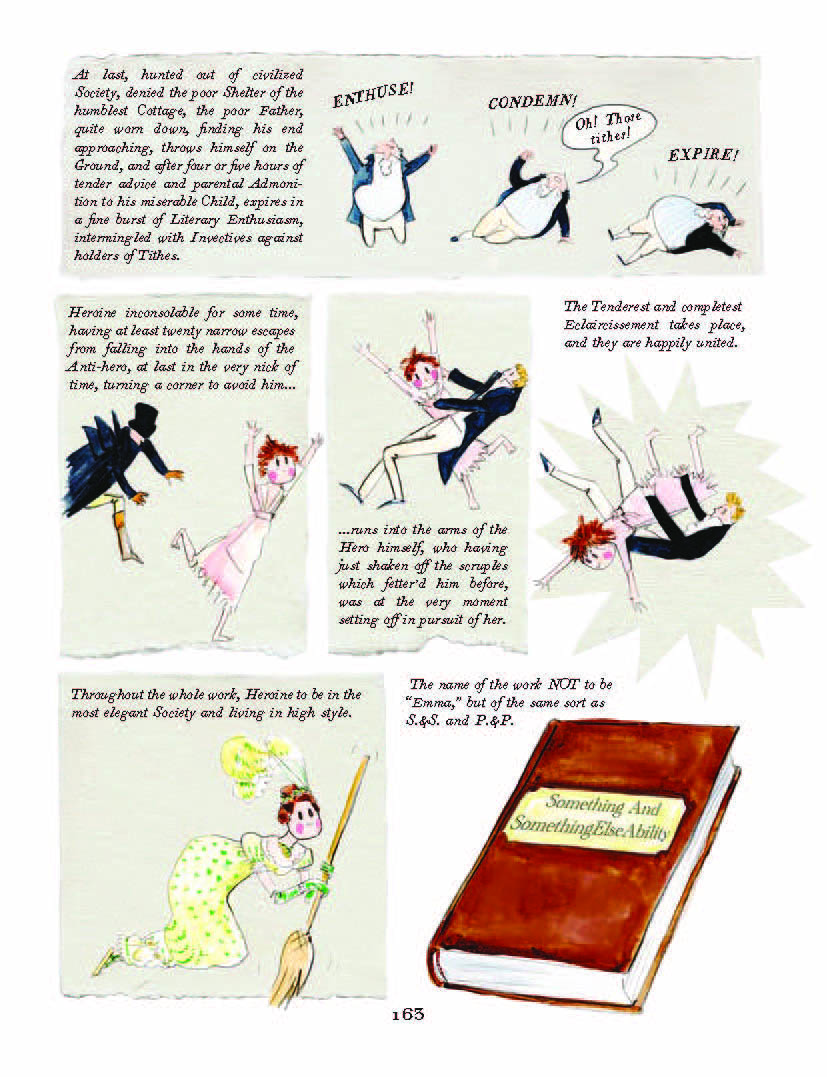
Throughout Patchwork, Evans steers Austen’s life away from a coherent arc with a happy ending, and rather insists upon its complexity. Patchwork does not promise to finally reveal the “true” Jane Austen to readers. Instead, it offers a meditation on what it means to reconstruct a life from fragments, and questions whose lives are deemed worthy of living on in writing. By embracing this sense of incompleteness, Patchwork gives us something arguably more valuable than biographical certainty: a textured, humane portrait of a woman who was shaped by her time, but never wholly contained by it.
Kate Evans (W/A) • Verso Books, £25.00
Buy online from Gosh! Comics here
Review by Lydia Turner