

Gou Tanabe has now created more than half a dozen graphic novel adaptations of H P Lovecraft’s horror-stories (translated by Zack Davisson), and readers familiar with the others will know that they are in safe hands here. In fact it could be argued that these versions, faithful and respectful though they are to Lovecraft’s original texts, actually improve the stories, because they strip away some of Lovecraft’s characteristic over-writing –From what black wells of Acherontic fear or feeling, from what unplumbed gulfs of extra-cosmic consciousness or obscure, long-latent heredity, were those half-articulate thunder-croakings drawn? – and allow the strength of the plotting, the gradual build-up of tension, and the weirdness of Lovecraft’s ideas, to come through.
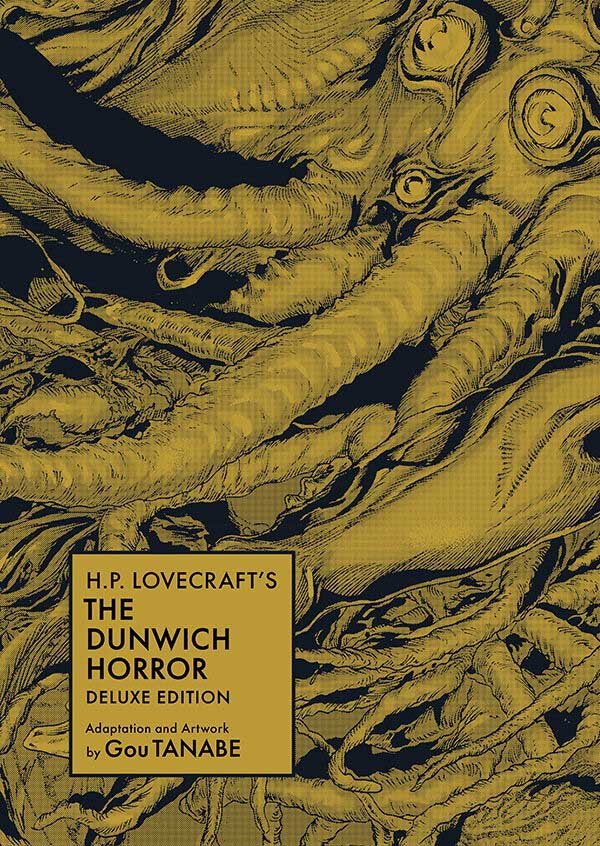
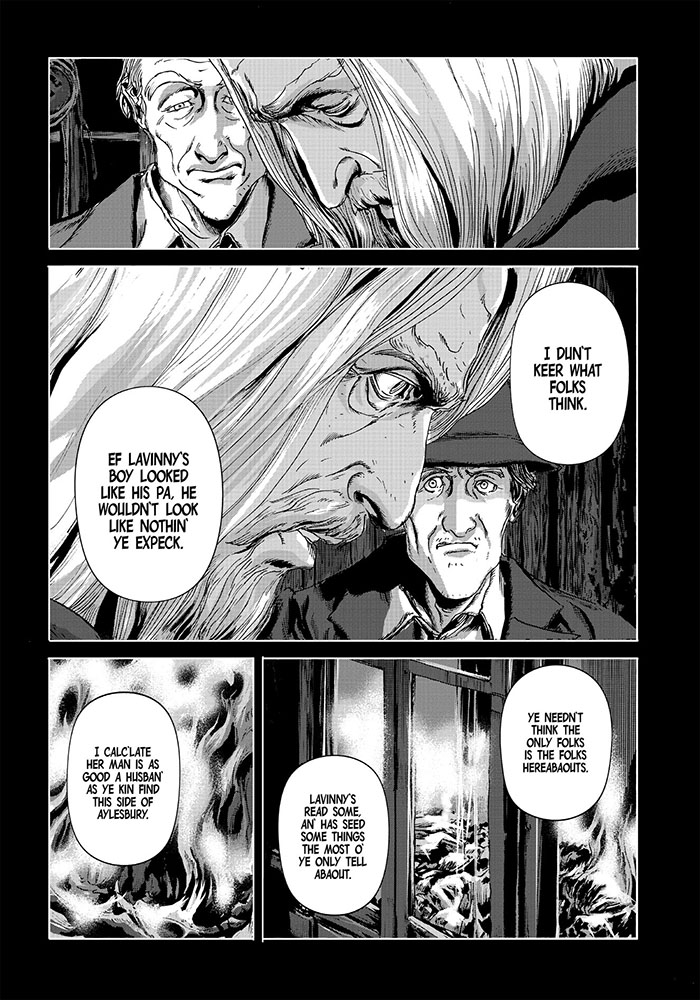
That being said, there are certain divergences between Lovecraft’s original version of The Dunwich Horror and Tanabe’s. Lovecraft portrays the inhabitants of Dunwich as inbred and degenerate: in his version of the story, it is three intellectuals from Arkham University who track down and confront the Dunwich Horror, while the Dunwich locals lose their nerve at the point of greatest danger – “Then the germ of panic seemed to spread among the seekers. It was one thing to chase the nameless entity, but quite another to find it…” Tanabe stops short of rewriting the end of the story to give the locals a more active role, but he does give them a speech which shows them in a quite different light: “Why so surprised, Professor? Think all we’s good fer is followin’ behind ye? Dunwich is our taown. Can’t leave ever’thin’ up to ye city folk, right?”
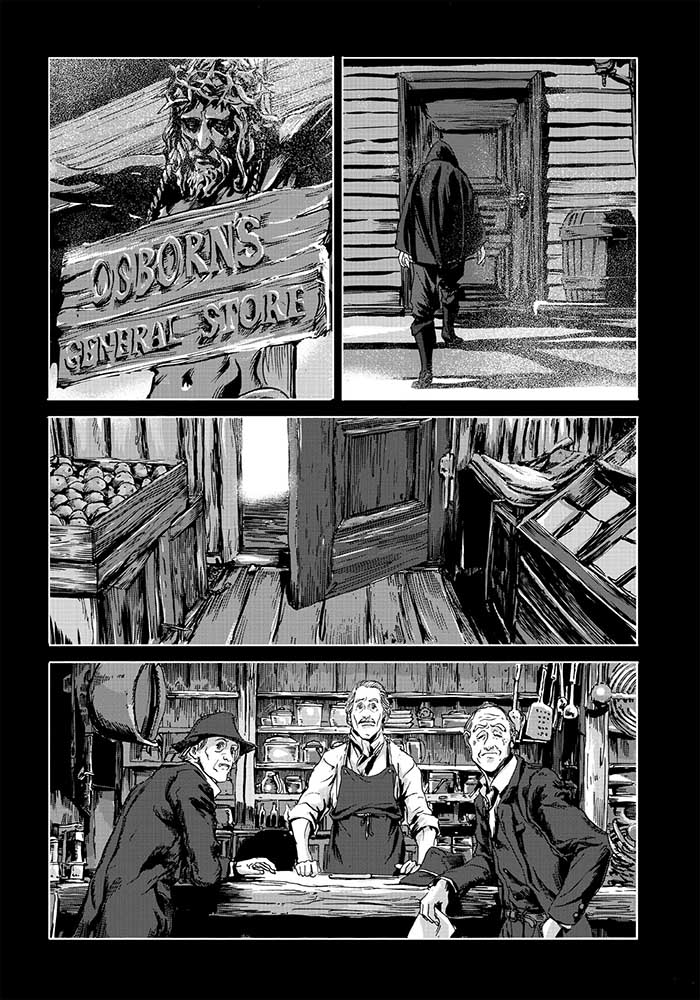
Tanabe also gives the story more of a quasi-religious (and devil-worship) context. He opens this deluxe edition with a full colour depiction of a naked female walking towards a ring of standing stones. This is Lavinia, the mother of Wilbur Whateley. The Whateley family are the ones that set the Dunwich Horror in motion, and Wilbur is one of their children, half-human and half-monster, prodigiously tall and clever for his age, who goes in search of forbidden incantations to summon the alien life-form Yog-Sothoth. In Tanabe’s version Lavinia plays a more prominent role than she does in Lovecraft; but her nudity is also indicative of the way in which Tanabe links the activities of the Whateley family more explicitly with witchcraft – she, her husband and her son all discard their clothes when they are performing their rituals, and those rituals are shown by Tanabe to include the sacrifice of cattle. The hill with the standing stones on top, where they go to perform their rites, is depicted littered with skulls, implying that numerous human sacrifices have taken place there too. There are also various points in the narrative where Tanabe introduces Biblical quotations (“I will destroy man whom I have created from the face of the earth; both man, and beast; for it repenteth me that I have made them”), which has the effect of reframing the story as a more traditional struggle between good and evil than Lovecraft may have had in mind.
Essentially what makes Lovecraft such an interesting writer is that his horror stories are not really about ghosts, demons, devils or conventional ideas of the supernatural as such, although they are frequently dressed up in those terms. They are a blend of horror with science fiction, and they deal with creatures from other times and other dimensions, which have a destructive and mind-bending effect on humans when they find their way through into our world. They often climax in apparitions which cannot be fully described, and which provoke mental collapse in those who observe them. In The Dunwich Horror, for example, Lovecraft gives us the following:
It would be trite and not wholly accurate to say that no human pen could describe it, but one may properly say that it could not be vividly visualised by anyone whose ideas of aspect and contour are too closely bound up with the common life-forms of this planet and of the three known dimensions.
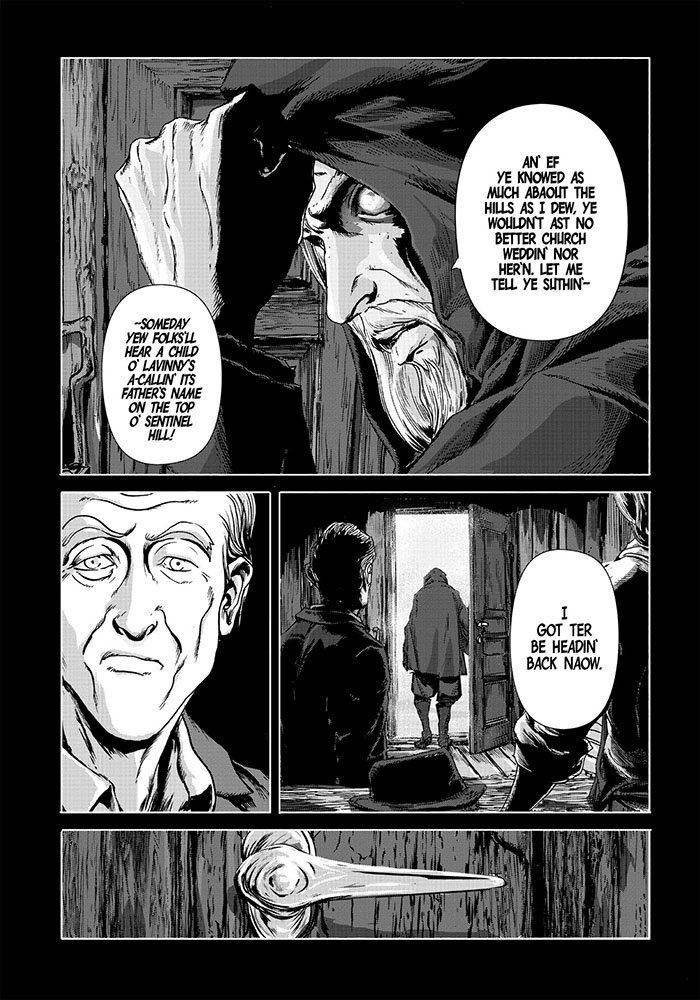
Clearly this kind of thing presents an extreme challenge for any graphic artist, but it is a challenge to which Tanabe manages to rise time and time again. He is a master of densely-detailed and realistic landscapes, architecture, flora and fauna – but where he really excels is the way in which he uses his more realistic panels to gradually build towards pages depicting monstrosities and otherworldly, cosmic visions. The Dunwich Horror is a particularly good example of this, and perhaps the most effective sequence in the book is the one in which the half-human Wilbur Whateley has broken into the library in Arkham in the middle of the night, and the three scientists gradually track their way through the dark rooms until they find him. The control of pace and tension in this sequence is superb.
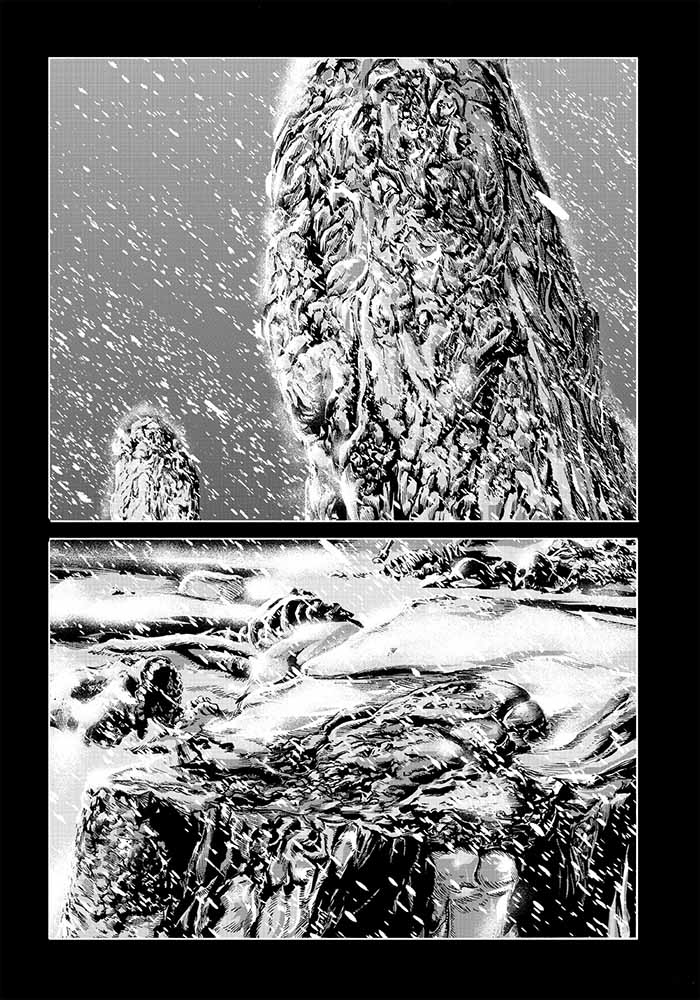
The book is more than 600 pages long, but it holds our attention throughout. Most of the illustration is in black and white. There are lengthy wordless sequences, where we often gather what is happening – for example a foul stench, indicating the presence of a monster – as much from the reactions of the main characters as from what is directly shown. Elsewhere there are sound-effects, such as ominous rumbling noises in the hills (“RRRRRRUMMBLL”), but the lettering is always restrained enough not to disrupt the antiquated, literary feel of the story as a whole. Gou Tanabe’s version of The Dunwich Horror is a tour de force, and it will undoubtedly bring one of Lovecraft’s best stories to life for a whole new generation of readers.
Gou Tanabe (W/A). Zack Davisson (T) • Dark Horse Comics, $49.99
Buy online from Gosh! Comics here
Review by Edward Picot