

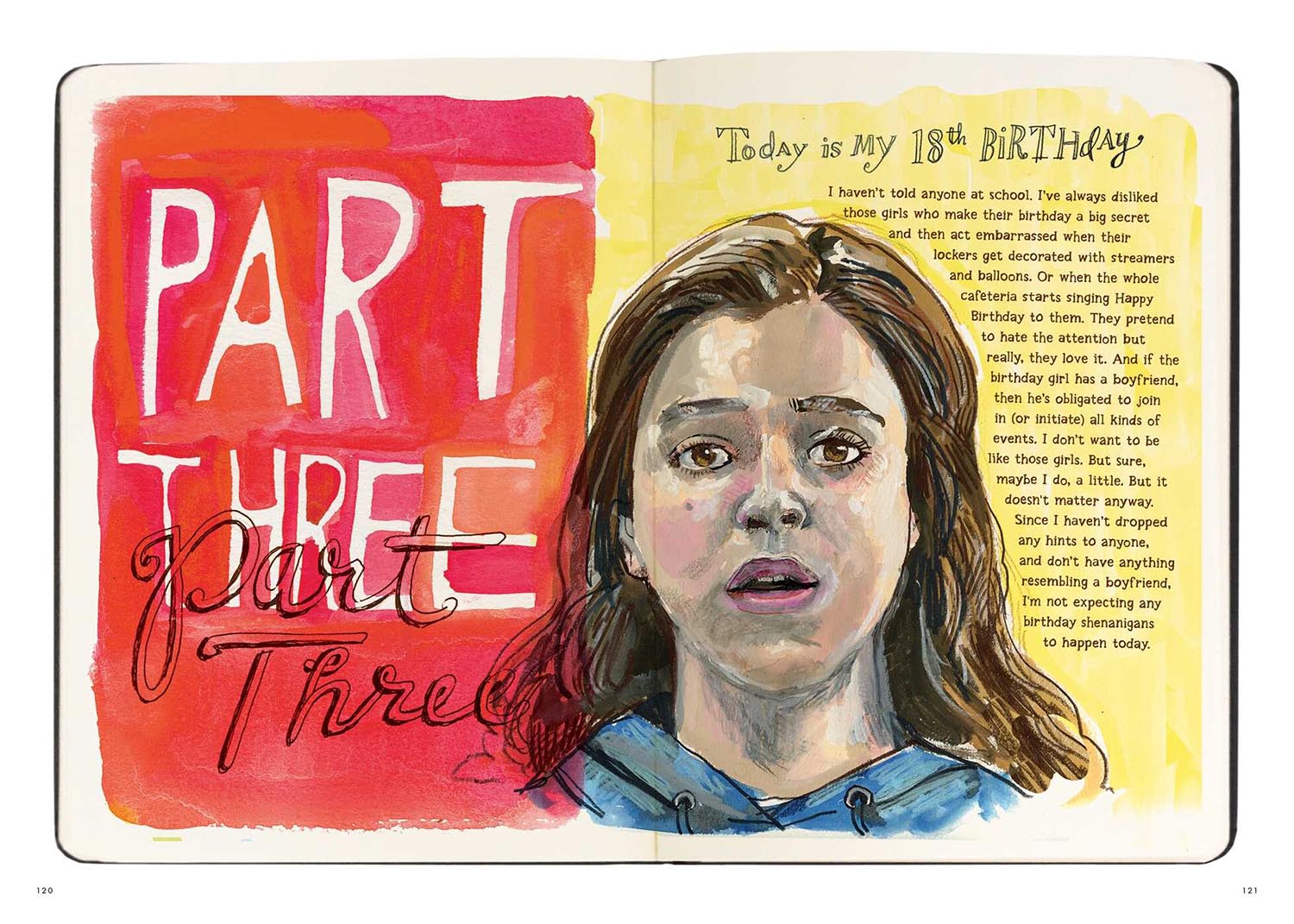
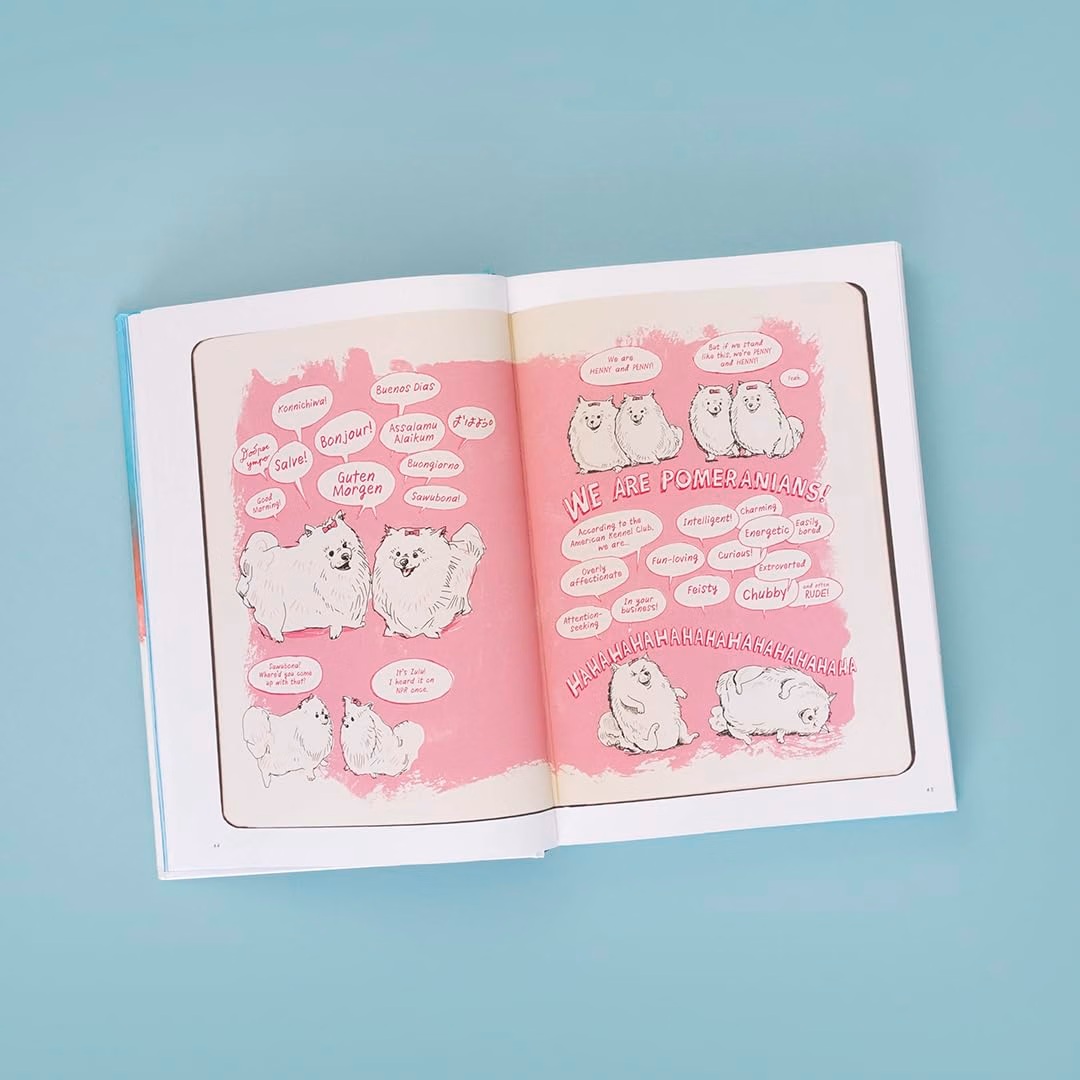
When it comes to the purpose of literature, Fran Lebowitz once declared that “A book is not supposed to be a mirror, it’s supposed to be a door.” Emil Wilson’s stunning, formally innovative graphic novel The Nightingales is a door that opens for readers to walk into the world of Louise, aka Lou, (she’s only Louise if she’s “in trouble”) a 17-year-old girl whose ordinary life in suburban Oregon changes overnight when Jim, an older gentleman and complete stranger who has AIDS, comes to live with her family, bringing along his two pomeranians, Henny and Penny (who get their very own monologues in a pink spread aptly titled “The Henny and Penny Show.”)
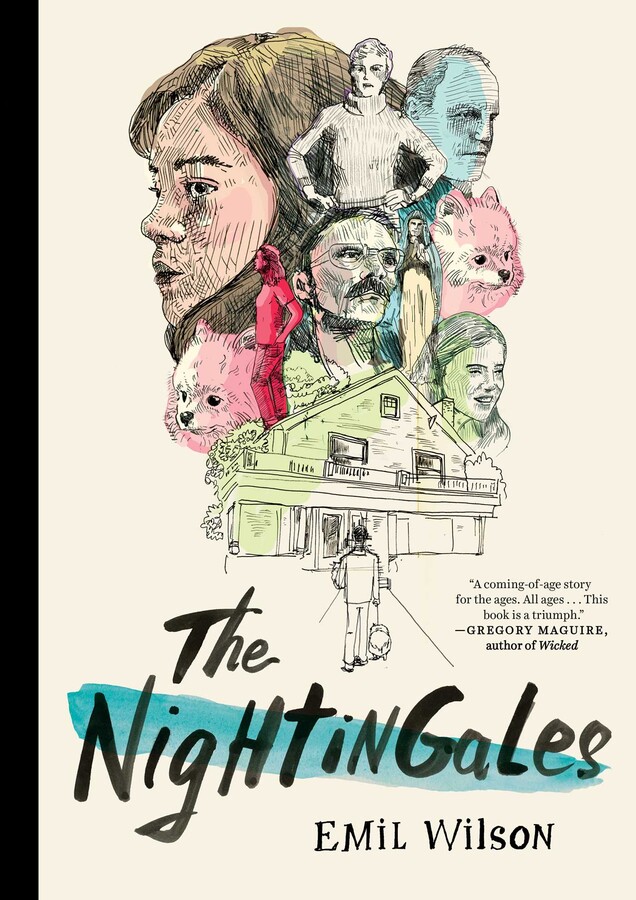
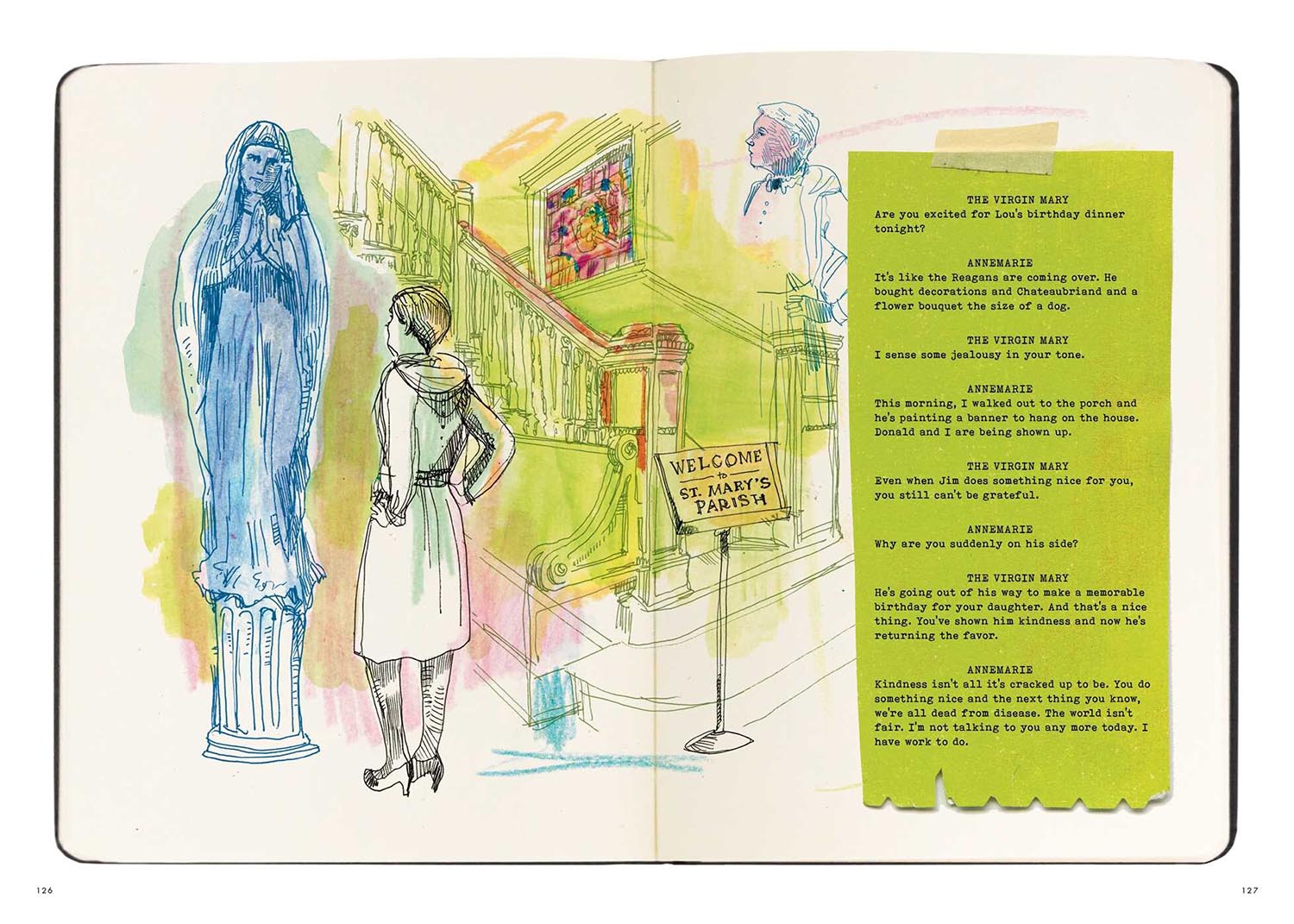
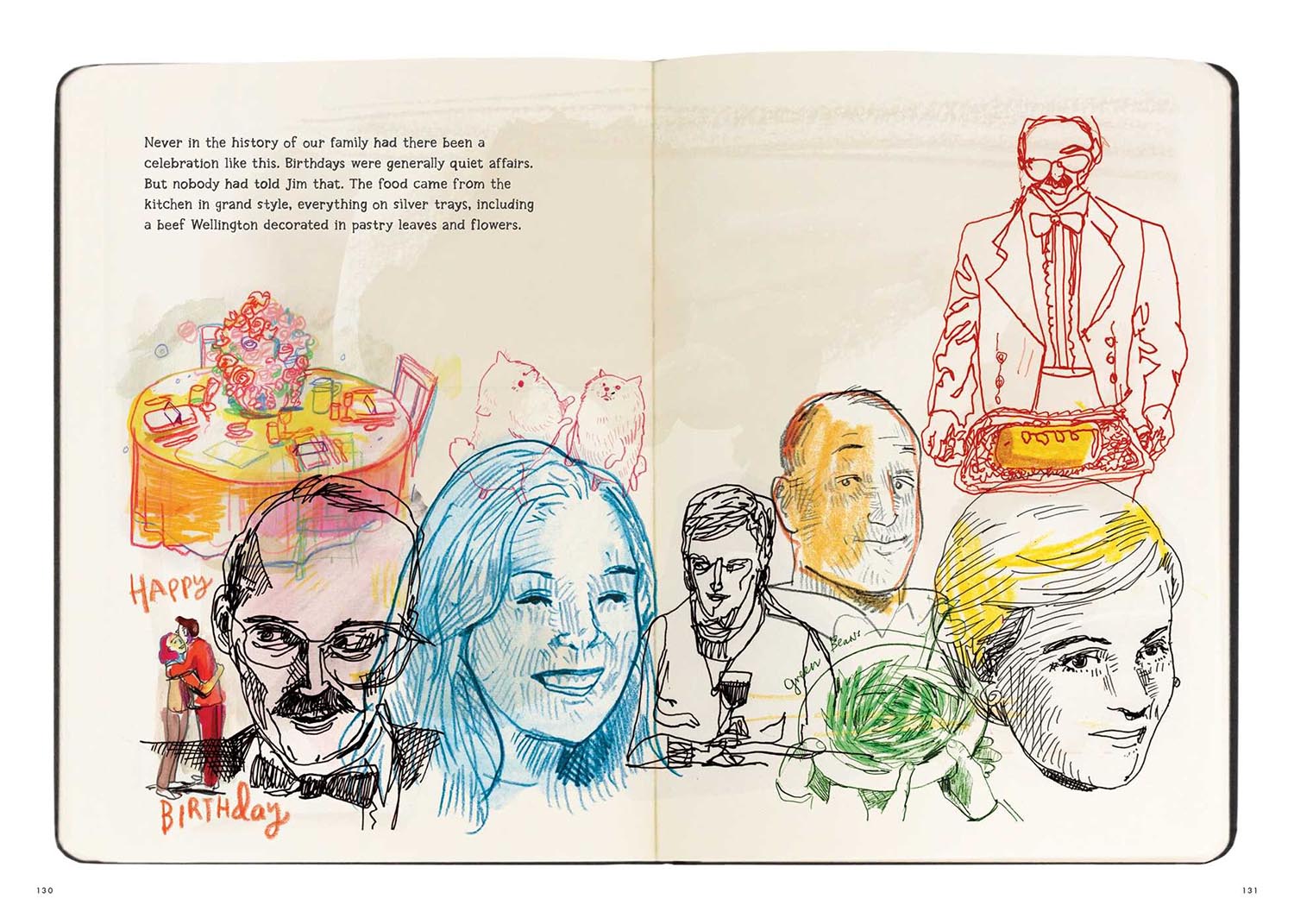
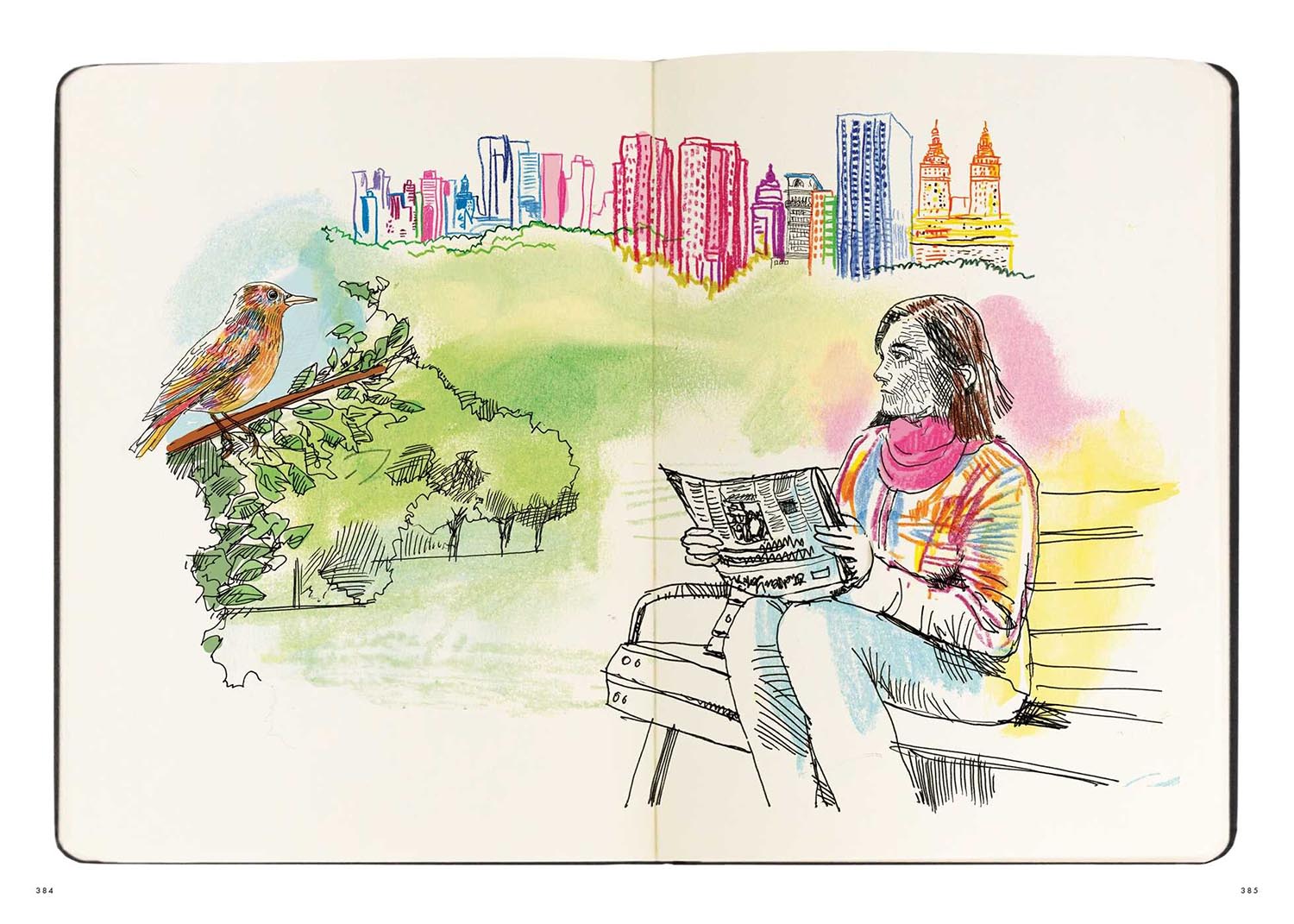
The prose is as sparse and concise as a short story by Lydia Davis, and the illustrations, with their purposefully sketchy lines, bright colors, and expressive figures reminiscent of Maira Kalman, convey the heart of each character alongside dialogue taped onto the page in a playwriting style format. I could visualize the whole book being depicted on a stage similar to Alison Bechdel’s Fun Home, and, like Fun Home, the book alludes to various books and pop culture to capture the time period depicted and give us a sense of the media which impacts Lou’s rich interior life. The book is also deeply funny and imaginative in a way fiction can only accomplish, including scenes where The Virgin Mary appears to offer Annemarie, Lou’s mom, a cigarette, give her some advice about her attitude, and, much to her surprise, even takes a slice of pie as an offering.
During our talk, Emil noted that his goal as an artist is not merely to show representational action in comics form, but to capture the “internal architecture” of the story. His narrative accomplishes this by using the form to show the poetics of what goes unspoken between his protagonists, in other words, he utilizes the white space of daily conversation to express emotion: a knowing glance, showing teeth and furrowed brows mid argument paired beside an illustration of two tigers fighting, a hand shake, the last look you give someone before turning away, a cup of tea given to a sick housemate, a gesture of compassion in spite of baseless hatred.
The Nightingales remind us of a simple fact: “Life is so precious,” Jim tells Louise toward the end of the book. “Don’t waste a minute of it.”
BROKEN FRONTIER: When did you first get the idea for The Nightingales?
EMIL WILSON: Yeah, surprisingly I was at the Center for Cartoon Studies. For the first year, they ask you to just concentrate on making comics and don’t worry about your thesis. And there are people who come to school with ideas they’ve always wanted to do. I thought: I’ll think about it through the year but I’m not gonna figure out anything, and we had this visiting lecture with MK Czerwiec, who had been an AIDS nurse, and I remember writing down in my notebook, oh yeah there’s this story that we never talk about in my family and we probably should.
As I was thinking about it through the summer, it was the summer of the George Floyd events, and it felt like there was a real lack of humanity in the world, and I just felt like here’s one experience that I’ve been through with my family where kindness was really complicated for us and it became really hard to navigate. I think my father had been given six months to live around the same time, he ended up living a couple more years, but I thought about writing about my family and I was thinking about this and MK kind of brought it all together for me.
BF: Did it originate in the sketchbook form? Do you keep a sketchbook? Have you always kept one?
WILSON: I have and I do. And I’m also really fascinated by others. There was this book at school about comic artists sketchbooks that Steven Heller wrote and I think I checked it out literally on the loop. I would put it back just in case anybody was looking for it and then I would check it out the next day. I just am fascinated by the way artists keep sketchbooks and I think it’s because a sketchbook feels like they’re not thinking, they’re just creating on instinct. They’re being expressive, they’re making mistakes, they’re doing all the things that I think are really wonderful to see in art and I just really like looking at them. All kinds of sketchbooks.
I come from the world of advertising and one of the things we’re asked to do is think about visually what can help tell this message without overtly telling the message. And I thought if I had to draw what memory looks like, I think it would look like a sketchbook because it was all kind of chaotic, and you kind of have to figure out what things are, and that’s the way memory works for me. I really love that. I’m not the comic kinda guy, so I didn’t think in the panels thing, so yeah.
BF: Do you draw in your sketchbook every day?
WILSON: I think it’s sometimes in between. I’m such a child of authority, Do I do it every day? I don’t know every day, but I mean I think I do it more days than I don’t. I think I’ve developed this over my career where I tend to draw with whatever’s near me. I sometimes don’t have my sketchbook next to me, so I will draw on something and put it in my pocket and put it in my notebook and then at some point tape it into the notebook. So one of the reasons that the tape is so relevant in my book is because that’s just how I keep ideas together.
BF: I really love the tactile feel that the book has. And you kind of have a playwriting style for the dialogue. How did you decide on that format as the best way to tell the story?
WILSON: I’m really proud of that, and maybe it’s because I don’t have a background in comics. One of the problems I have with dialogue in comics is that everything is so incredibly contained. I know if you grow up with comics, that is something you’re used to. You go from box to balloon, to the next box to the balloon. The problem for me is that the dialogue gets really stop and start-y. You stop it, you start it. You have to reassess in the panel what’s happening and look at the dialogue again. I wanted to find a way where you could read the dialogue and not worry about the pictures immediately but just really be interested in what they’re saying to one another which is what propels the story.
BF: What made you get into design and advertising?
WILSON: The thing about advertising that I love is that advertising is about problem solving. It’s about hey I’m having this problem people aren’t buying my product, I need you to help me solve that problem. I feel like so much of being creative is oh, this solves the way to do dialogue. Or this solves the way to be different. Or to make something that doesn’t look like this.
BF: The book is loosely based off of personal experiences. What made you decide to tell it as a fictional work instead of a direct memoir?
WILSON: Well, there were two reasons. One is that I wasn’t there. As in the book, I came home one weekend and I met Jim, and then the last third of the book is based on my experience of being a buddy to people with AIDS, but there’s this thing that I have, and I wonder if a lot of memoirs have it, where if I wasn’t there I don’t feel confident that I should act as if I was. The happy end of that is that because I wasn’t there I felt like I could take liberties and I felt like I could manipulate the story in a way that felt comfortable to me.
I also didn’t have to analyze myself. The hard thing about memoir is that the writer has to analyze themselves. I think if you take yourself out of the equation, your characters are people you know intimately because they’re your family members. You sort of have the best of both worlds. I literally did write dialogue for my mother. I know what would come out of her mouth in any situation. The other reason I didn’t do it as a memoir is because I wanted to play and feel confident playing.
BF: Do you feel like that distance allows you to be more vulnerable? Because you still get that vulnerability throughout the book and it’s still an intimate reading experience.
WILSON: I felt the freedom to make myself kind of a dick. Pretty much everything in the book happened. Who it happened to and the order it happened, I definitely changed. And that’s okay.
BF: How did you go about looking for agents for a non-traditional graphic novel?
WILSON: I did this book first as a pitch. The only reason I went to a guy who is now my agent is because I’d written a memoir 15 years ago that is the next book I’m working on, which I’m turning into a graphic novel, and I knew him. But I went to people who did graphic novels, and I gave them the first chapter, which I’d worked on three thousand times, and it was fascinating to me the amount of feedback I got which was: can this girl be trans or nonbinary? Can he have Covid and not AIDs? The AIDS thing is too old for us. No one’s gonna get it. No one’s gonna like it. They just kept really wanting to change it. My agent Warren said: I can’t sell an adult graphic novel on a pitch. You’ve got to finish the book. And I said, well I don’t want to work and not get paid for it. He said: Okay, well then why did you start it? What choices do you have? Are you committed to it? Will you see it through? You don’t know what’s gonna happen. I thought, okay, but does he need to have Covid? He said no, what’s different is what makes it special. Do that.
And then come back to me and show me what you’ve finished. I wrote to him a year and a half, two years later, and said I finished this book. What do you think? He wrote back and said I love this. I wanna represent it. I think everybody who was a comics agent wanted to change it. I thought: I don’t want to change this for a market that is in of itself very isolated and specific. I wanna work on this for people who will like it. I think it was that and having people who championed that.
BF: It’s nuts that they wanted to change the history and the fabric of the story.
WILSON: I think that a lot of people in comics underestimate the fact that the people who are selling it need to sell it. They have to be very conscious of the fact that you have something that is very timely, which again, is only timely at the moment they’re looking at it, and three years down the road, nobody’s talking about Covid anymore. To be honest, AIDS is actually having a bit of a resurgence this year. There’s movies coming out. It’s a bit of a thing. I have always believed that with the market. The market’s gonna change. You have to do the thing you like and not worry about it. You hear that a lot in school: follow what’s working in the marketplace, create comics based on what people are buying, etc.. By the time you finish your book, the market is gonna be a completely different market. Do the thing you love.
BF: How do you work intuitively and let go of over-thinking in your process?
WILSON: You just kind of figure it out. One thing I do in my work is pin things up on my wall. Sometimes it’s a fully formed idea, but often it’s just something that intrigues me–an instinct I can’t quite explain. I’ll leave it there, sometimes for weeks or months. Then one day, I’ll walk into my office, glance at something I’ve been looking at all along, and suddenly I see it in an entirely new way. Something clicks. It’s one of those magical moments in the creative process.
There are a lot of people I showed this book to who didn’t like it. The thing I learned as an artist is that sometimes showing somebody who has negative feelings about your book only strengthens your feelings for the book. It’s a great feeling when someone’s like oh this is just like Fun Home, no one’s gonna read it. and you go oh, okay, well I’m gonna make it different and do something really cool with this, and you watch. There’s a feeling of like I wanna prove it to you and myself. What I took as a negative comment propelled me to do something really great with it. Being offended can be a great motivator. I’m really grateful for the people who didn’t like my book.
Buy online from Gosh! Comics here
Published by Jonathan Cape in the UK and Avid Reader Press in the US
Interview by Lara Boyle