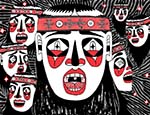


THOUGHT BUBBLE MONTH 2026! Just in time for Harrogate we have the next of our spotlight interviews with this year’s Broken Frontier ‘Six to Watch‘ creators and this time it’s the turn of Skai Campbell, aka Skhoshbell, to talk about his work. Skai’s energetically endearing cartooning really caught my attention and imagination when I was looking at candidate’s for this year’s Six, as is very much in evidence in comics like Jungul Man-Thology and Hog Hog: A Hedgehog Anthology. We caught up with Skai to chat about finding your place in the small press scene, exploring ecological themes in comics, and the fascination of small, prickly mammals…

Skai (far right) at the Broken Frontier ‘Six to Watch’ table at ARC Festival this summer. Also pictured left to right are Manon Wright, Zen K., Dominique Duong, Andy Oliver and Rein Lee
AO: You’re one of this year’s Broken Frontier ‘Six to Watch’ creators so let’s begin by asking you to introduce yourself to the BF audience and tell us a little bit about your wider artistic background?
SKAI CAMPBELL: Hi! I’m Skai, I’m a cartoonist from South East London (woop woop!), and I’m so excited to be part of the Six to Watch! I’ve loved drawing since I was a kid, but I took a weird hiatus from it around my A levels onwards – I think all the cool kids in school got really into film photography and I wanted to follow suit. After I’d graduated from my undergraduate degree in biology, I had a break-up which sent me into an existential spiral and In my quest to rediscover who I was I reconnected with my love for drawing! Hooray to heartbreak!
As I spent more time reconnecting with that side of myself and began to consciously try to expand my skillset and my influences, I felt that I needed to find a way to spend more time working on my craft, and so when my contract ended I applied for an Illustration Masters, which I finished last year! Now I’m working at a charity where I can use a lot of my illustration skills, and doing freelance work and personal comics and arts projects alongside!
AO: What was your entry point into comics as a form?
CAMPBELL: It’s going to inflate his ego way to much but I have to say my dad. He was a massive comics nerd when he was younger and so my wardrobe as a kid was filled with all of his old comics that he couldn’t store anywhere else. I would spend ages going through them and I got really attached to Marvel stories like Civil War and Planet Hulk. But he also had comics like Preacher and The Boys (which might have been a bit much to be reading in primary school), which made me feel really ahead of the playground comic curve.
At the same time, my brother and my cousins were all massively into anime and manga, Dragonball Z being the main one, so I followed their lead on that and ended up getting sucked into Shonen. I read loads of Dragonball, really random fragments of One Piece and Shaman King, and also one called Märchen Awakens Romance which to this day I haven’t found anyone else who’s read it. At this age I know that I tried to make all sorts of comics and short stories, but I never stuck with any of them that long, and they’re all lost in random scrapbooks or folders that my mum probably has.

Then when I was rediscovering my love for comics, I think Zoe Thorogood and Juni Ba were two of the first artist that I came across. It’s Lonely at the Centre of the Earth was such an impactful read, I think the first autobiographical comic that I had properly sat with, and the depth of its emotional exploration was something that I didn’t know was possible. I exploded into a million pieces and then glued myself back together with such a renewed understanding of the power comics held, and how I could use them to get to know myself. Similarly, I fell in love with Juni Ba’s style and how expressive and vibrant it was, and in a way it liberated me in the sense that I felt more emboldened to be playful with the work that I wanted to make. I went to Thought Bubble for the first time at a year when they were both there and managed to nag them for some advice too which I’ve tried to follow as much as I can ever since!
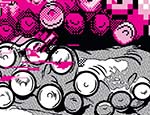
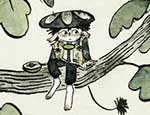
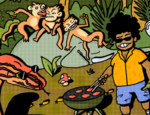
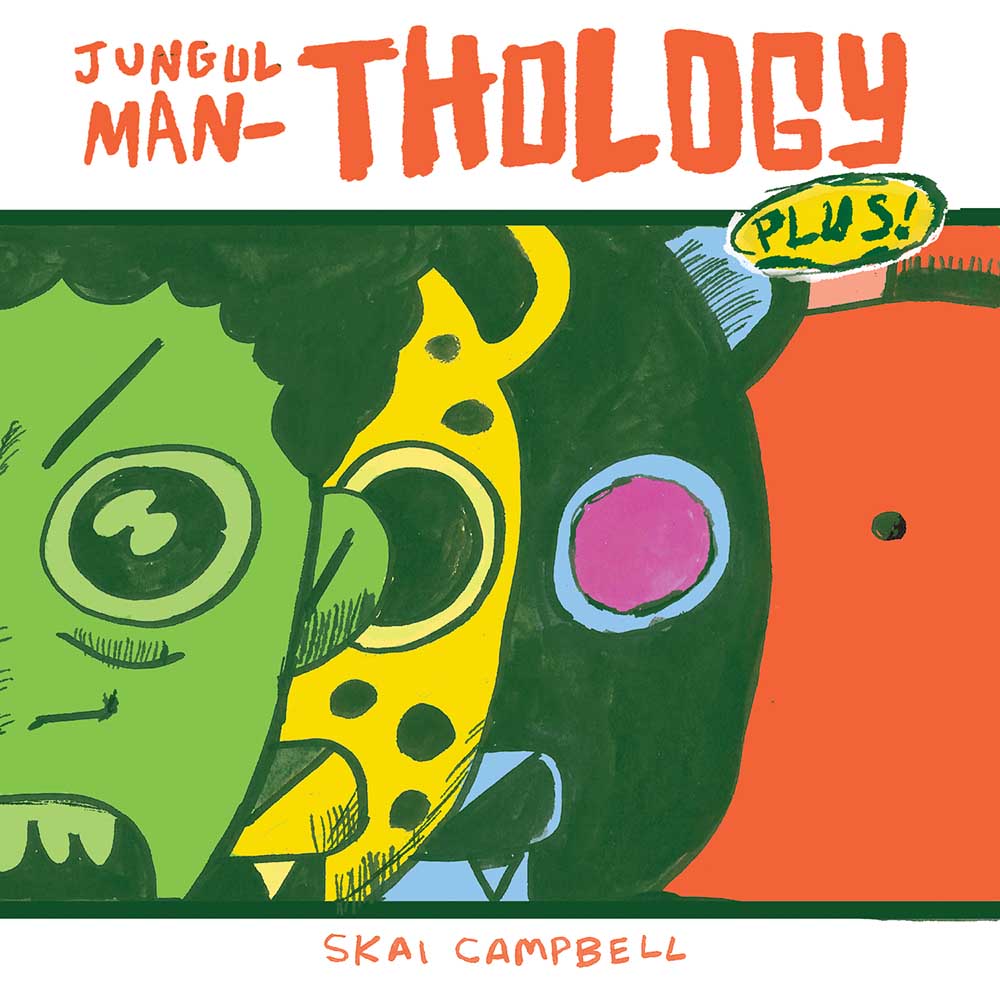
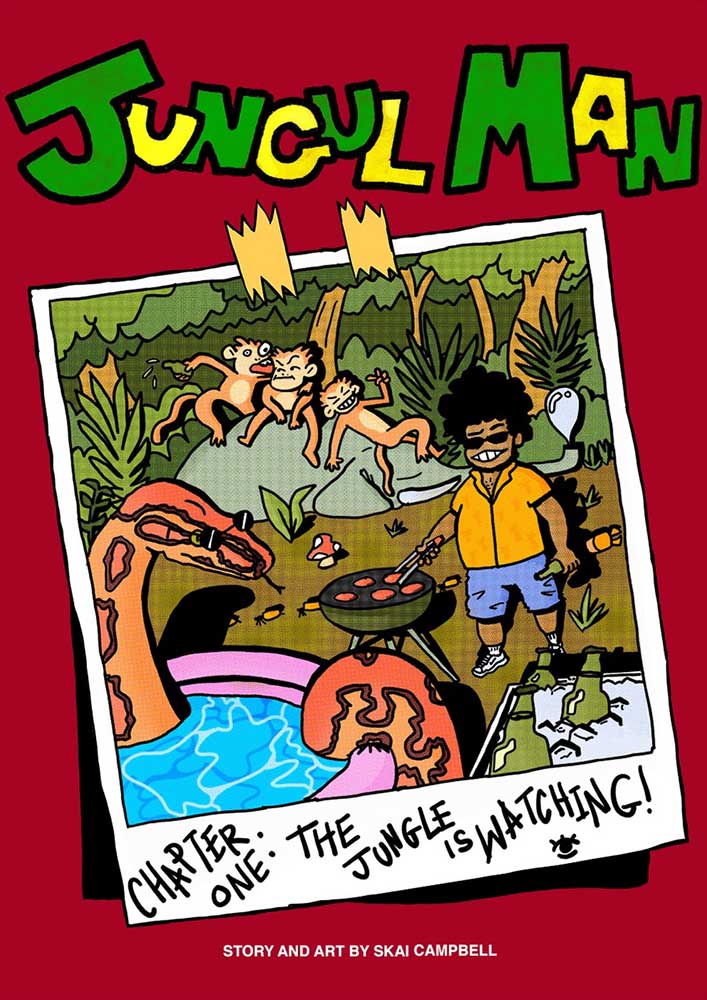
AO: Your first major self-published project was Jungul Man-Thology (above and below) which you describe as being “inspired in equal parts by Calvin and Hobbes and my travels in Côte d’Ivoire.” Can you give us some background on that comic and its playful approach to cartooning?
CAMPBELL: I was on a trip in Côte d’Ivoire as part of a job I was working at the time, and had to stay in this forest reserve for a month. It was such a cool place but I wasn’t used to that kind of travel, and I felt really out of my depth. As a way to get through this, every evening when I had some downtime I would use the pages of this a6 notepad to make teeny A8(?) zines about this character called jungle man who would be having idiotic misadventures in jungle all whilst complaining about how much of a drag the whole thing was. I think the exaggeration in it was really a way of me to release all of my anxieties and stresses about how the trip was going, and it gave me a nice thing to look forward to in the evenings.
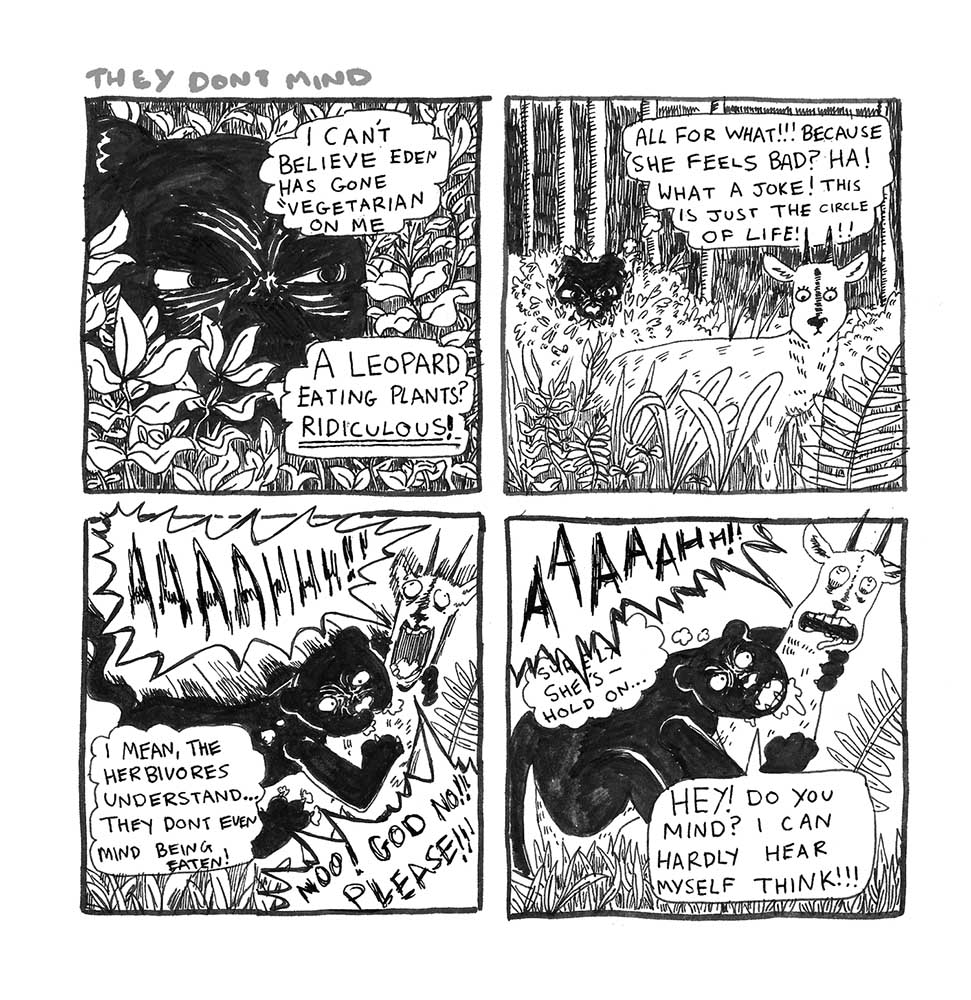
Following this through this Kent arts scheme called Makes Waves, I was introduced to the picture book artist Esther Coombs, and she gave me a stack of Calvin and Hobbes books to study and I fell in love with them. Their humour, their pacing, and the playfulness that Bill Watterson showed was so cool. At the time I was thinking of a comics to make for my first project, and I thought that extending the jungle man universe in a Calvin and Hobbes style would be the best way for me to approach it – that four-panel formula gave me a really good set of constraints that I could try to find my style within.
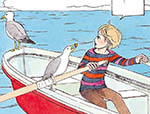
AO: Earlier this year we reviewed your hedgehog-focussed comic Hog Hog (below) which we described as “a fun read but also one with something important to say.” What was the inspiration for that collection?
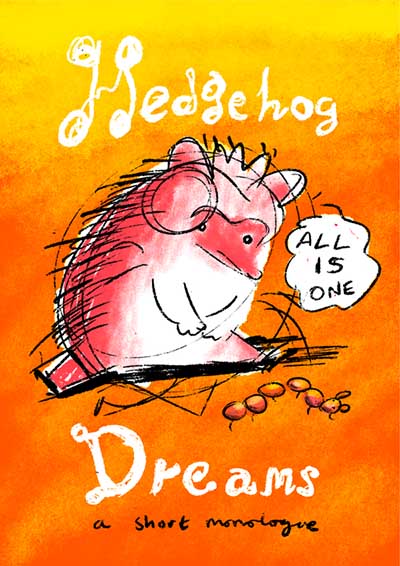
CAMPBELL: The hedgehog obsession really came out of the blue – I was having a conversation with a community gardener in Honor Oak in South London, and he made an off-hand comment about how you used to see hedgehogs all over the place, and now there’s hardly any around. That one comment really stuck with me, and I feel like hedgehogs became a strange kind of mascot for me in that moment, a symbol for all the wildlife decline that we’re seeing. Initially I riso-printed a short 4-page comic called Hedgehog Dreams which was a monologue by a hedgehog with a South London dialect where he talks about his woes, but also his hopes for the future.

I thought it was really unimpressive at the time so I only printed like 10 copies (which is so annoying in hindsight), but kept on drawing hedgehogs after that, and wanted to build on that exploration of urban wildlife. I came up with a story about a hedgehog and a worm going on a journey to find a pesticide-free community garden (inspired by a real garden that I volunteer at), and that became the anchor for all those other drawings and musings about hedgehogs. I also wanted to give that first comic some more shine too, so I included it in the collection!
AO: You’ve also contributed to a number of anthologies for the University of the Arts London’s Camberwell Comic Club. How important a learning process was it to work and collaborate with your peers on those projects?
CAMPBELL: That was one of the first places I began to feel like I was involved within the comics community – it was so much fun to be surrounded by people who loved comics and wanted to explore the art form! I learnt a lot from the different styles of storytelling that were present, and it was another moment of realising how much broader the comics world was that what I previously imagined. It was a really cool combination of both students and staff who were working on projects collaboratively, and it really felt that everyone was supporting each other and invested in each others’ works. I received so much helpful feedback and advice – it felt like a whole extra education alongside the degree that I was doing was happening through the people I met there.
AO: Ecological themes and ideas of connection with the natural world seem to be a very important part of your practice. Why do you feel comics is an effective form for exploring those things?
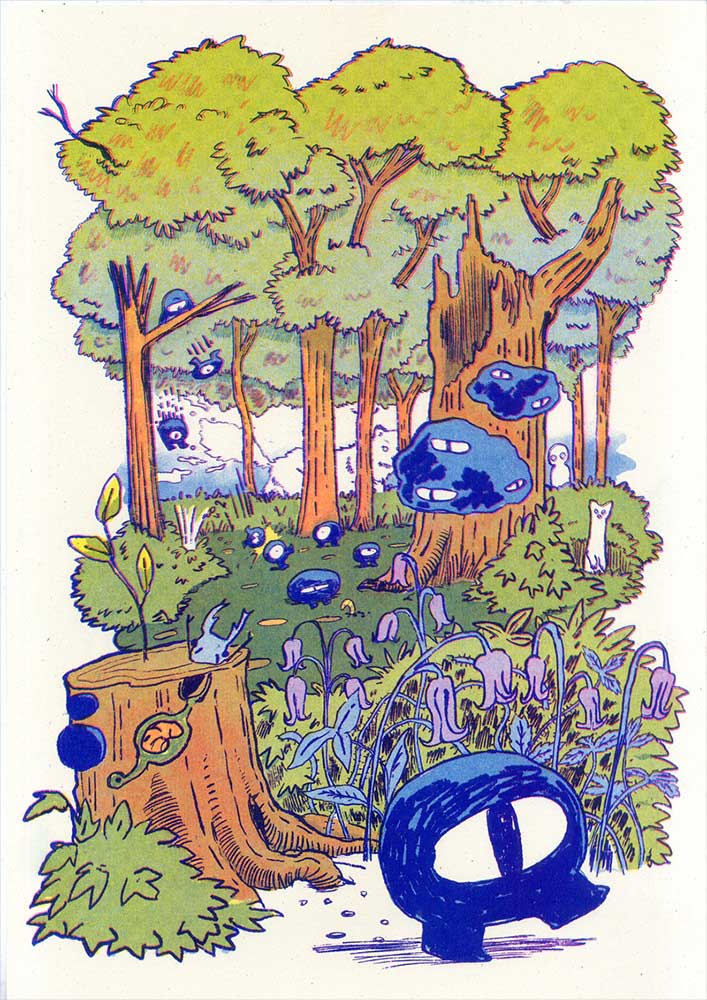
CAMPBELL: I really like comics for talking about these themes because of how accessible it can make them. There’s a large body of writing/information about the environment that feels very dense and hard to digest, and I think that being able to break it open and mix it in with visual storytelling really helps to get the message across. I think that it’s clear that pure science/information alone isn’t going to solve all of the ecological crises that we’re facing, and so I’m really interested in trying to come at it from a cultural angle, and make things that build of that emotional connection/investment that we can have with the natural world and its cycles, in hopes that that can be part of something more sustainable.
I take a lot of inspiration from Miyazaki’s films, in the ways that they’re rooted in environmentalism and anti-imperialism, but they’re also about pigs flying planes and girls tanukis using their unmentionables as parachutes. I feel like I want to build a feeling of curiosity and wonder about the world, and that that feeling might be part of a wider movement to place more value on these things, and as a society we begin to find any way of living that doesn’t include consideration for the natural world unacceptable.
AO: Your art has such a wonderful raw energy to it. Can you tell us about your creative process and the mediums you work in?
CAMPBELL: I love that. My creative process is very much a work in progress, and I feel quite like it’s always a surprise to me when something I make works out. Whenever I’m working in a way that feels like I’m “onto something” I think I’ve realised it starts with lots of observations. My mind moves around quite a lot and I think I get overwhelmed by all the different options and directions a project can go in, but I think that starting with something real, and then following what comes into my head next keeps me anchored. I do a lot of journalling too and I think that the themes or topics that im exploring in that side of my life often spill into the work I make.
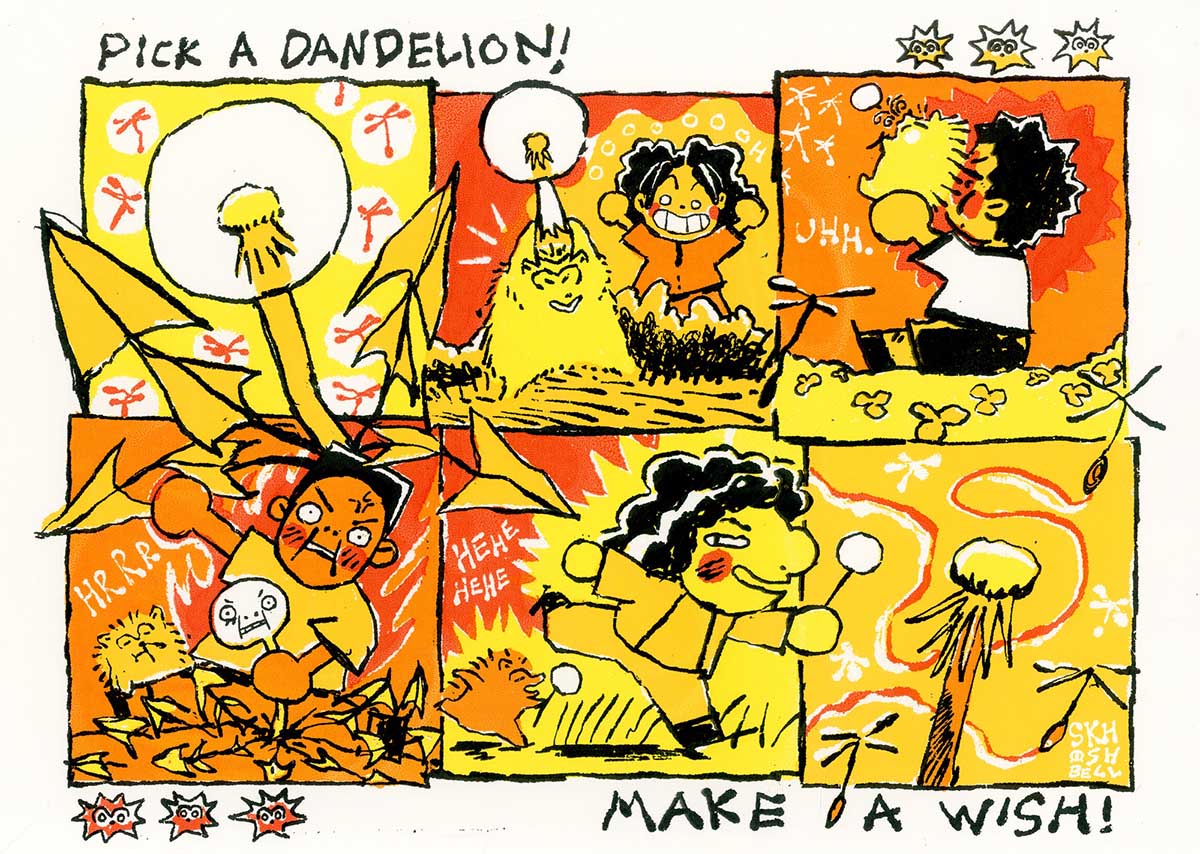
I do get very uncertain about my style of working, and I think this worry sometimes paralyses me, so recently I’ve started making comics on post-it notes, which was a way to get pressure off myself. I don’t know how long ill keep it up for, but so far its been really helpful for focusing on the spirit of what I want to make, and limiting the room for me to fuss over appearances. The hope is that then I can bring that confidence into larger projects, and get around that pesky voice in my head that poo poos all my ideas!
Medium-wise, when I’m making comics, I like to use dip pens and ink. last year I copied all the comic artists that I like and copped one of those G nib pens, and its so cool! I’ve also recently gotten a yellow (important detail) Lamy safari pen and it’s been so much fun to work with. As much as I love working with colour when possible, and typically opt for pretty punchy palettes, I feel like my true love will always be working with black ink. There’s something about the look of a little scraggly line doodle with a good pen that I can never reach when I’m working with colours, or other mediums even. Maybe it’s the universe, or maybe I’m just too comfortable. Otherwise, I love printmaking and love to do riso and screen printing!
AO: You’re an emerging name on the scene so what have been the main challenges of getting your work seen by wider audiences? Do you have any advice for would-be comics small pressers?
CAMPBELL: Finding time to create was really hard initially – before I did my masters it was weekends/after work and that can be super draining, and you are really dependent on energy levels. Comics takes a lot of time and I think that It can feel like you’re kind of flapping around but not moving anywhere (like a kestrel), and I think that its hard to keep up that momentum when you’re still having to support yourself through other means.
I think going to in-person events and meeting people, and sharing in that love for comics was really invigorating – I love comics because you can work on them by yourself, but there’s something so uplifting about being around people that care about it as much as you do – it really lights a fire inside that helps keep me going. The people that you meet at these things too end up becoming friends, and it’s really cool how quickly you can go from feeling like an outsider to feeling like you’re part of a community. The other advice that ill share is the advice I got from Zoe Thorogood and Juni Ba, which was “be irritating” and “finish things”!
AO: Will you have anything new for Thought Bubble this year?
I have a zine filled with oil pastel drawings about how much I dislike A.I, and a short Jungul-Man origin story!
AO: And, finally, what’s next for Skhoshbell? Are there any upcoming comics projects you can tell us about?
CAMPBELL: I have a comic that I’m currently working on, which is going to be the longest story that I’ve ever done – it’s currently looking like around 50 pages, and I’ve just finished thumbnailing it. It’s all about birdwatching, the relationship between your inner child and your constructed adult self, repressed childhood memories!
Visit Skai Campbell’s website here
Interview by Andy Oliver
Skhoshbell/Skai Campbell is at Table B9b in the 2000 AD Hall at Thought Bubble.
Thought Bubble 2026 runs from November 9th-15th with the convention weekend taking place on the 14th-15th. More details on the Thought Bubble site here.
Read all our Thought Bubble 2026 coverage so far in one place here.
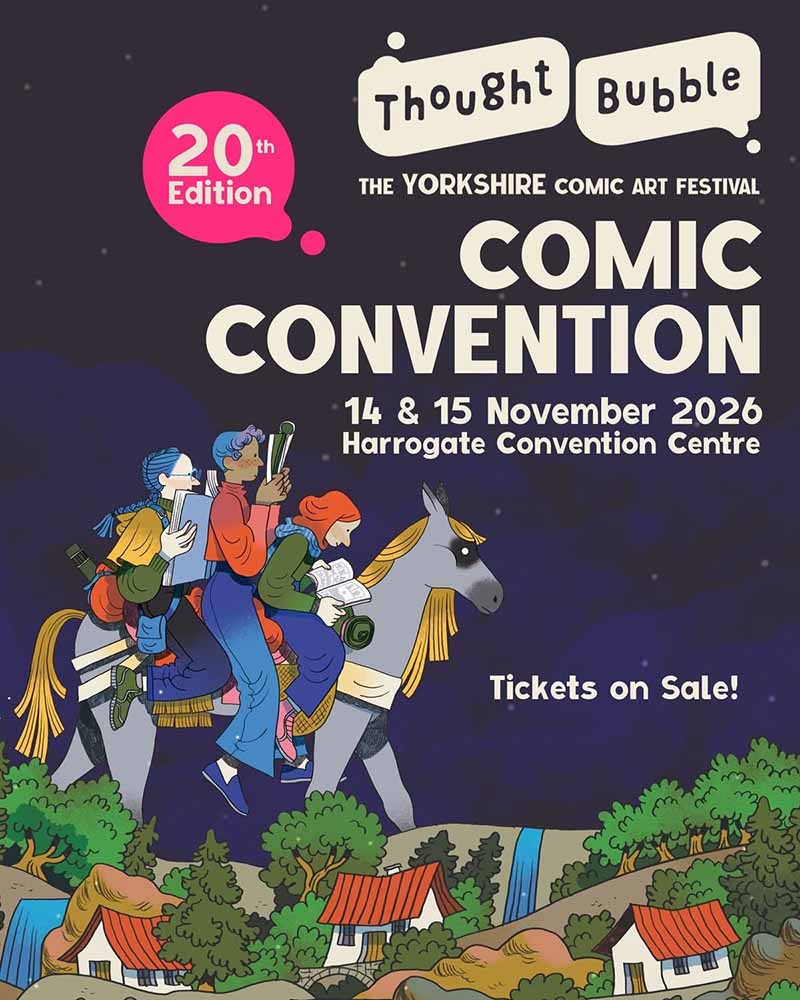
Poster art by Núria Tamarit