

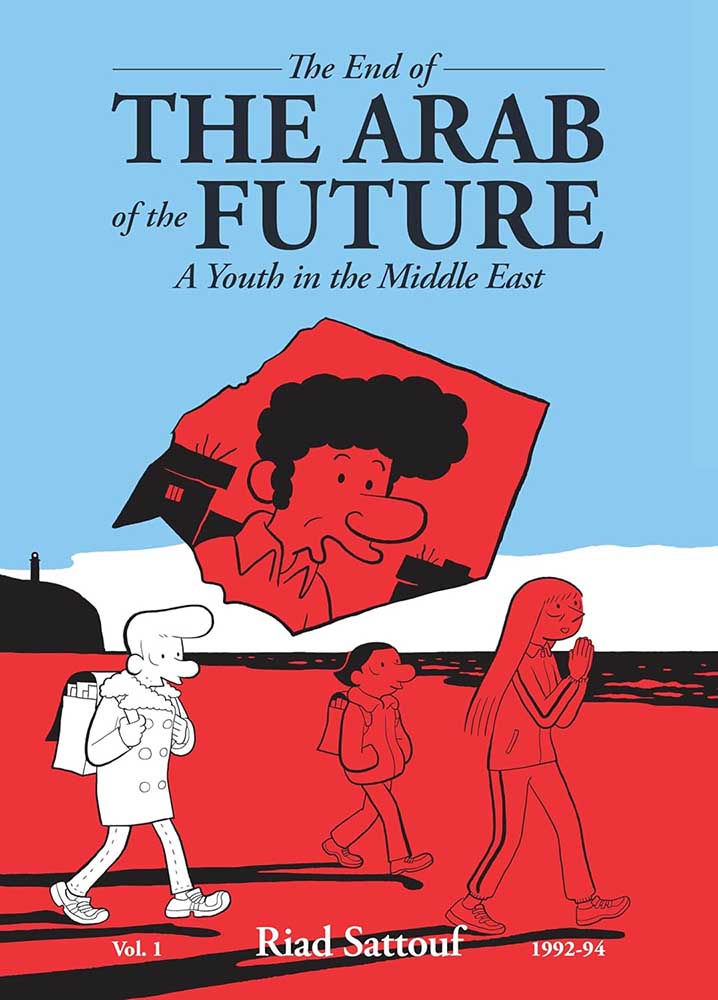
The End of the Arab of the Future: A Youth in the Middle East Vol. 1 features 14-year-old Riad, an aspiring artist and a self-proclaimed loser, whose seemingly ordinary life in France changes overnight after his nationalist father kidnaps his brother and takes him back to Syria, leaving his mother bereft and his house haunted by the absence of his sibling. Readers of Riad Sattouf’s graphic memoir The Arab of the Future series, which sold millions of copies and has been translated around the globe, will quickly recognize his iconic, easy to read drawing style and familiar characters who did appear in the first trilogy, given the nature of non-fiction, but they will also find something new, because The End of the Arab of the Future has the structural integrity to stand on its own as a wholly separate storyline.
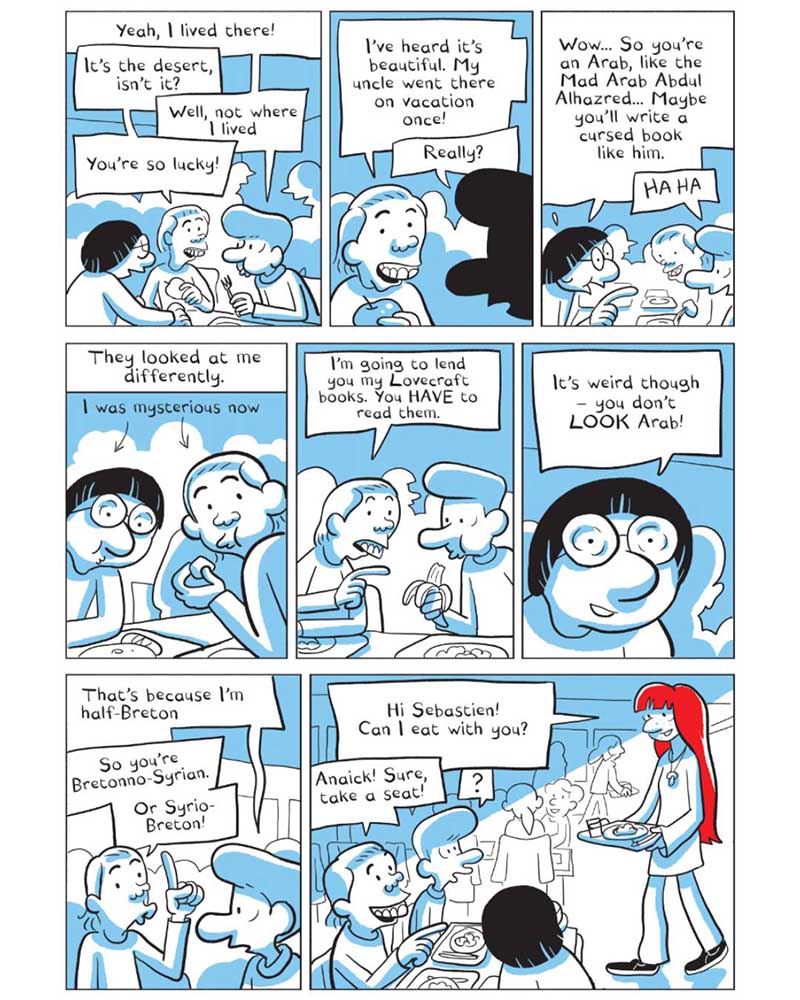
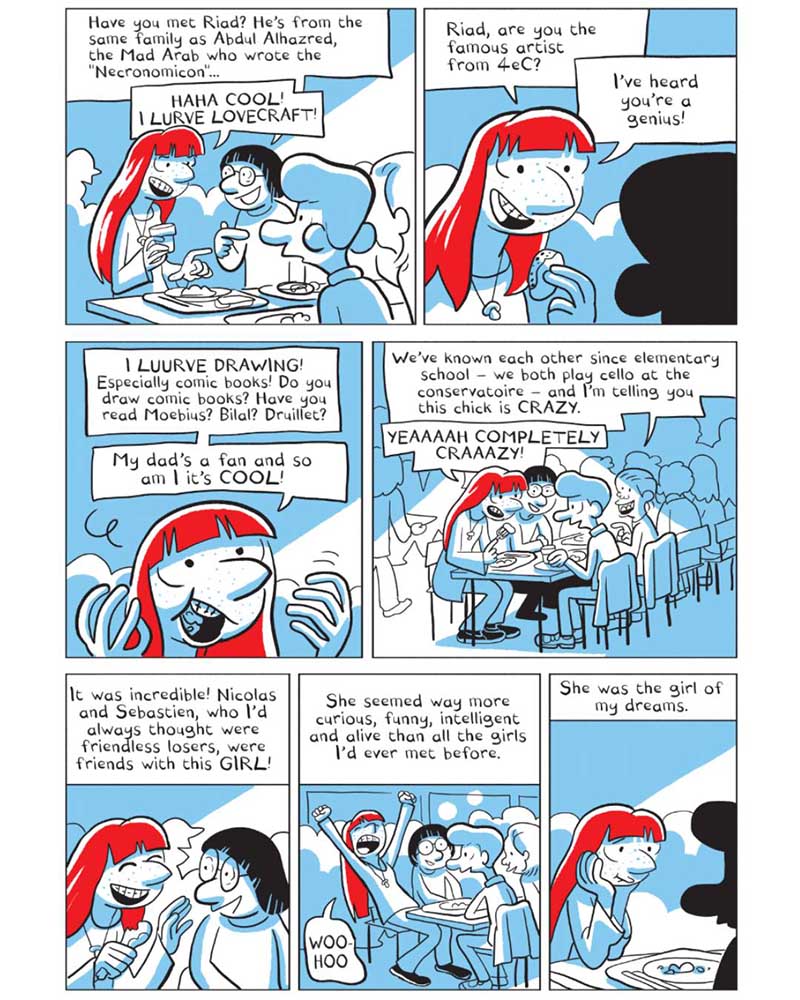
In school, Riad is socially othered for his childhood in Syria and his heritage. This becomes particularly clear in a beginning scene with his friends, who, while reading H.P. Lovecraft’s novel, recognize him in ‘The Mad Arab’ who writes of eldritch horrors in other worlds, though they share nothing in common besides being from the same place.
“Wow. . .” A peer tells him. “So you’re an Arab, like the Mad Arab Abdul Alhazred. . . Maybe you’ll write a cursed book like him.” After this, Riad observes “They looked at me differently.” Their only reference point for him being a fictional Syrian character warped their perception of Riad as an individual person beyond his marginalized identity. Still, Riad feels the allure of seeing himself represented in literature, even if that representation fails to capture the full spectrum and humanity present in his own culture.
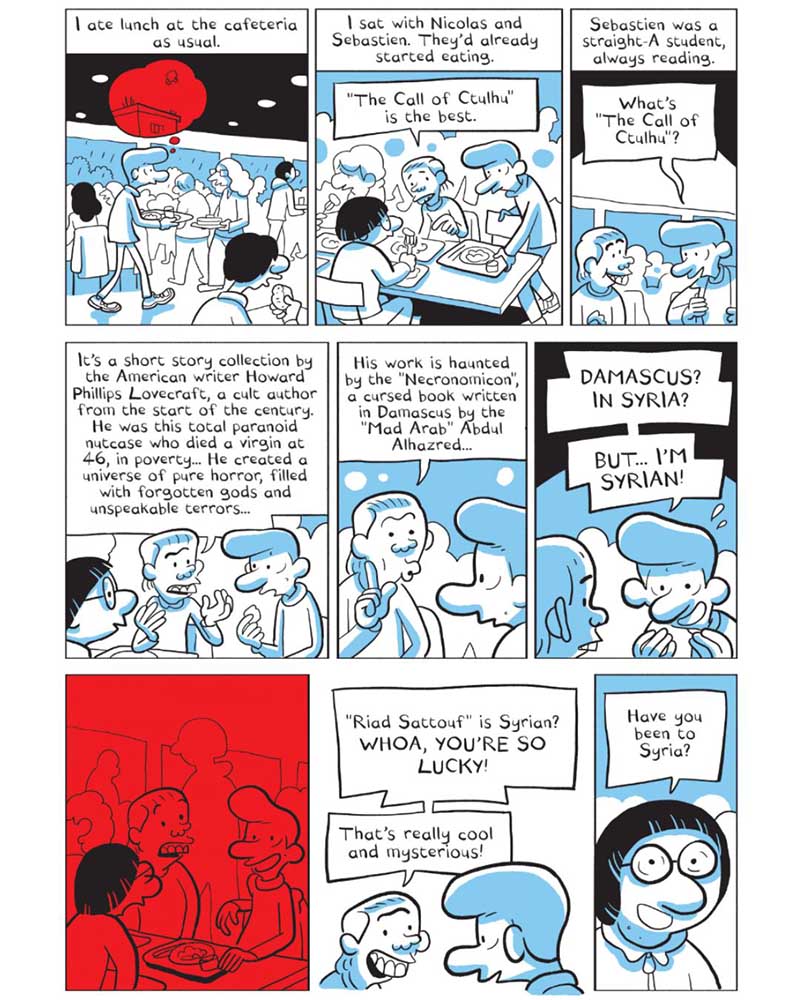
Despite being racist as an author, Lovecraft opened a possibility for Riad to write his own story into a book, and no doubt paved the path for The Arab of the Future series. “It blew my mind that an Arab who lived in Syria could be a major character in a book,” he tells us. “He ended up being eaten alive by an invisible monster in front of a terrified crowd. . . Most of Lovecraft’s stories were written in the first person, like witness statements.” Similarly, The End of the Arab of the Future is itself not that different from a witness statement. Riad bears witness to the loss of his brother, his mother’s grief, and her attempts to get him back, as well as his ostracization and feeling torn between two cultures – the place he’s from and the place where he grows up now.
Though the monsters in Lovecraft’s story are fictional, the monster in his life is real: his father, who at any point may return from Syria to steal him away from the existence he knows and back to a foreign landscape full of trauma he thought he had escaped. The supernatural, too, is real for Riad, whose father believes in black magic and whose mother regularly visits a fortune teller for obsessive reassurance that Fadi is all right. Intertextuality is a prevalent theme in the work, with Riad developing an obsession with both Lovecraftian literature and classic Franco-Belgian comic books like Tintin.
Alongside a coming of age story, The End of the Arab of the Future is also a kunstlerroman, an artist’s novel that follows Riad’s journey to his profession as a cartoonist, where we see him develop his talent and interest in the comics medium. His talent is recognized by peers and teachers from an early age, and his ability to draw people like Michael Jordan wins over the masculine boys who would have otherwise picked on him or bullied him, morphing into a life-line as well as a coping mechanism.
We also get introduced to the kind of music popular at the time Riad is an adolescent, like discussions of the band Nirvana, which speak to his own experiences being rejected and isolated for being different. One reason Riad gets bullied is because he’s told he looks like a Jew, an insult he also experienced in Syria for having blonde hair. As a Jewish reader, I really appreciated Sattouf’s impulse to be as honest as possible in depicting his childhood while also being willing to call out the antisemitism around him. “Whoa, take it easy,” a classmate says. “Don’t be such a Jew.”
Sattouf uses the color red to depict his younger self’s anger and shock at the term’s use. He isn’t afraid to confront or question the blind hate internalized by others his age. “Why Jew?” He asks. Then, after the friend explains the joke is that Jews are “selfish and miserly,” Riad combats it, saying “How do you know all Jews are like that?”
Sattouf is a master at the sequential narrative and clean, effective linework that heightens readers’ emotional experience. I recognized hints of Herge’s Tintin in the iconic shapes of his characters and his ability to immerse us in the story panel to panel. He is able to capture the emotions of his protagonists through their facial features and body language effortlessly. Much like a movie, he uses a director’s eye to guide us through scenes, zooming in or zooming out on his memories as needed to tell this story. This is what great cartooning does: communicates a whole life in as little lines as possible.
The Arab of the Future may be a hyper specific memoir of a young Syrian-Bretton cartoonist’s struggle to reunite with his brother, and feel at home France, but it’s also a graphic memoir many will find themselves in regardless of their identity or homeland, a story about struggling to fit in, falling in love for the first time, discovering what you want to do, standing up for yourself, and coming into your own.
Riad Sattouf (W/A), Sam Taylor (T) • Fantagraphics Books, $22.99
Review by Lara Boyle