

How do you tell a story that has already been told many times? How do you tell a story that at times seems stuck in time because the past, present, and future look almost the same?
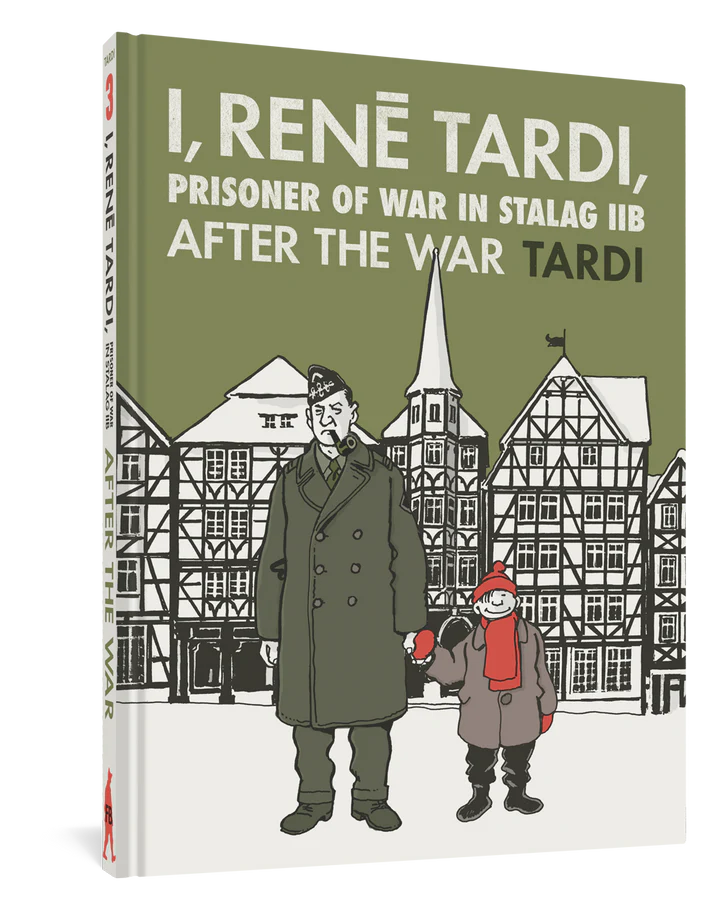
Jacques Tardi attempts this monumental task in the most excellent war memoir, The Complete I, René Tardi. Masterfully translated from the French by Jenna Allen, this account comprises three volumes that outline Jacques’ father, René Tardi’s experiences before, during, and after WWII. It’s also an extraordinary and piercing documentary of wartime Europe and its politics.
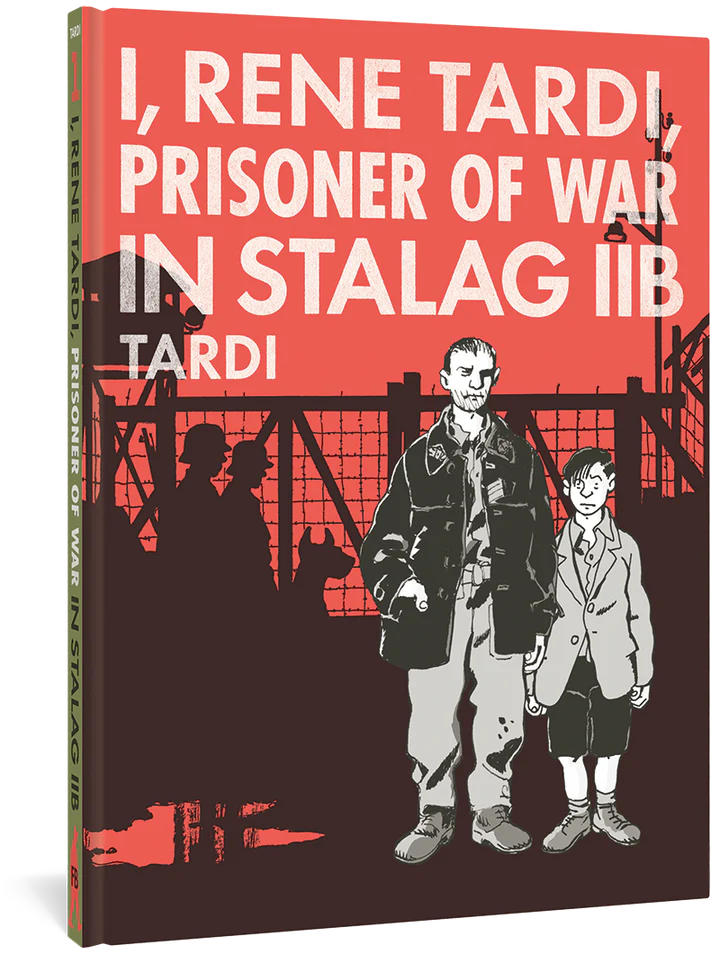
The first volume is about active combat rendered through René’s memories of tank warfare, and his eventual captivity. Rene spends years in POW camps enduring starvation, forced labour, and brutality. He maintains a detailed journal throughout his years there, and records the sheer monotony of deprivation, which in itself becomes a kind of horror.
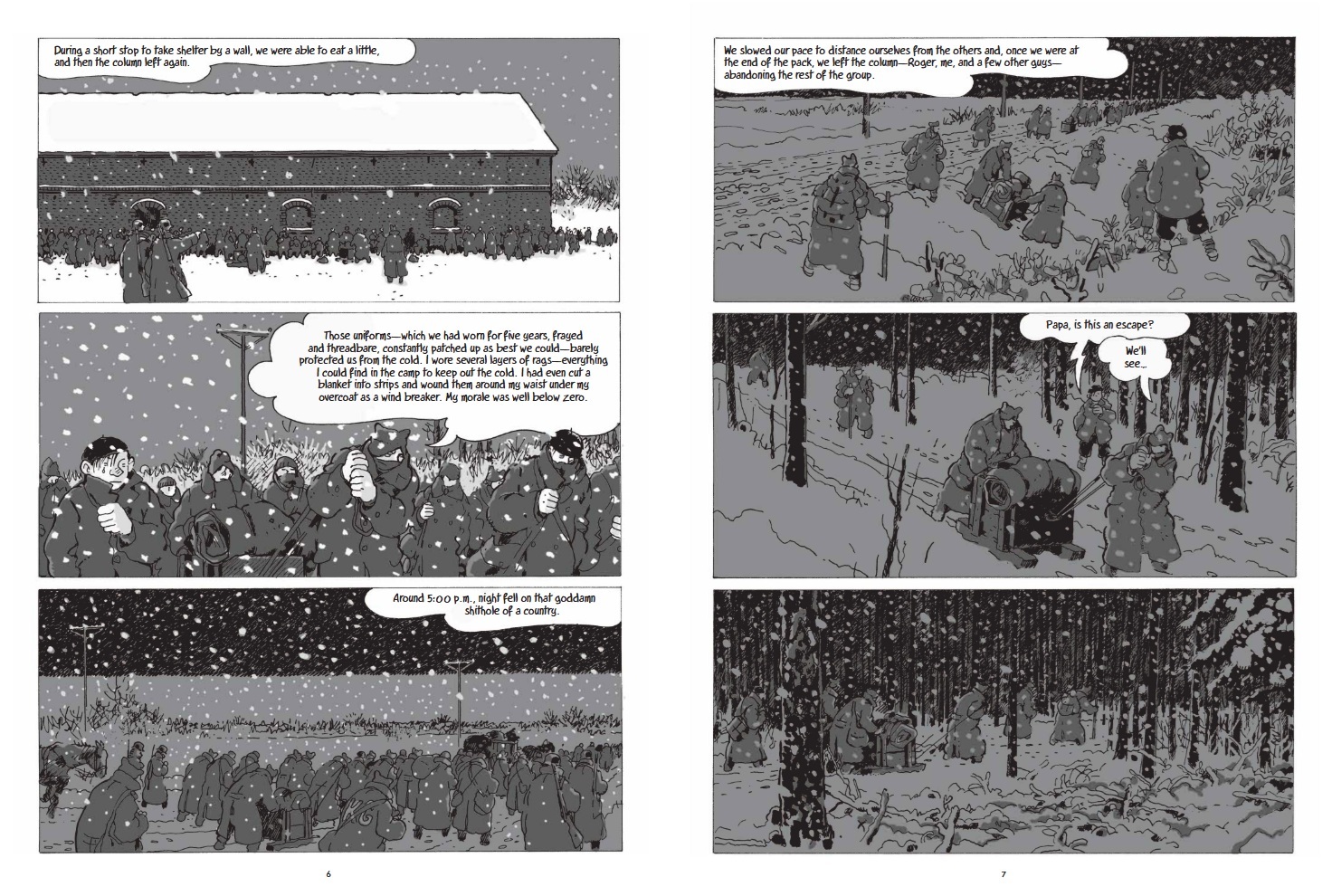
In the second volume liberation is close but René and his fellow prisoners are dragged across Europe by the Germans, desperate to maintain the illusion of control. Even as Germany falls apart around them, German authorities continue to hold absolute power over them by striking fear and withholding basic necessities.
By the final volume, the focus shifts towards the aftermath. René manages to return to civilian life but his family sees a completely different man. His assimilation is painful and emotionally fractured with frequent angry outbursts and general moodiness. The war has not ended inside him. His return to Germany during post-war reconstruction introduces Jacques himself more fully into the narrative. Until then, Jacques had shown up on the pages as a listener and commenter as he carefully reconstructed his father’s recollections of military service, imprisonment, and post-war existence. In a quirky, effective move, Jacques inserts himself into the narrative as a schoolboy questioning, listening, wondering out loud, and commenting on René’s anecdotes.
War memoirs are often wrapped in glorious ideas of heroism and sacrifice. Tardi strips all of that romanticism away to show the constant hunger, utter humiliation, soul-deep exhaustion, and the neverending struggle of survival. “It’s not like in the movies! It’s a lot less fun!” Jacques interjects at one point. Such observations elevate René’s oral storytelling style to make the reader feel included, and nod along to something you agree with too.
There’s also a self-awareness that Jacques brings to René’s narrative. In one panel, as Rene describes a deathly march through forests in lashing rain and muddy roads, Jacques asks, “What are the Einsatzgruppen?” Rene explains that they were death squads that killed “Romanis, escaped Russian prisoners, hostages, partisans hiding in the woods, and Jews, of course.” In the next panel, Jacques asks how he is aware of it, and Rene says, “At the moment I’m talking to you, I don’t know about it. It’s much later that I’ll read books about it.”
In this way, very cleverly, Jacques manages to place René in the moment and also endow him with knowledge of the future.
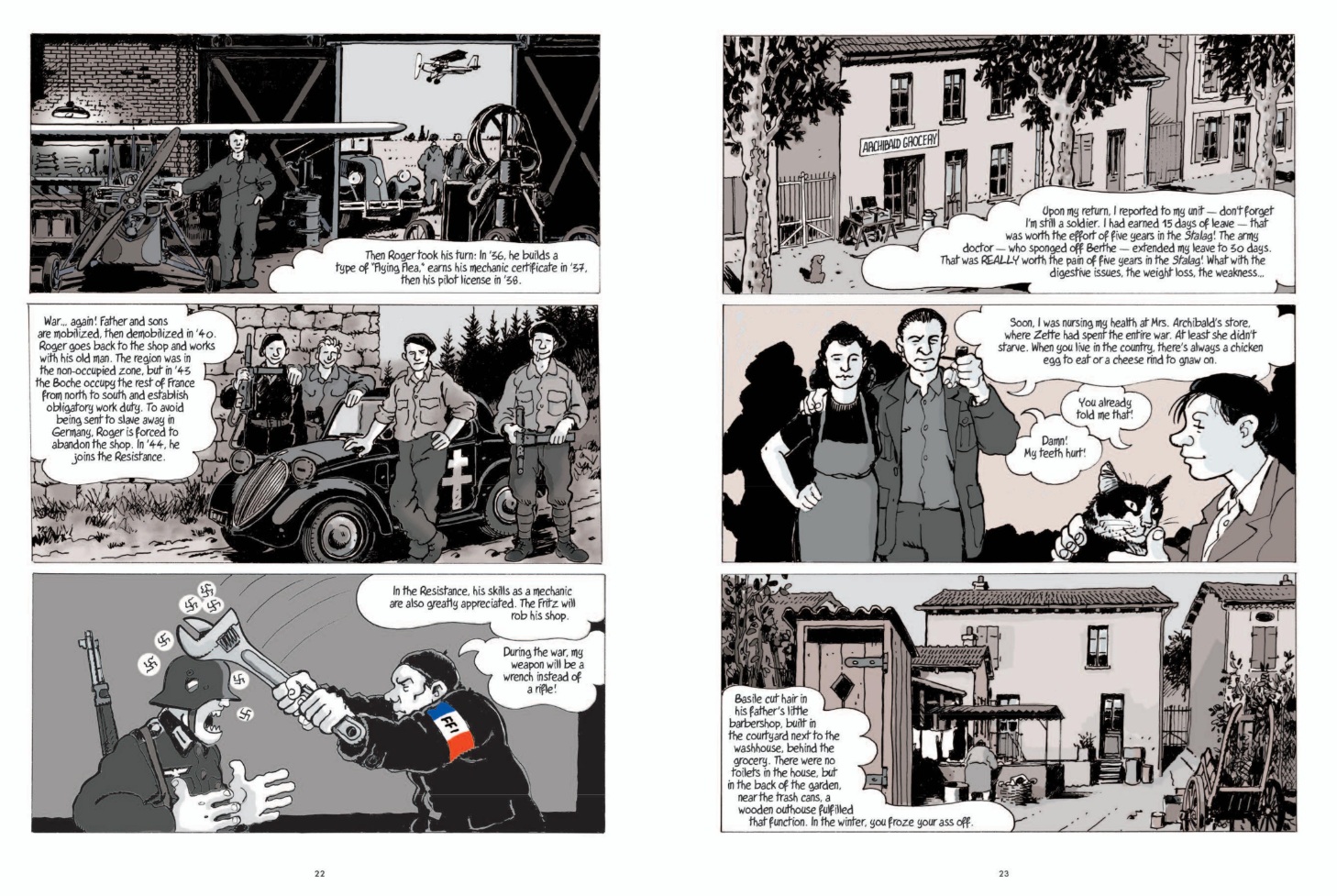
Jacques also preserves René’s feelings and attitudes through his wry, cynical voice brimful of contempt for the Germans. René is stubborn, weary, often emotionally inaccessible, deeply influenced by his experiences. Jacques’ unique manner of telling René’s story also allows his character to breathe to the full extent possible.
René’s recollections are filtered through notebooks, conversations, and emotional residue. Tardi never pretends this reconstruction is objective truth. Instead, the work acknowledges the instability of remembrance. At one point, Jacques says – “Papa, you made it to this little village – Siedenbollentin – on February 17th. You left on March 1st at 4:00, you write. 4:00 a.m. or p.m.?…You don’t specify in your notebook…”
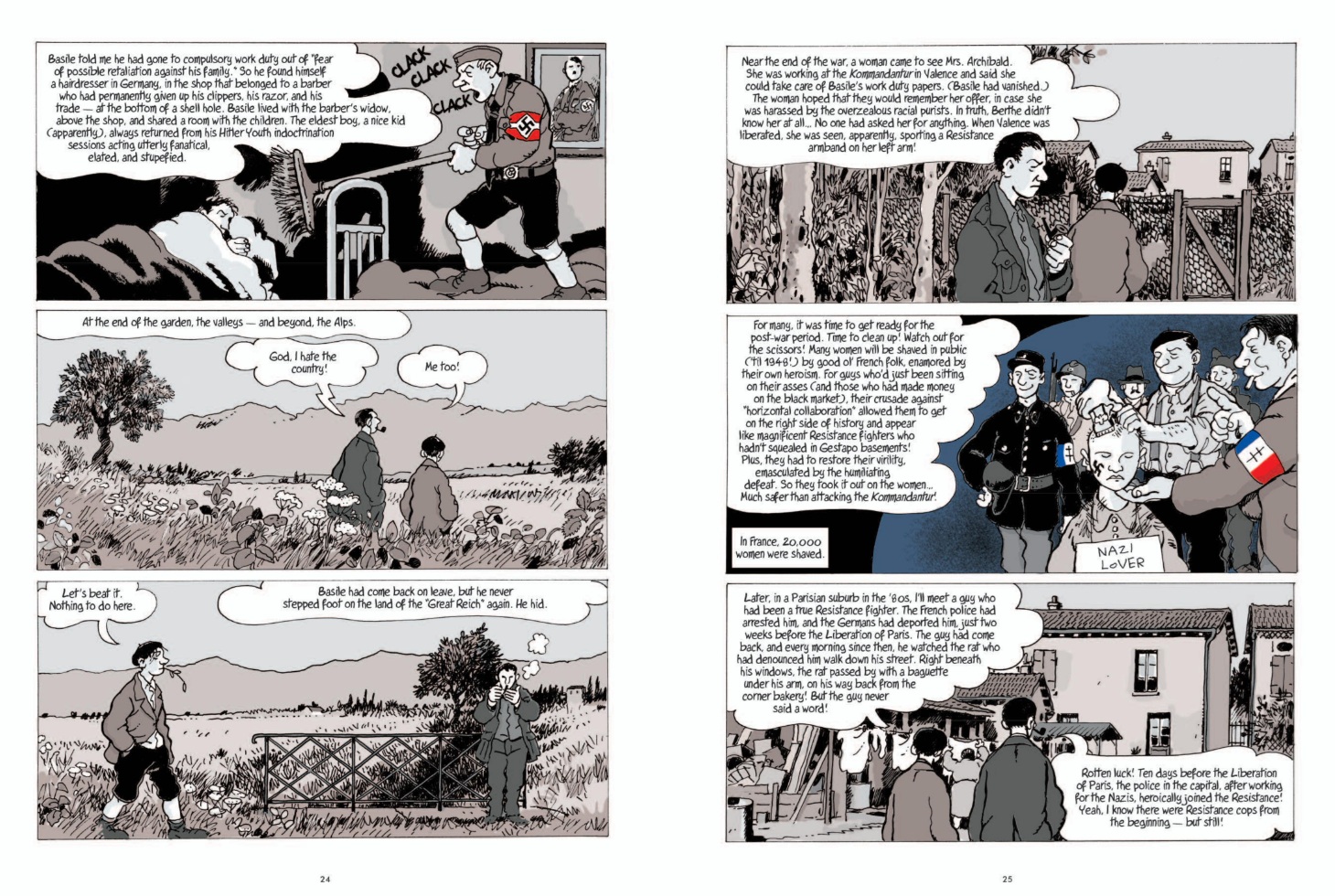
Visually, Tardi’s colour choices supplement his words. He imbues all his panels with a monochromatic, cold grey to evoke decaying photographs and wartime newsreels but without the warm sepia that induces sweet nostalgia. The sparse introductions of colour come later in the trilogy only to indicate the few emotionally charged moments.
Very few graphic works attempt something this ambitious, and even fewer manage to successfully sustain momentum and reader interest. Tardi achieves this fine balance and the result feels less like reading a memoir and more like sitting across from someone determined, finally, to tell the truth before it disappears with them.
Jacques Tardi (W/A), Rachel Tardi (C), Jenna Allen (T) • Fantagraphics Books, $29.99 each
Review by Swati Nair