

PRIDE MONTH 2026! It’s time for the second of this year’s Pride Month interviews to go up as we chat today with webcomics creator LJ Nakamura. LJ discusses intersex representation in comics, the particular challenges of building an audience in webcomics, and what to expect from sci-fi infused series Spirelle…
ANDY OLIVER: One of the aims of our Pride Month interviews is to introduce featured creators to a greater readership so let’s start by asking you about yourself, your creative background and your route into comics?
LJ NAKAMURA: Sure! My name is LJ Nakamura and I’ve worked as an illustrator and writer for several years. Prior to that, I was part of various private companies that offered combat support in unstable local areas or situations. But comics have always been my first love. They’re a unique art form, one which provides a way to tell stories varying from superhero tales to autobiographical ones. I’ve been lucky enough to work with some great publishers and writers. I also publish my own comics online.
Spirelle
AO: Your two comics projects to date are very different in terms of genre but are connected in some of their subject matter. Why are comics as a medium such a connective one for you in exploring themes of intersex experience?
NAKAMURA: I had a number of upcoming projects killed by publishers because they were suddenly seen as “too queer.” A lot of countries shifted to a more conservative outlook and that impacted on getting work out there. Having an intersex character also made some higher-ups uncomfortable because it’s something that’s not well understood and there are few narratives about it. I’m not a fan of stories being reduced to products so I decided to create and self-publish the queerest sci-fi comic I could XD It turned into my online comic, Spirelle. One of the main characters is intersex and that’s a big part of the story.
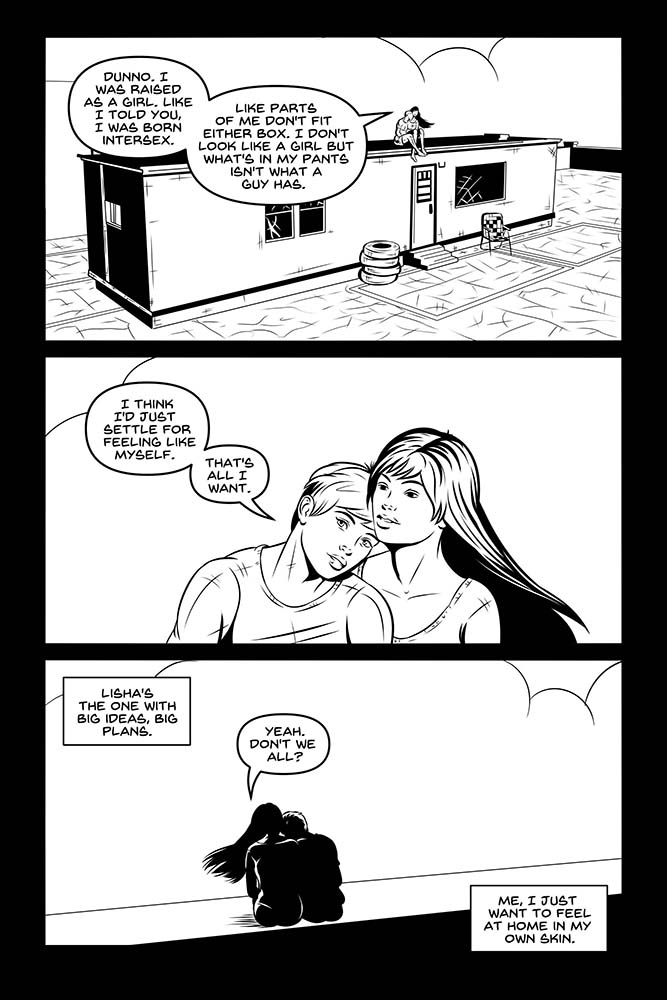
Spirelle Prequel
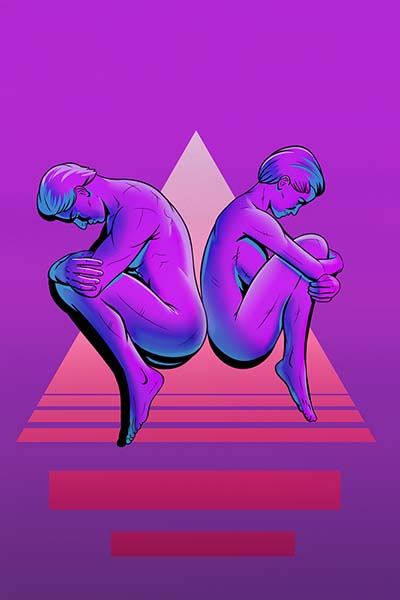
With my other comic Intersex: Between the Currents (due to be published by Oh Joy Sex Toy), I wanted to showcase the experience of navigating life with a body like mine. There’s no universal truth or experience when it comes to being intersex so all I could do was share part of my personal experiences. Not everyone uses the term “intersex” but I personally prefer to use it, largely because it’s most commonly understood in my country.
AO: What’s the premise of your webcomic Spirelle which features an intersex protagonist? And how does it link into your Iron Nail Afternoon story?
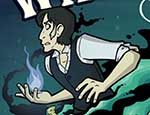
Spirelle is about monsters and the people who make them. Who sell them. Who fight them. It’s set in a world where vat-grown creatures are sold to the highest bidder and used as weapons. The story follows a largely queer cast who are all part of this world. It also features a character with an intersex condition similar to mine.
Boy or girl? No one seems to know when it comes to Jackie Kaiser. Not his mother, not the doctors, not the army. After years as a soldier, an injury throws Jackie into the world of illegal biotech and into the arms of a genius gangster….who just happens to be one of the people who makes monsters for a living.
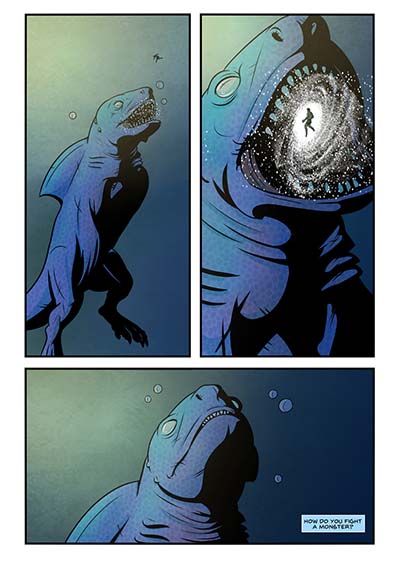
Iron Nail Afternoon
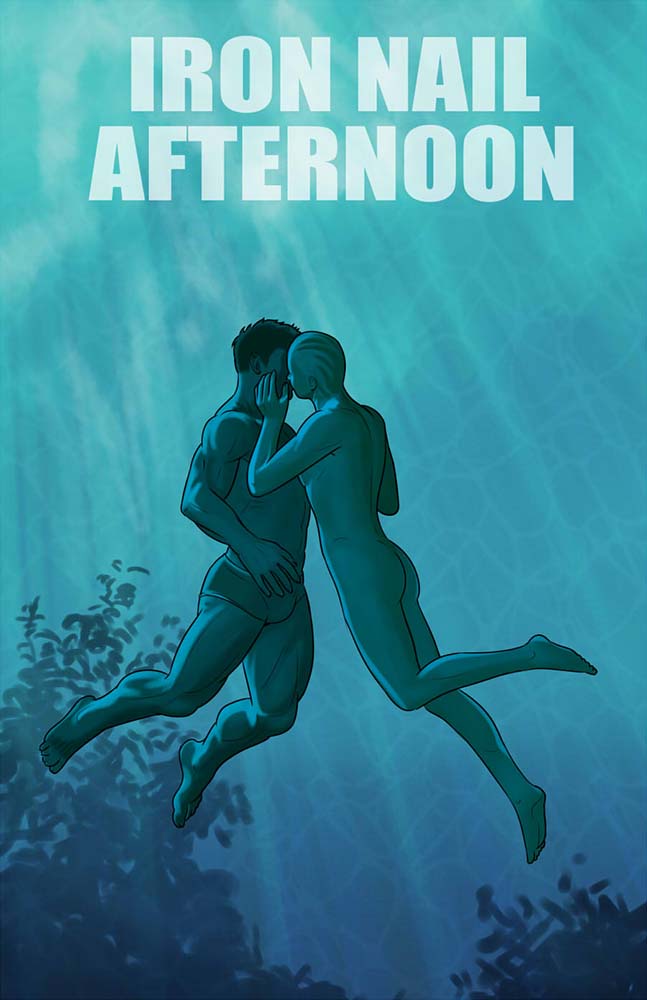
Iron Nail Afternoon is the flip side of Spirelle. Spirelle is all about found family and science gone wrong. Iron Nail Afternoon is more fantastical and takes place in a dimension where magic is the norm. They intersect at times because the characters can pass between the two different worlds, causing chaos in both!
AO: Why, for you, does science-fiction style storytelling work so well as a vehicle for elements of social commentary?
NAKAMURA: Writing a sci-fi story like Spirelle gives me a little more of an emotional barrier, even if Jackie has to deal with being misgendered or Morgan has internalized homophobia.
And sci-fi is a bold genre – themes can be magnified through pulp elements 🙂 A character like Vermeer with a complex identity is literally split into two different bodies, one male, one female. Jackie’s medical abuse (something commonly experienced by intersex individuals) is embodied by a bio-implant that was put into him by the army and which later malfunctions. Metaphors in pulp science fiction can be bright, big, physical. It’s very liberating to write!

Spirelle
AO: As mentioned, you have an upcoming short comic via Oh Joy Sex Toy which is more directly personal in its take. How important a part of your practice is bringing intersex lived experience to a wider audience?
NAKAMURA: Unfortunately, I’m currently dealing with chronic health problems (due to a clinic mishandling my intersex condition with the wrong medication.) So taking on a hands-on role in activism isn’t an option for me anymore, at least not for the foreseeable future. But I can still draw and write.
There is no singular or correct intersex narrative or queer narrative. My work incorporates elements of my own life and that of certain friends but it doesn’t speak for everyone. Hopefully, if someone likes my work, they’ll also consider reading the fine work produced by other queer creators. It’s out there!
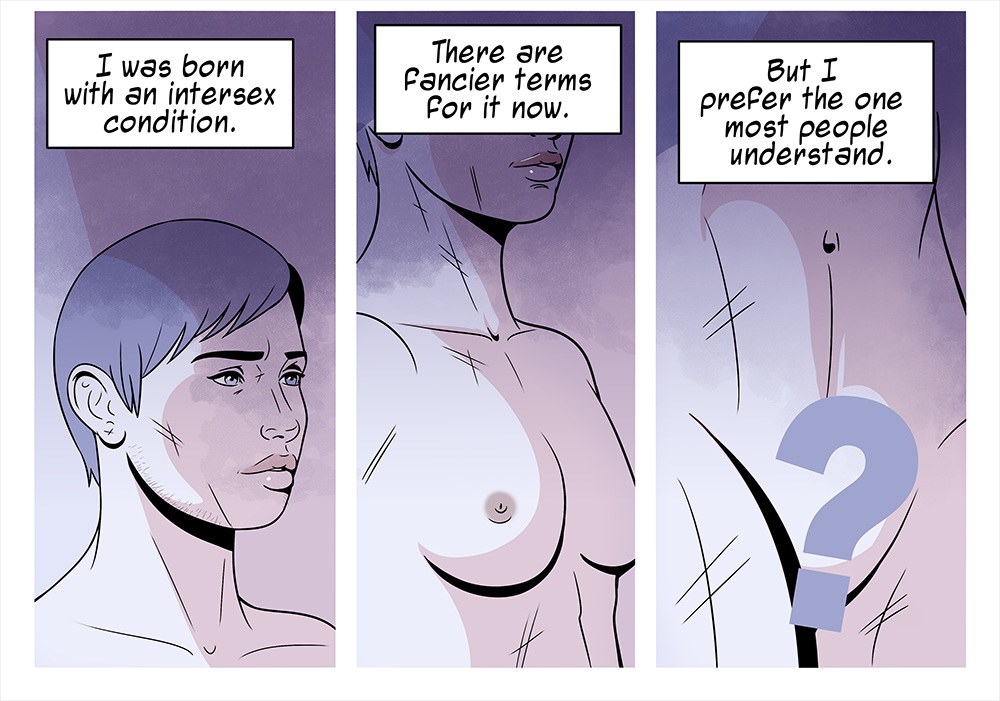
Between the Currents
Between the Currents wasn’t an easy comic for me, especially when it came to revisiting things like having undergone non-consensual “corrective” surgery. But I’m glad it’s out there and very grateful to Oh Joy Sex Toy for greenlighting it and for the support of my awesome editors there, Matthew Nolan and Ziggy.
AO: Your art has such an appealing clean line to it. Can you expand on your creative process and the mediums you work in?
NAKAMURA: Thank you! I used to work in a studio that insisted on doing everything on paper. No tablets allowed! It was tedious at the time but good training in the long run. I’m a bit of an inking devotee and like the black-and-white version of a page to hold up on its own, even without the addition of coloring. I currently work on a fairly old-fashioned Wacom tablet and use Paint Tool Sai. I’ve been told that my set-up is pretty basic but it gets the job done. I do layout then loose linework (the equivalent of the pencils stage for me) and then normally the final, tighter inks. That’s my black-and-white process. If there are going to be colors, I add those in last, using either Sai or Clip Studio.
AO: Webcomics are very different in their incremental updating than other forms of comics storytelling. What are the particular challenges of that method of delivery in terms of maintaining and building an audience?
NAKAMURA: The biggest challenge is reaching an audience in the first place XD Especially since I can’t publish most of my comics on platforms like Webtoons or Tapas, which have in-built traffic. My work has some mild mature content that wouldn’t be welcome on those platforms. But apart from that, the key part of publishing online is to provide some sort of pay-off or a narrative hook every few pages. At least in my opinion. I’ve found that brings people back to the story.
AO: And, finally, what’s next from you in comics? Are there any other upcoming projects you can talk about?
NAKAMURA: Well, more Spirelle obviously 🙂 I’m getting to the point where there are going to be enough pages to put together a graphic novel of the first story arc. Hopefully, I can find a publisher for it and release that in 2027 or so. There’s also a Sink one-shot coming out from ComixTribe, written by the talented James Fairlee and illustrated by myself with lettering by Shawn Lee. As a huge fan of John Lees’ Sink and the ComixTribe work in general, I’m very excited about it.
Check out all our Pride 2026 coverage in one place here
Interview by Andy Oliver