

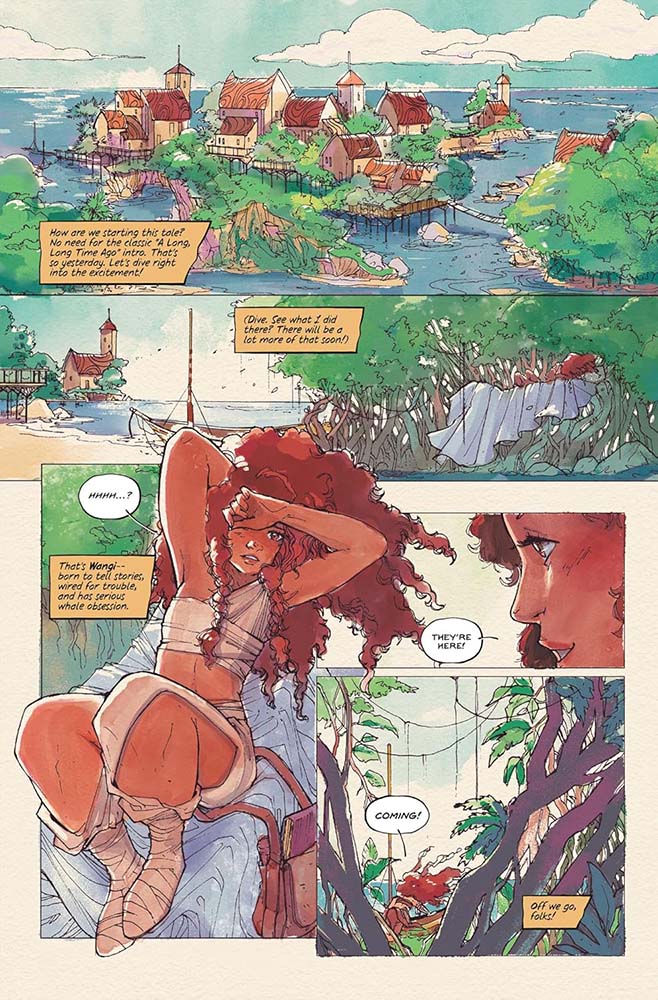
The Girl Who Draws on Whales is an environmentalist story set in a futuristic flooded world. Wangi, the lead character, lives on an island which is visited every year by a pod of whales. She has a special relationship with the pod leader, a whale called Maaha. Maaha (who is gender-fluid) allows Wangi to draw colourful illustrations all over them – hence the title of the book – and the two of them are also able to communicate – “Wangi and Maaha don’t really talk the way you and I do. They speak in tides and poems.”
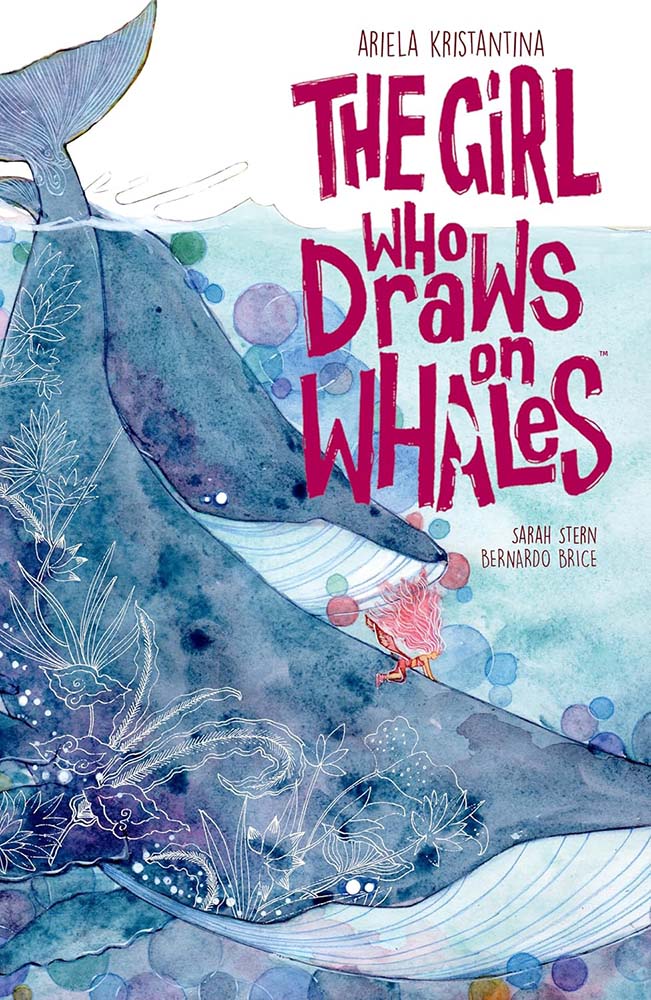
A lone whale-calf arrives at the island, covered in wounds all over its sides and back. When Wangi attempts to heal these wounds, she also discovers that it has been decorated with a map, and that it carries a poem-message from Maaha, urging her to undertake “A journey perilous, where angels fear to tread” in order to find out who is responsible for the injuries. Despite the warnings of the village elder (who thinks that the islanders should avoid all contact with the outside world, in order to keep themselves safe), Wangi sets off to sea with her brother Banyu.
There follows a series of adventures involving a giant sea-turtle, an underwater city ruled by a mer-queen, a jellyfish forest, a giant sea-serpent, and a flying pirate ship with wings. It turns out that there is a new threat to the ocean-world, and only Wangi has the power to avert it – as the mer-queen explains, “A new island breathes fire now – Kala Api. Somehow, you hold the unifying power to fight back.”
The plot of The Girl Who Draws on Whales doesn’t bear too much close examination. When Wangi and Banyu set off on their quest, they don’t seem to be going in any particular direction – they simply launch themselves out to sea in a boat, find themselves in a storm, get picked up by a giant sea-turtle, and from that point onwards they’re on a conveyor belt of events which carries them through the rest of the story. But the rapidity with which the narrative unfolds, the way it transitions from one situation to another, is one of its main attractions, even if the plot developments seem random at times.
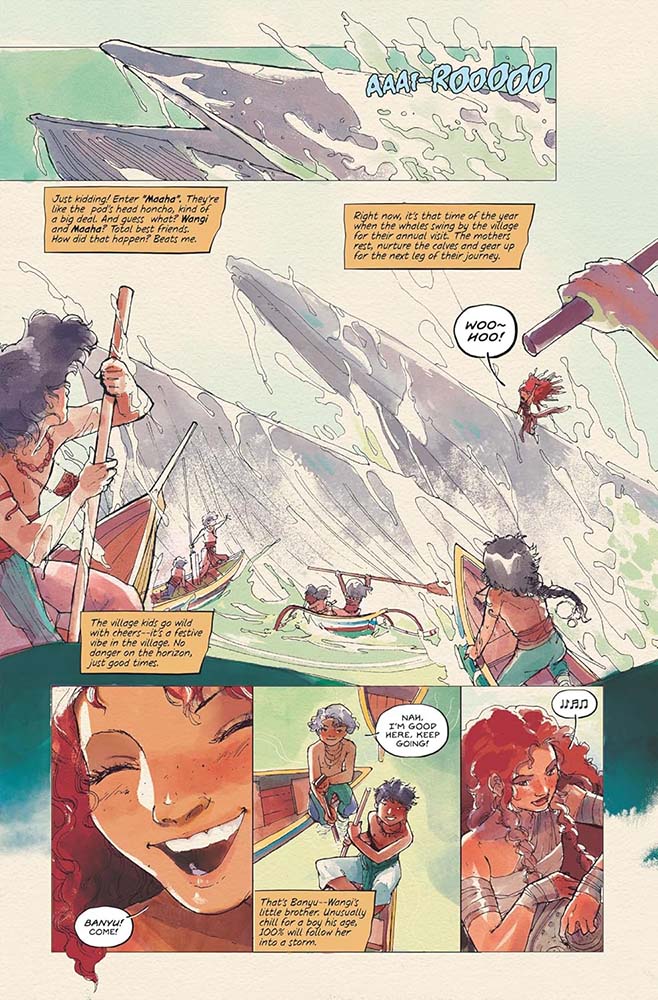
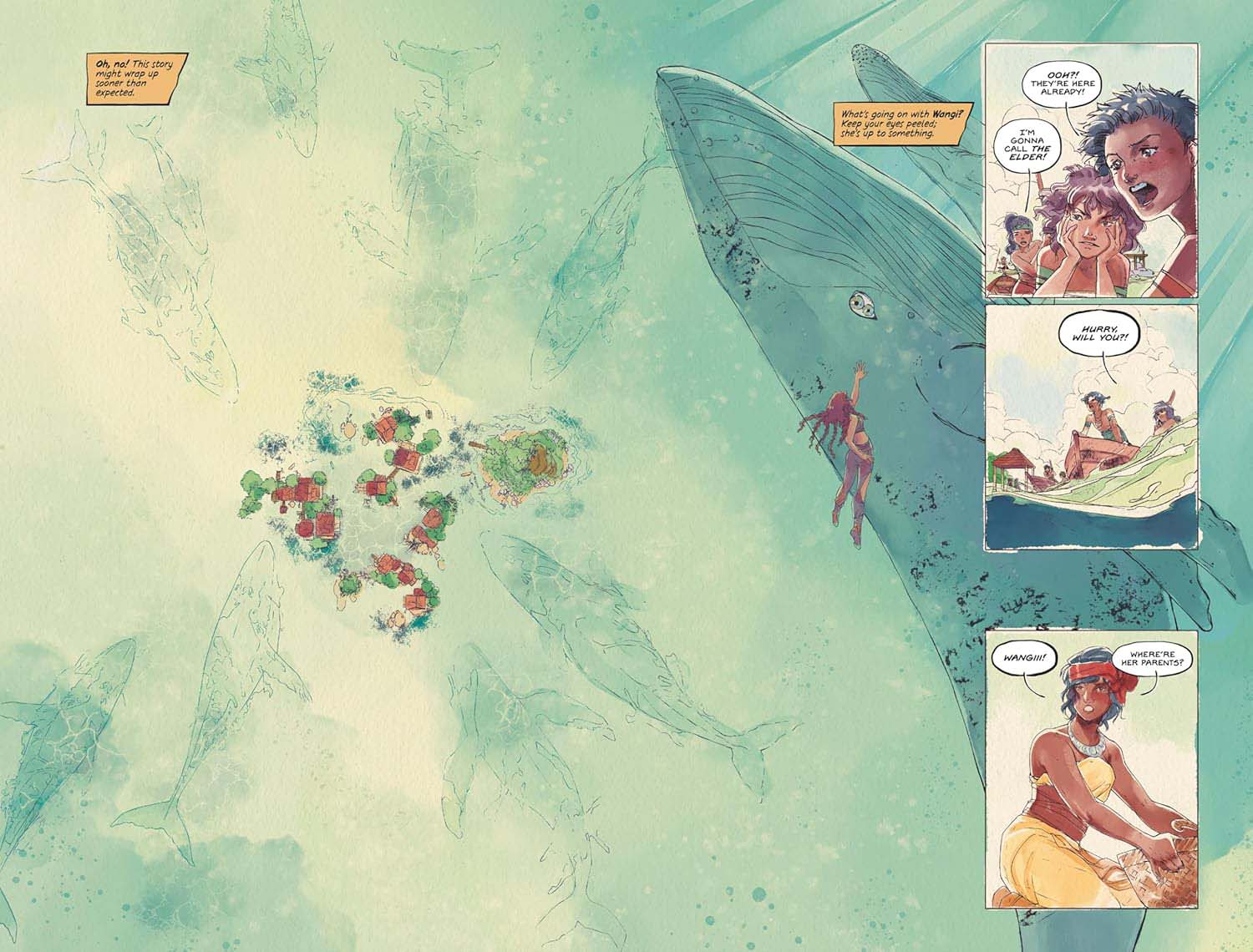
The biggest attraction of The Girl Who Draws on Whales, however, is its visual design. The colours are sumptuous, especially the blue-greens of the oceans and sky. There are several spectacular double-page spreads, with smaller panels overlaid on top of big background designs. There’s clever use of different text styles to convey different voices: human speech in conventional speech balloons, Maaha’s voice in white lettering surrounded by black, and narration (which comes from a boy called Citra) in brown parchment-style captions.
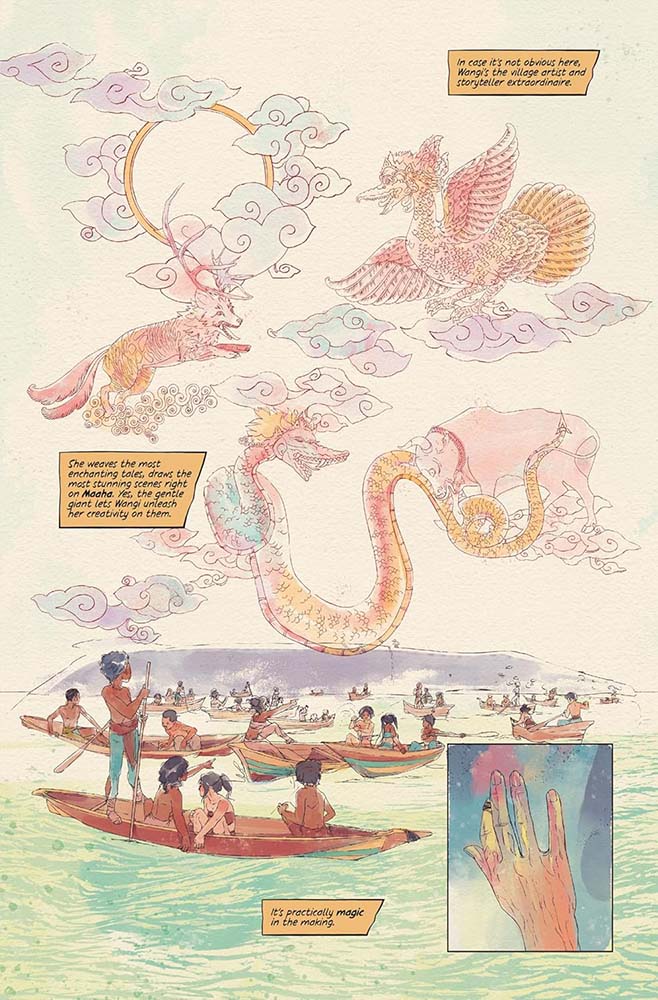
At times things get wordy: there are long explanations strung together in speech balloon daisy-chains, and it isn’t always clear in what order these daisy-chains are supposed to be read; but even when this is the case, they’re always arranged on the page so that the visual design maintains a sense of rhythm and balance. And the artwork is uniformly excellent, detailed without being cluttered, especially the whales and the pirates’ flying ship.
Wish-fulfillment narratives in which the central character turns out to be endowed with special powers, and the only one capable of saving the world from impending doom, are fairly clichéd by now. But The Girl Who Draws on Whales moves along at such a pace that the story never feels tired, and it’s enough of a visual feast to make the plot-holes seem relatively unimportant.
Ariela Kristantina (W/A), Bryan Valenza (C), Bernardo Brice (L) • Dark Horse Comics, $22.99
Review by Edward Picot