

PRIDE MONTH 2026! Pride Month at Broken Frontier may be drawing to a close but it’s also overlapping with the beginning of our summer spotlight interview series with this year’s BF ‘Six to Watch‘. The first of the six to chat with us today is Jua OK! who talks about their spiritual exploration of trans identity in Road to Chimera, LGBTQ+ community work, and the challenges of building a profile in the arts when the social media landscape is so fractured…
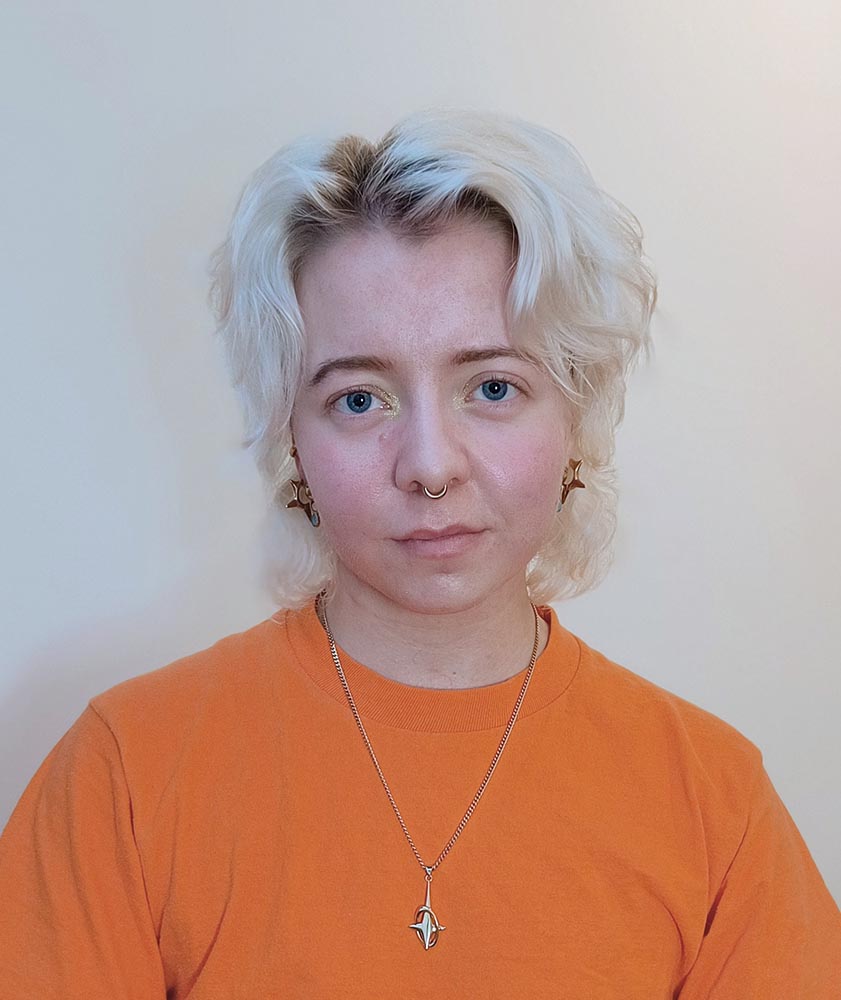
ANDY OLIVER: Our opening question for our ‘Six to Watch’ creators is always about introducing them to our audience. So can you tell us a little bit about yourself and your creative background to begin with?
JUA OK!: I was born in Belfast and I’m of the ceasefire generation, where I never actually witnessed the war in Northern Ireland but grew up as the country was finding its feet post-conflict. Coming into myself as a trans person in a place where politics, religion and violence were all so tightly intertwined has had a lasting impact on my artistic interests and creative practice.
I went on to study illustration BA and MA at Arts University Plymouth and have lived here ever since. We have a great creative scene here and I’m lucky to be surrounded by many amazing comic artists who are of constant inspiration to me. I wear a lot of creative hats beyond comics – I’m an illustrator, designer, ceramicist and painter among other things.
AO: What was your entry point into comics?
JUA OK!: I began reading manga in my teens, then western comics. I started self-publishing autobio comics on Tumblr in the mid 2010s. I felt very isolated in my day to day life, was closeted and had no community around me. Putting my work online felt like screaming into the void, so I was moved when people actually responded and connected with it. I used to spend hours reading the tags and notes people left on my work. Since then I’ve always been drawn to comics as a vehicle for personal narrative. I find that through combining words and images I am able to communicate things that neither medium can accomplish by themselves.
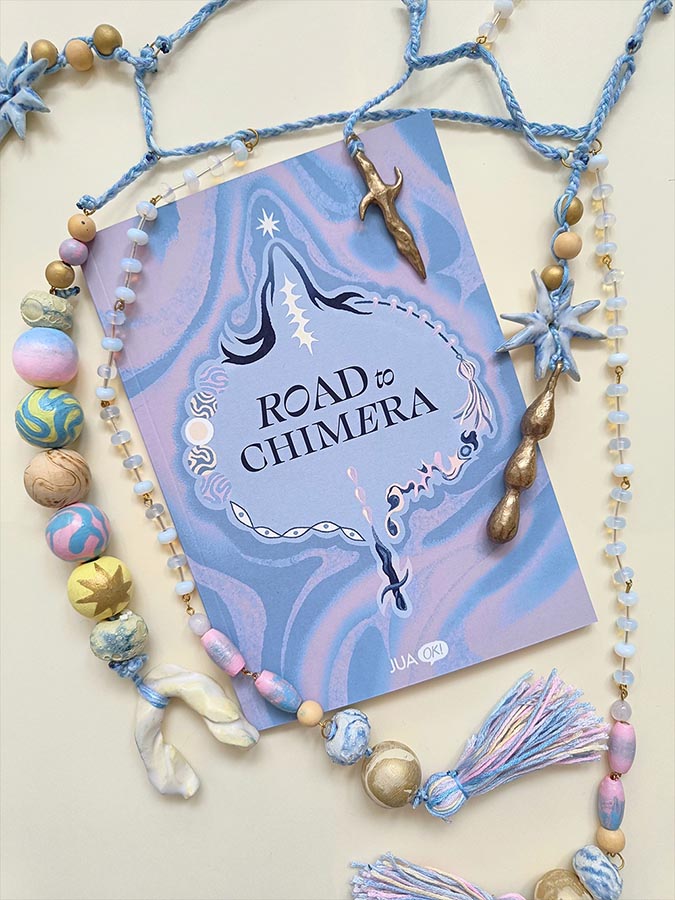
AO: Last year at Broken Frontier I reviewed your comic Road to Chimera calling it “a powerful and expressive use of visual metaphor”. For readers yet to pick it up can you give us an idea of the premise of the comic and the themes it explores?
JUA OK!: I had a gender-affirming double mastectomy (more commonly referred to as ‘top surgery’) in 2023. In the final module of my masters degree I used my artistic practice as a vehicle to process the experience, and out of that work grew the story of Road to Chimera.
The story follows a person marked with a strange curse as they embark on a pilgrimage to a nearby mountain that is calling out to them. While travelling, they meet a variety of characters who help them to understand the nature of their “curse” and what the pilgrimage will mean for their future. While written from a trans lens, ultimately it is a narrative about having to face and reckon with uncomfortable truths about ourselves, and I think that’s a pretty universal human experience.
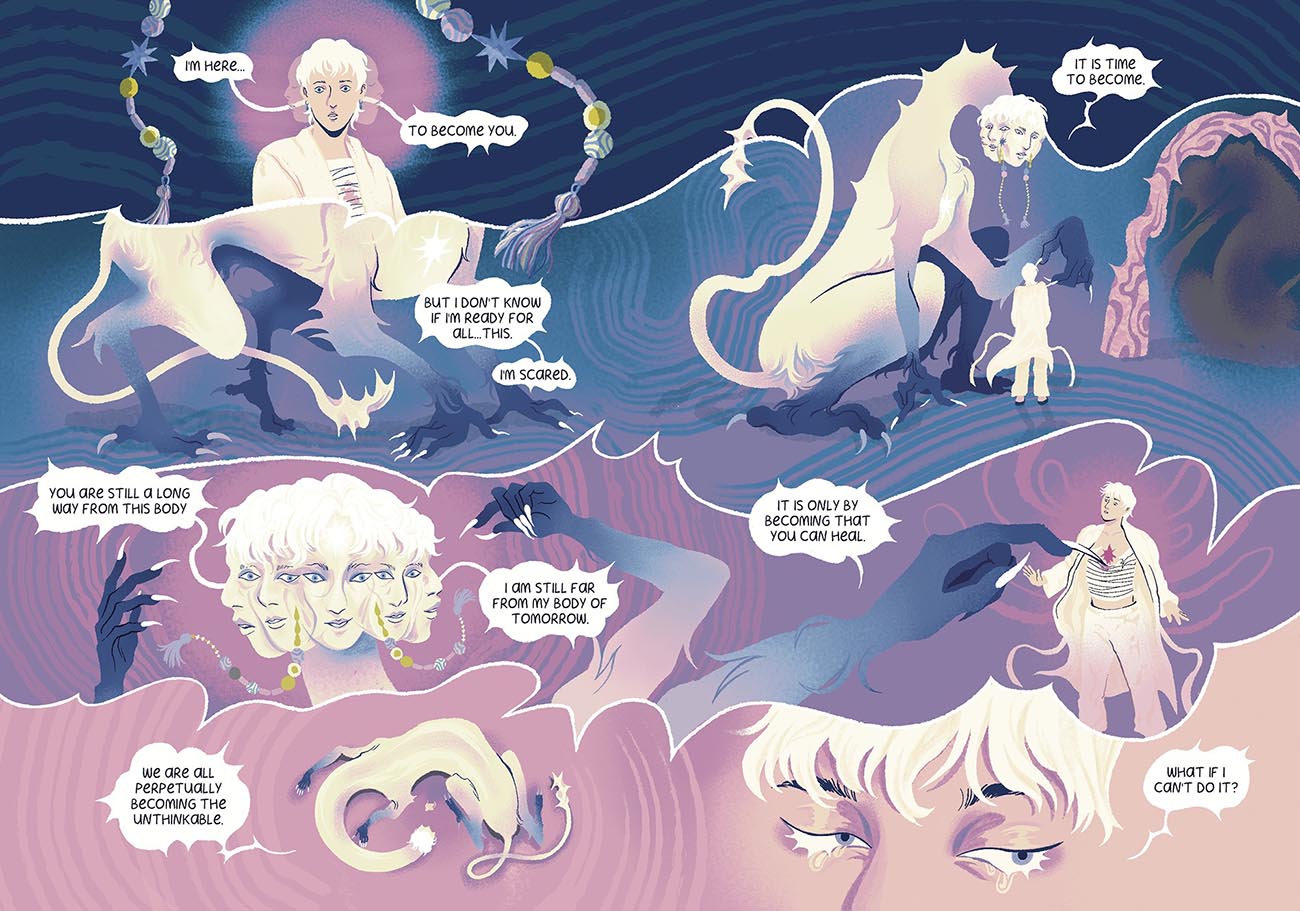
AO: Obviously there’s a very spiritual element to Road to Chimera with the story employing that more allegorical form of presentation. Why did you choose to express and celebrate trans lived experience on the page in that more symbolic way?
JUA OK!: There is a misconception that trans people are a modern phenomenon. When I was beginning to reckon with my own gender I discovered that third gender people have existed in various cultures across human history, and that in many cases these individuals held spiritual roles in their communities (like the gala priests of Sumer or two-spirit healers in various Indigenous American tribes).
Trans people are facing pronounced challenges to our rights across the world right now. Our very existence and presence in public life is a topic of constant heated debate. In the face of that cruelty, I find great comfort in reminding myself that I am part of a spiritual tradition stretching back thousands of years. I wrote Road to Chimera primarily for myself, but it was always my hope that it might help other trans people find spiritual meaning in this journey, as well as broadening how cisgender readers conceptualise transness.
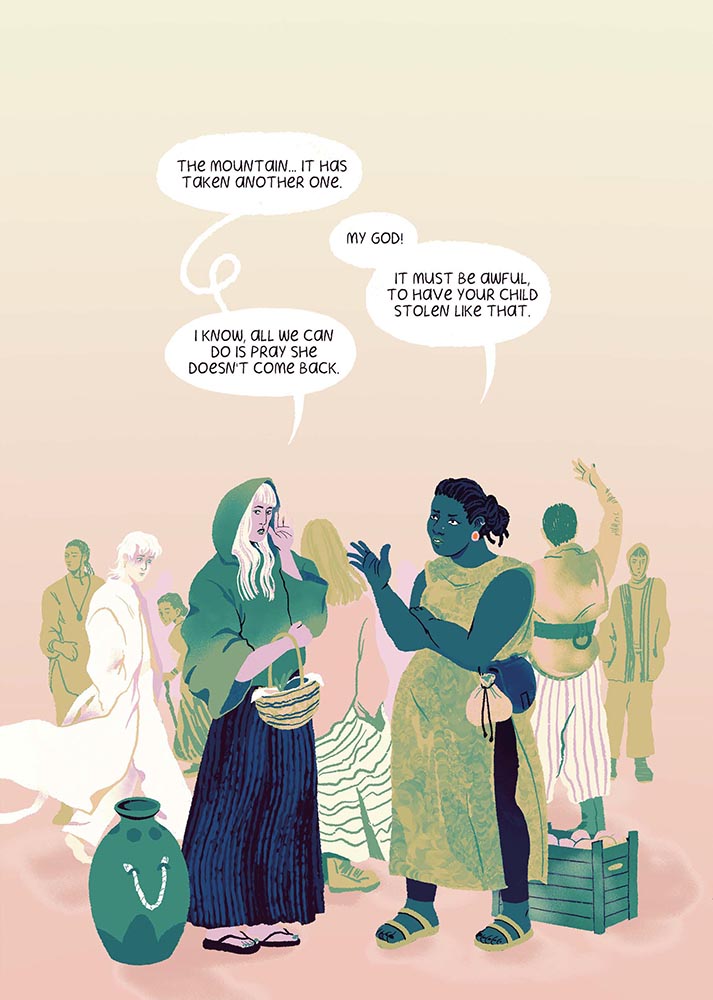
AO: You incorporate physical artefacts into the narrative in Road to Chimera so I’d like to ask you about your thinking there in terms of how that inclusion of other sides of your practice feeds into the story?
JUA OK!: During my masters studies I was preoccupied with David Burrows and Simon O’Sullivan’s concept of ‘fictioning’, where creative practice is utilised to create or anticipate new modes of existence. So in creating this spiritual narrative and framework it was important to me that it felt tactile and anchored in the physical world, because I’m not trying to tell a story so much as do what O’Sullivan describes as “fictioning as mythopoesis: the imaginative transformation of the world through fiction.” [Simon O’Sullivan, Art Practice as Fictioning (or, myth-science), p.6-7)
Growing up in the Catholic Church, I was surrounded by reverently weighty religious objects, and those objects continued to feel special to me even after I stopped practicing Catholicism. Creating artefacts that evoke a similar feeling of ethereality and protection has become something of a preoccupation in my creative practice. I find that my drawing and comics practices are fed by my ceramics practice and vice versa.
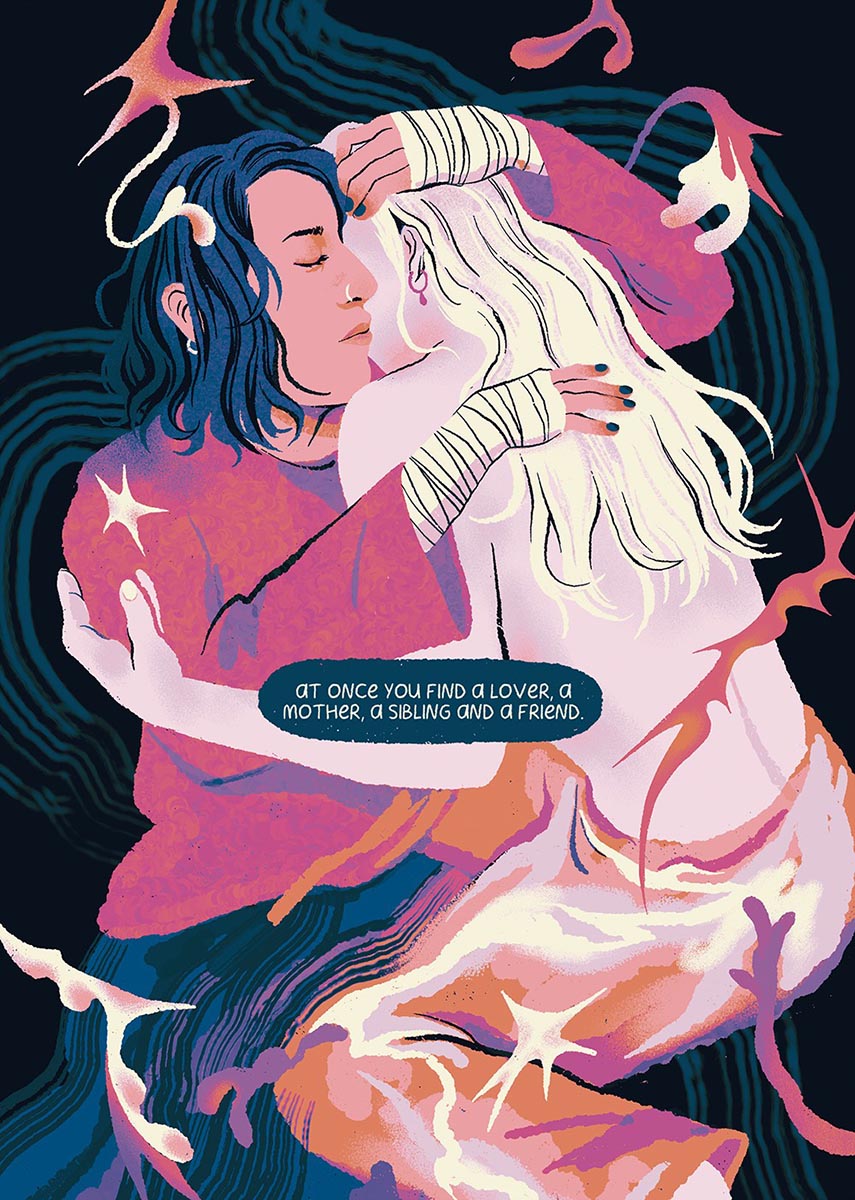
AO: More generally what is it about comics as a form for you that makes them such an empathetic and connective narrative vehicle for communicating the realities of queer lives?
JUA OK!: I read Understanding Comics by Scott McCloud and Opus by Satoshi Kon while studying my BA, and became fascinated with how the structural fundamentals of comics (panels, gutters, etc) create a self-contained metaphysical rubric which an artist can then choose to break or subvert for narrative effect.
This is very appealing to me from a queer-lens. At the time I was working on a comic pitch about a non-binary model whose body would change across the pages of the comic based on how other characters perceived them. It’s the kind of story which would never work in live action, you’d cast a real person and have to work around their actual gendered features. But in a fully illustrated medium, the body is transformable without limit.
There’s also a personal intimacy to comics. It’s totally feasible to write, draw, letter and distribute a comic yourself, it’s much less easy to have all that personal control in a medium like film.
AO: Your use of colour and irregular page structures give so many extra layers to the story. Can you tell us about your creative process and the mediums you work in?
JUA OK!: I created Road to Chimera under a pretty intense time crunch. I was also rebuilding my comics process from the ground up, so it was a big learning process. I knew the story needed to be told in colour and ended up using gradient maps to try and keep that colouring process as efficient as possible.
Once I have my written outline I go straight into my roughs, which tend to be pretty tight. I like my drawings best when they are loose, but it can be difficult for me to avoid tightening up when working on comics. My goal for my next project is to integrate a looser approach across my roughs and inking.
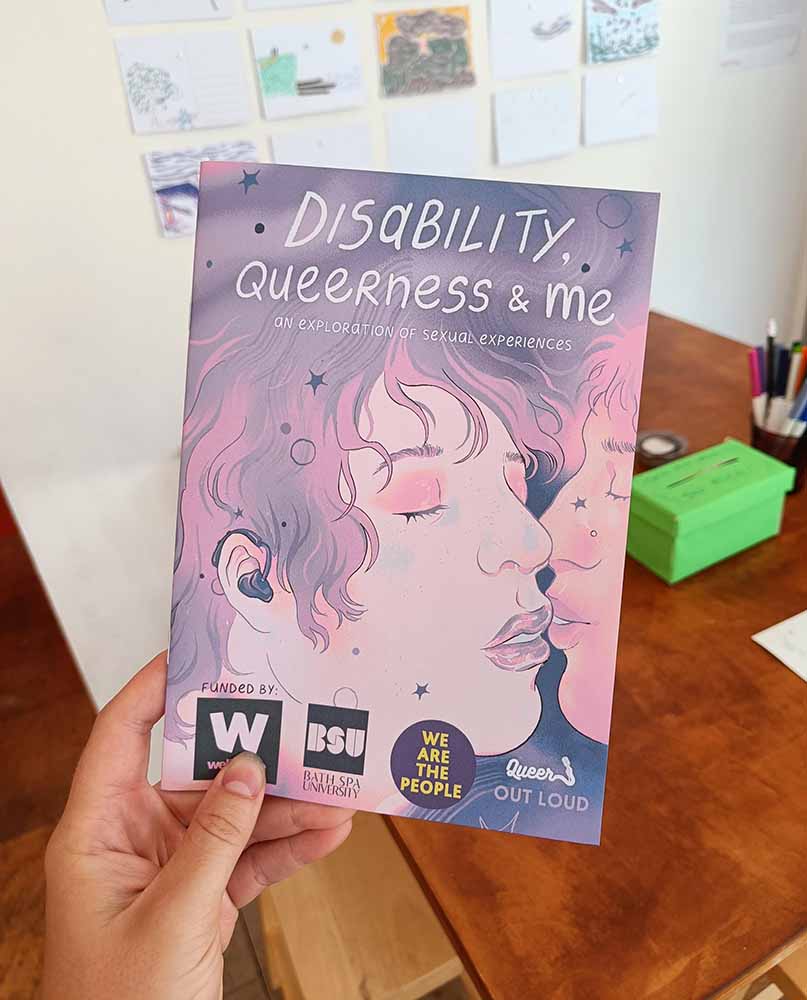
AO: Recently in comics you’ve been working on Disability, Queerness & Me: An Exploration of Sexual Experiences illustrating the findings of collaborative research between Bath Spa University, We Are The People and Queer Out Loud. How did you get involved with that project and can you elaborate on its aims?
JUA OK!: I do a range of LGBTQ+ community organising here in Plymouth, so I was already connected with Queer Out Loud. They reached out to me while in the process of securing funding for the project asking if I would be interested in being involved.
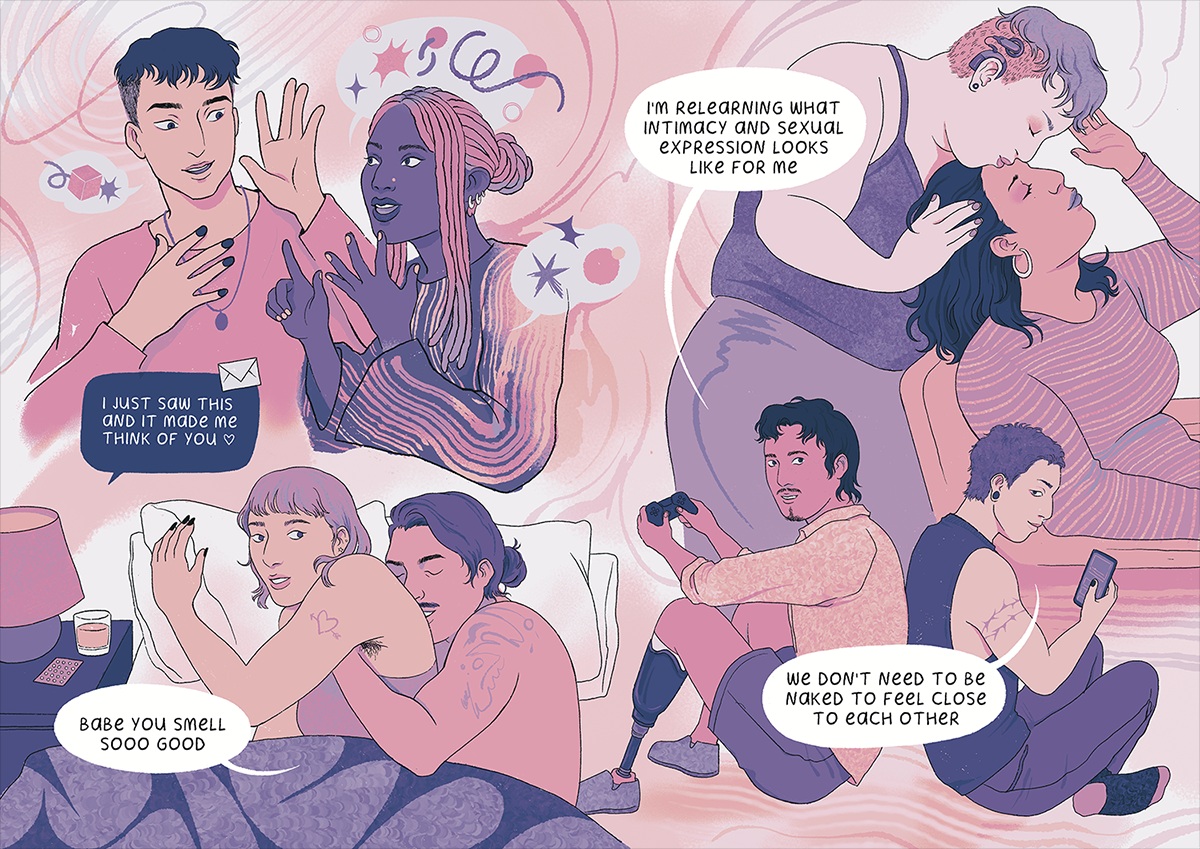
Research into the experiences of marginalised communities too often treats them as subjects to be studied rather than people to be collaborated with. It was important to the team that alongside producing an academic paper, the research findings should also live in a format that would be accessible to the average queer disabled person – and a comic is perfect for that! As the artist, I had to strike a balance between representing some of the very difficult and at times dehumanising experiences that participants reported while also creating a comic that felt uplifting and ultimately empowered its readers.
I would love to see more academic research utilise comics as a format for disseminating their findings, so far we have had a really positive response to this project.
AO: Your recent zine Caverns had a very different approach to its presentation. What were you looking to achieve narratively with such a tactile format?
JUA OK!: With Caverns I was challenging myself to try a looser approach to sequential image. The particular zine fold I utilised has various hidden pages and designed the zine so that the process of reading it would mirror the central character’s exploration of this cavernous labyrinth. I’m hoping in my next comic I can find the sweet spot between this spontaneous playful approach and the more rigid planning I undertook with Road to Chimera.
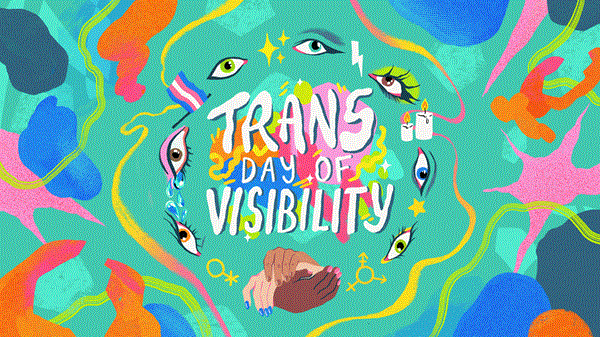
Jua’s design for Facebook’s social media channels for Trans Day of Visibility, art direction by Heron Bourke
AO: As an emerging artist on the comics scene what have been the main challenges of getting your work seen by wider audiences? Do you have any advice for would-be comics small pressers?
JUA OK! Social media has changed so much even in the last five years. I find it harder and harder to reach people via platforms like Instagram. As a result, I’m trying to focus less on digital metrics and more on IRL human connection. For me that looks like cultivating my creative circles here in Plymouth, tabling at comic fairs and art markets across the UK, as well as doing community organising.
If you’re looking to break into the small press comics world, I would really emphasise the importance of finding and contributing to offline communities.
AO: And finally are there any upcoming comics projects we haven’t covered? And where can people see you at fairs and cons this year?
JUA OK!: I am currently working with partner on Hemlock, a coming-of-age horror comic that we have been stewing on for 5+ years! We’re hoping to debut it at Thought Bubble this November. I will also be at Caption Comics Festival in August, participating in the Trans Narratives and Broken Frontier Six to Watch panels.
You can visit Jua’s website here and store here for print and here for digital.
Interview by Andy Oliver