



Comics commentary is contracting online. That’s hardly a secret but it does feel like that Golden Age of blogging and countless dedicated comics-related websites is something we are unlikely to ever see again. It’s a topic we have written about a number of times at Broken Frontier, including this extensive piece last year on the subject. There are still holdouts, though, including Steve Morris’s wonderful Shelfdust site with its “One Issue at a Time” tagline neatly summarising its eclectic approach to “modular criticism”.
This year at BF we have been trying to put a spotlight on other platforms within the comics community with missions to bring strong writing about comics to appreciative audiences. Today you can read my chat with Steve about Shelfdust’s purpose, the site’s very different ethos, and thoughts on where it all went wrong for the comics blogosphere…
ANDY OLIVER: Before we talk about Shelfdust let’s talk about Steve Morris. Tell us about your own background in comics commentary over the years and your current role at Rebellion…
STEVE MORRIS: Steve Morris! That’s me! I’ve been writing about comics for something like fifteen years now. I started out writing bits for a blog, back in the days when blogs were things people wrote, and it felt like a lot of comics commentary was this dry, semi-ashamed sort of thing where people weren’t having the sort of fun with comics that I thought was possible. So I started writing strange and silly things about comics, absorbing and reflecting back out the writing I read elsewhere at The AV Club, TelevisionWithoutPity, Cracked, that sort of thing.
 From there I got picked up by Heidi Mac and wrote for The Beat, before transitioning to writing for ComicsAlliance, CBR, Publishers Weekly and a bunch of other places like that. When Valnet took over CBR I realised that I couldn’t keep living off the limited leniency of tech corps, so I set up a newsletter with Megan Purdy and Christian Hoffer called The MNT, which hired a lot of terrific writers to submit paid-through-Patreon articles which we’d publish once a month and send out to subscribers. That then led to Shelfdust, my current website!
Separate to all that I had a day-job, because everybody in comics needs to have a day-job. I worked in marketing, but hadn’t considered that comics… get marketed too? Y’know? So one day I saw a job application go up at Rebellion to be the Marketing Manager for 2000 AD and Graphic Novels. I applied, and got the job! It was a very weird moment, not least because one of my interviews was with Mighty Mike Molcher – a man I’d interviewed a decade earlier for The Beat about his new role as marketer for 2000 AD! A very strange, full circle sort of moment. And now we’re stuck with each other as hapless robots who work for a godlike alien editor.
AO: How would you describe the ethos and mission of Shelfdust? What marks its approach out as different from other comics sites?
MORRIS: Shelfdust does what I describe as modular criticism: each article is about a single comic book issue; a single manga volume; or a single webcomics chapter. The writers can use that as an anchor to then go off and discuss other issues (and sometimes we barely touch on the original comic because we’re spinning off into so many other tangents) but mostly we’re offering hyperfocused and hyperfixated articles about comics as a single item. That’s how they’re sold! So we’re covering things one comic at a time.
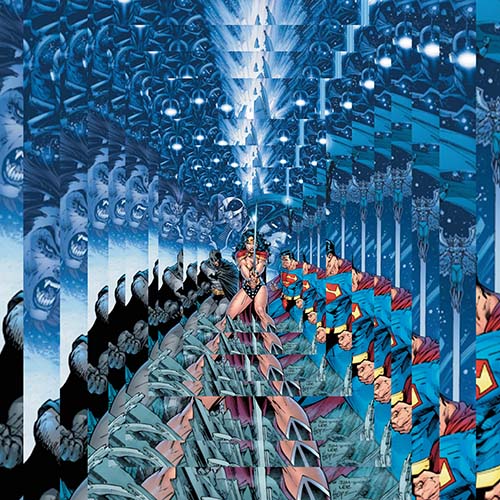
From Shelfdust’s Infinite Infinite Crisis series
I think that gives us a unique approach which benefits comics criticism as a whole. There’s value in being the oddbeat offering which has an unusual niche. You can get brilliant interviews elsewhere; you can read reviews from incredibly gifted writers; you can also get video coverage; podcast discussion; and a top ten list or two anywhere across the internet. We mostly don’t have that sort of thing.
Shelfdust is an added benefit on top of that: the health of any community is based around if it can support somebody being weird on the fringe.
It’s unexpected, right? We have one article a week, and every Wednesday we throw out something with no explanation. Looking at the recent posts as I type this, we have Batman comics from the 1980s followed by webcomics from last year followed by modern romance Manga, classic Green Lantern, Larry Hama’s GI Joe run and comics by Drawn & Quarterly. Each week, readers don’t know what era we’re covering, which characters, or what type of comics. When writers pitch to the site, they pitch their current hyperfocus, and I’ll publish anything that has a good approach: be positive, be negative, be unsure if a comic is actually good. Just write something interesting about it! Expand the conversation.
AO: What do you believe are the advantages of focussed deeper dives into single issues in terms of not just critical appreciation but also in giving historical context to comics analysis?
MORRIS: It forces writers to avoid the typical beats of a review. I don’t want people to write six paragraphs about the writer and then an apologetic paragraph about the artist at the bottom. I don’t want a score out of ten. I don’t want to appear on ComicBookRoundUp.
Comics commentary can often be delivered solely for the benefit of creators, but Shelfdust is largely useless to the comics industry itself. Writing about a 1980s issue of Ghost Rider or a Manga series which is popular in France isn’t going to generate pull quotes – but it is hopefully going to get people to try out comics they hadn’t even considered could be fascinating or relevant in the big 2026.
From Shelfdust’s Dust to Dust series
For example: in X-Men, before Iceman came out as gay in a modern issue, there had always been suggestions that the character might be closeted in some way, hidden in subtext because Marvel in years past would never have let somebody make that creative decision outright. That meant we could look back at issues which touch on the idea from way before he came out, and it not only showed what creators were doing subtextually – but it also let our writers look at the ways that queer coverage has shifted over the years. How queer readers have to approach comics if they’re looking for something reflective. Mainstream publishers won’t often give you the thing you know is there, so our series about Iceman was a chance to show how queer reading of comics has to work around that obstacle.
I feel sometimes like each generation cuts off what came before them and positions their era as the important one. By going back in time to look with modern eyes at comics from the 40s, 50s, and anywhere else in history, we can perhaps get a bit more vision of what comic creators have always been trying to do, and the steps back and forwards that they’ve had to take along that journey. Every era of comics is a golden one, not just the one that happened when you were 7 years old.
AO: What are some of the other series/areas of comics history you’ve covered to date? And what were the reasons for choosing them to spotlight?
MORRIS: We have a series called “Land’s End” where British writers wrote about John Constantine: Hellblazer; a series covering The Good Asian which had Asian critics working on each essay; a 52-part column by Charlotte Finn which wrote about every issue of Astro City’s last run. There’s more projects on Shelfdust than I can list!
It’s a genuinely random process based largely around what seems like a good idea at the time! For example, one of the first major projects we ran was one focused on Watchmen – might as well get that out the way early, right? It seemed like women never got to write about that series; having covered it as part of my highly-useful English degree, all the academic articles were by men. So I commissioned twelve women to write about each issue in a row, and published it as “Women Watch The Watchmen”.
It led to viewpoints I could never have had myself – but also that same ignorance led me to realise that I’d done a terrible job by stating this was a female-only series, and I eventually changed it to “We Watch The Watchmen” because non-binary people exist too, Steve, you idiot. Progress needs change, and Shelfdust has helped me realise my own weaknesses as I’ve gone along. I try to change myself as often as I can!
Read Shelfdust’s Watchmen series here
Maybe the most notable column was Black Comics History, where Black writers wrote about the journey of Black inclusion within the medium, year-on-year, starting with 1970 (just because it had to start SOMEWHERE, even though there was lots of comics made by Black creators before that date). I view it as an additional benefit to comics criticism rather than a defining statement – I hope we’ll continue to see much more coverage across the internet in years to come.
What I thought was most fascinating was seeing names like Billy Graham appear in the series, first as behind-the-scenes editorial; then on-page creative; reflecting how Black creators worked their way into an industry which wasn’t friendly to them. You can see alternative and indie comics creators then push into the mainstream, and make themselves an undeniable space. I don’t think we give enough credit and attention to the Keith Pollards and MD Brights of the industry and what they did for creativity as a whole.
AO: You’ve curated an impressive line-up of writers over the years. What names will BF readers recognise? And what are you looking for in a Shelfdust contributor?
MORRIS: I’ve had a lot of my favourites write for the site! I want to be a place where we can surprise people with the comics critics who return for a guest piece every so often: “hey they’re back!”, that sort of thing. It’s fun that way! We’ve had writing from all the Greats: you can find David Brothers, Tiffany Babb, Claire Napier, Wendy Browne, Kelly Kanayama, Ritesh Babu, Emma Houxbois, Charlotte Finn, there’s hundreds of people.
Several critics have then go on to become a name in comics as well! Sara Century, Steve Foxe, Zoe Tunnell and Jordan Clark have all written for the site in the past, and are now doing fantastic work as comics writers. We did special collaborations with writers like El Sandifer and Osvaldo Oyola, and hosted a podcast run by Al Kennedy from House to Astonish, which was just amazing fun.
Listen to Shelfdust: The War Effort here
I think that if you can name a comics critic, they’ve probably written for Shelfdust or done something for us at some point in time? I’m first and foremost a fan of reading commentary, so I absolutely had a hit-list of people I wanted to write for the site. Only a few haven’t been available, but there’s still loads that I’d love to do something for Shelfdust at some point. I pay everyone who writes for the website, and that rate rises every chance we get – so hopefully people are increasingly tempted to put a foot back in the, uh… warm pool. I don’t like that metaphor I just made.
AO: As we both know the landscape of online comics commentary has changed significantly in recent years with the number of venues for that kind of work having diminished significantly of late. Do you have any thoughts on the reasons for that rapid decline?
MORRIS: The internet has contracted and people are incentivised to sit and let “content” happen to them. Go on any social media platform and all you have to do is scroll the down button to get everything you think you’ll need. On TikTok or Instagram, you don’t even have to scroll! Click one video and it’ll supply you with new things forever. People are encouraged to never click AWAY, and I think that’s the issue we have online now. Nobody leaves their scroll.
It’s why you see so many people reacting to a news headline or photo, rather than the content of the article that are linked to – people do NOT click away to actually read the thing they’ve engaged with. So the loss of blogs and forums and the conversational aspects of the internet feels very much tied to the fact that tech leaders are creating online society where nobody has to do anything, but they can simply be fed curation and consume that instead. Huh. That’s the plot of Batman Forever, I guess.
So when faced with lack of engagement, I understand why people writing criticism online might be moving on from their work.
Also, well, it’s fair to say that the comics industry itself doesn’t want comics criticism to exist. They definitely want to get good reviews and 10/10 scores so they can put a pull-quote on the back of their title (and hey! I work in marketing, I understand that myself!), but they won’t read criticism as part of a healthy online diet.
I think there’s value in seeking out commentary and opinion on comics you’re not working on – “hey, did you see that article about the new Vertigo series? Really makes you think” – that sort of thing. But there’s a strong argument to say that the people making comics don’t read comic book websites as much as we’d like to think they do. They have Google alerts for their name, not an interest in reading varied coverage.
AO: And, finally, how can readers support Shelfdust? And are there any plans for the site’s future direction you’d like to share with us?
MORRIS: Shelfdust is funded through Patreon! You can see how much the site makes on our Patreon page, and that then leads directly to the rate I can pay writers. The more we make, the more I can pay, and that is a genuine thing: ask the writers and they’ll (hopefully!) be happy to confirm that my rates have increased over the years. Transparency is the core of this whole thing. I’ve written for exposure and I’ve written for pay, and I hope Shelfdust is paying step-up on the ladder into… whatever freelance writing has become in 2026.
What’re we up to? Shelfdust has just arranged a deal with the lovely Chloe Maveal of The Gutter Review, which means all the articles Chloe published on her terrifically trashy (complimentary!) website will be republished onto Shelfdust across the course of this year and into 2027, as TGR itself is currently offline. We also have a new podcast in the works, which will get announced when it’s ready.
The next project on the site is going to be about Wonder Woman. I was thinking “how many issues exist which are called ‘Wonder Woman #1’” and so now we have a series coming to the site soon where we’ll cover each Wonder One in turn, going from the Marston/Peter run to the current Tom King-written series. It seems like a woman has never written ‘Wonder Woman #’ in history, so this’ll also look at that fact, and what being a wonder woman means across the course of several decades. What do all these men think a Wonder Woman should be?
There’s more; I can’t reveal it yet. With Tiffany Babb finding massive success with The Comics Courier recently, I think we’re all trying to find ways we can try to match her and push ourselves forwards as well. Hopefully we’re in a period of new growth, and I’m planning to ride that wave of momentum into the… um… warm pool.
Damn, I used that bad metaphor again, Andy.
Interview by Andy Oliver









I clicked away from BlueSky! Some of us can’t WAIT to click away, but they are a useful launchpad.
Also, as a comics-maker, I can confirm we don’t check comics criticism media much because making comics is time consuming and if you’re a webcomic artist, adding the marketing, around presumably also a real job, who has time? The last thing you want to do is probably read about comics. It’s all video games, D&D and procrastinating by writing comments on websites in an attempt to repopulate the web.
Oops.
Anyway, as someone who doesn’t keep up with the trends, I look forward to reading something different!