


Sometimes it’s impossible to be entirely disconnected from an interview subject because comics is a small community and we’re all aware of the people who have worked tirelessly to create opportunities for others and raise the profiles of the deserving. Dave White is one such figure on the UK scene which is why the announcement last month that he was stepping away from Avery Hill Publishing – the indie publisher he co-founded – was met with so much sadness. But Dave’s contributions with AHP also deserve to be celebrated. There’s absolutely zero hyperbole in saying that he’s been part of something for the last near decade and a half that has fundamentally changed the landscape of UK comics. So it’s a privilege today to be able to publish this chat we had reflecting on the last 14 years as Dave leaves his co-publisher role and gives back his keys to the Avery Hill executive drinks cabinet.
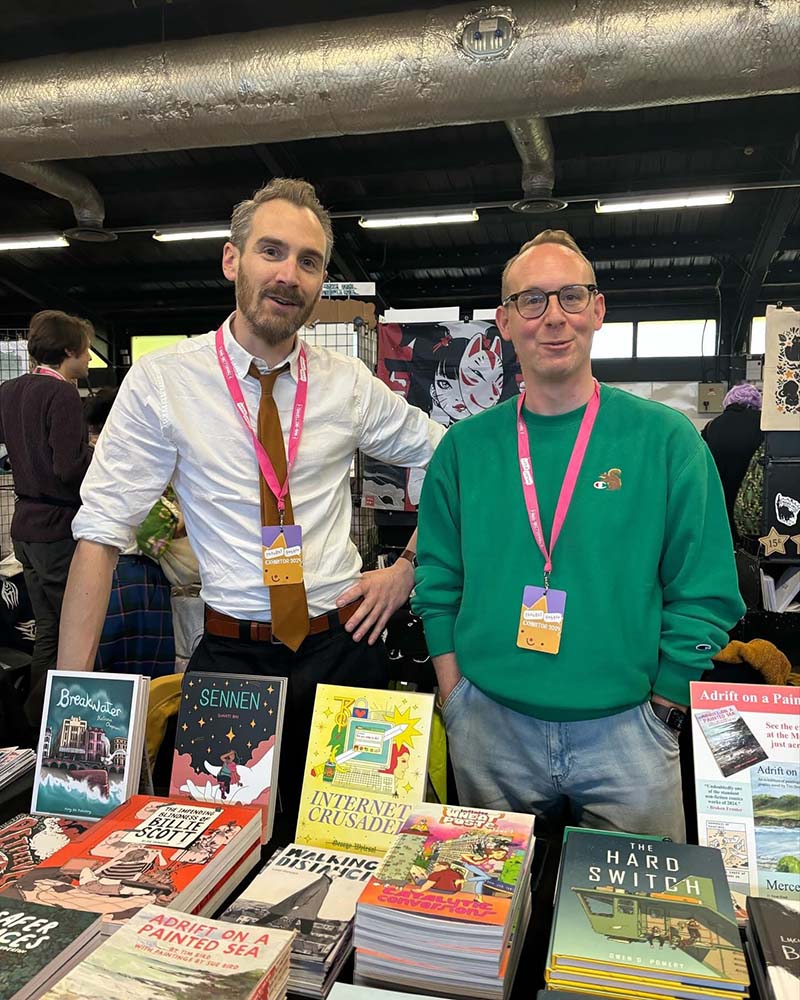
Dave White (right) with Owen D. Pomery (left)
And on a personal note I know I can speak for the Broken Frontier team both past and present in saying thanks for everything, Dave. Especially all those Yearbook edits…
ANDY OLIVER: So, after nearly a decade and a half, you’re leaving Avery Hill effective this month. What you’ve given to the community in that time is phenomenal. Why is now the right time for you to step back from the world of comics publishing?
DAVE WHITE: A bit of a boring answer, but ‘life.’ A lot has happened over the last 14 years, for both me and Ricky, and it’s got to the point where my day job and other responsibilities were stopping me from contributing in the way that I wanted to. It’s been a gradual thing for a few years, and it was a conversation I’d been putting off having for a while, but it didn’t feel fair anymore to expect Ricky, Kat and Gina to carry the bulk of everything whilst I wasn’t able to help anymore.
And although the formal stuff has all been done, I’ll still be editing a few projects that are in progress, including new books from Tim Bird, Owen Pomery and Lucy Sullivan – being able to see those through and continue working with some of my favourite creators has made it all seem a bit less sad.

Cover by Liz Jordan
AO: Having been covering Avery Hill Publishing since the first volume of Reads way back in 2012 this really does feel like the end of an era to me. When I interviewed (co-founder) Ricky Miller for your 10th anniversary in 2022 he described AHP as “a hobby that got out of control”. Does that soundbite encapsulate things for you too?
WHITE: Very much so – but in the best way possible. We’ve never been shy about having to keep our day jobs alongside running Avery Hill, because we’ve never taken anything out of it – everything goes back to the creators or running the company. But that’s meant we’ve been able to make decisions that have allowed us to maintain the ethos of Avery Hill primarily focussing on our creators and their work, which we might not have been able to make otherwise. Factory Records was an early model for how we wanted to do things, and I think we’ve been pretty successful at maintaining that.
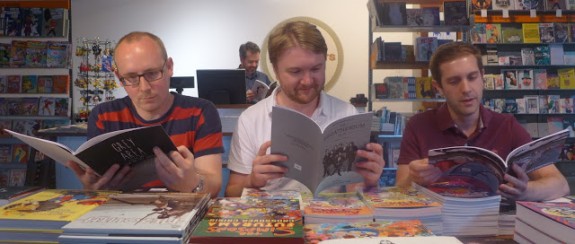
Dave White, Ricky Miller and Michael Gosden at London’s Gosh! Comics
AO: I realise we’ve documented those very early days before at BF but there are always going to be new readers unaware of Avery Hill’s origins. It’s a constantly shifting small press world after all. So let’s revisit that time. How did you, Ricky and Michael (Gosden, AHP co-founder) meet? What were the origins for what would eventually become AHP?
WHITE: We met at school and bonded over similar tastes and passions – music, books, comics, football. Over the years we were in a band together, we wrote a music blog together and eventually started making zines together. Trying to get those zines into comic shops like Gosh! and Orbital led to us finding other self-publishing creators who started to contribute, including Tim and Owen. And once we started to understand the community that was out there, and how many incredible creators there were to potentially work with, the next step was starting to publish other people’s comics, and that led to starting Avery Hill as a going concern. That all happened pretty quickly, over the course of a few years.

Mitchell Collection – very early AHP esoterica! A zine of black and white photos of police and military figures taken on a holiday in Europe in 1984 by one T.P. Mitchell, as compiled via a photo album bought from a stall in Deptford Market
AO: Looking back on that era of handmade zines and sometimes quite esoteric and niche publications could you ever have foreseen the place and importance Avery Hill would go on to have within the UK comics scene?
WHITE: Absolutely not – when we started, not getting caught sneaking into work to use the photocopier on a weekend was the main goal. But because of the way we set Avery Hill up, we were able to develop at a pace we felt comfortable with and were able to take the next logical steps at the right times. A couple of very important things to add – lots of people have been very generous with their advice, time and guidance over the years, which we’ve always been very grateful for. And Ricky is brilliant at spotting the right opportunities at the right times – he’s been the force in driving that, and I’m excited to see what he’s got planned next.
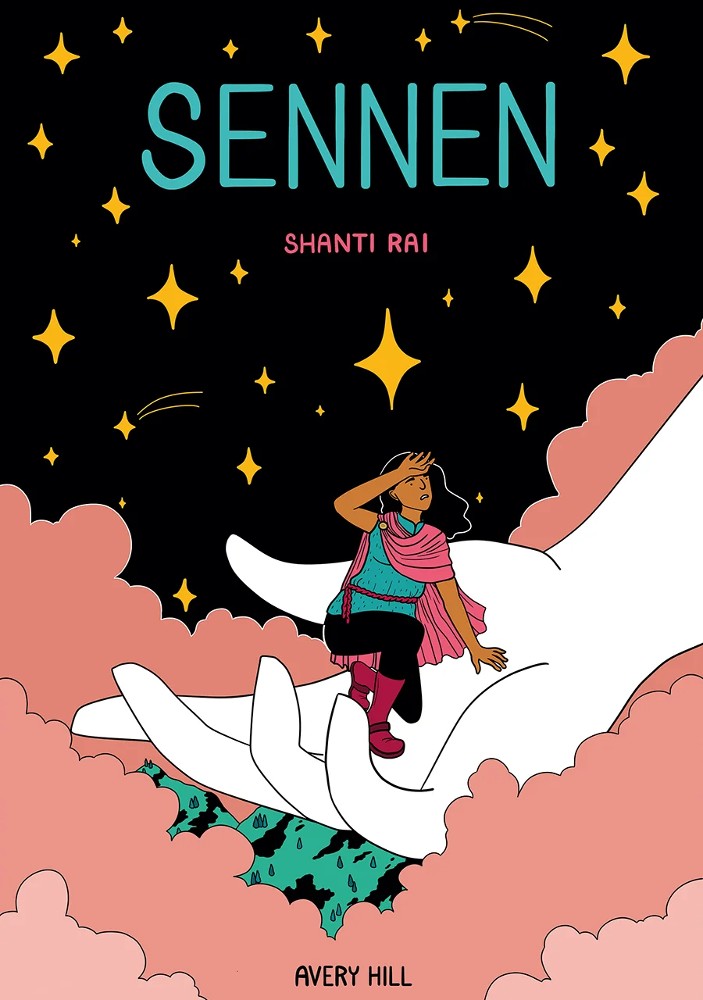
AO: What has been your personal ethos when it came to curating Avery Hill projects?
WHITE: It’s an ethos we both share, but put simply, we wanted to publish the books we wanted to read, and that wouldn’t have an opportunity to find their audience otherwise. We’ve often got feedback that our list is very varied but still identifiable as ’Avery Hill‘, and we take great pride in that. We’ve also focussed on newer creators over the years, in the UK particularly, and it’s been a big thrill to see creators who published their first books with Avery Hill become big names in the industry as their careers have skyrocketed.
AO: From the purely publishing side of things what have been some of the highlights of that near decade and a half at Avery Hill? What were some of your proudest accomplishments both in terms of books and in bringing emerging creators to wider audiences?
WHITE: There are genuinely too many to mention – we’ve wanted every project we work on to be a success on the terms the creators wanted them to be, so it doesn’t necessarily have to be the biggest sellers or the award winners. I’ve got some very personal attachments to a lot of our books, which generally come from supporting the creators through their development and creation, sometimes through tough or challenging circumstances. It’s been a real privilege to be part of that process.
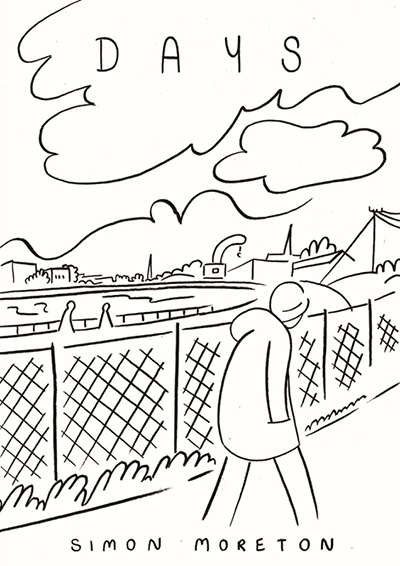
AO: Conversely, are there things you would have done differently in hindsight? Projects that never quite happened or creators you would have loved to have worked with?
WHITE: Zero regrets. Every decision made was for the right reasons at the time, and if something didn’t work out exactly how we wanted it to, we learned from that for the next time. And if we never got to work with a creator we loved, as long as their books were being published somewhere, that’s the most important thing.
AO: What would you mark as the key moments in Avery Hill’s evolution? I would imagine publishing Tillie Walden’s first book would be one but what else would you say were pivotal factors in the company’s growth and reach?
WHITE: Publishing Tillie’s first books definitely gave us a turbo boost in a bunch of ways, and was hugely important in our development, but a moment I’ve always pointed to was Kat (Chapmen) joining us – it had just been Ricky and me for a while before then, and it was getting tougher and tougher to keep going. Kat coming in immediately helped us out in so many ways, and she’s now an absolutely fundamental part of Avery Hill and its history.

AO: Comics in the UK is very much a community and Avery Hill itself has been bolstered by the contributions of a number of different team members over the years. I imagine the friendships and relationships you’ve formed within the community in that time will be a big takeaway from the last 15 years?
WHITE: I‘ve just mentioned Kat and how incredible she is, not only as a part of Avery Hill, but also a massively important creator and all-round brilliant person. It was a privilege to first meet and then welcome the great Steve Walsh to the team. That wouldn’t have happened without Avery Hill, and the thought of never having the opportunity to know him as a friend, let alone spend important time with him, makes it all worthwhile on its own. And now Avery Hill are very fortunate to have Gina as part of the team, and a big part of keeping the company driving on. AHP really are set to achieve even bigger things in the years to come.
And as you mention, getting to meet so many wonderful people in the comics community, from so many different areas, all sharing the same passion and drive to keep pushing the medium to greater heights, has been something I’ve loved. I’ve made friendships through Avery Hill that I absolutely treasure, and that will last long into the future. I’m truly grateful for that.
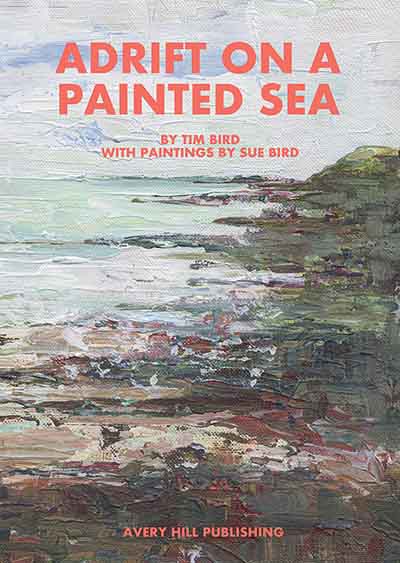
AO: Let’s think about events for a moment. Do you have a favourite fair/festival/con-related Avery Hill anecdote? And how satisfying was it to see the Avery Hill exhibition at the Mercer Gallery in Harrogate over the last few months?
WHITE: We’ve had a lot of fun at events over the years – I remember one member of the team at the time (no names, obviously) sleeping under the table following a 3am exit from the casino during our first Thought Bubble, when we had about three comics to sell; our first LICAF, which felt like a weekend jolly with a bunch of best mates; our visits to events in the US, Canada and other countries are always great experiences. Of course, I was always extremely well behaved at every event we went to, so if there were any shenanigans going on, I mostly wouldn’t have known about them.
The exhibition at the Mercer Gallery felt like a real inflection point – not only that the team at the Gallery wanted to put the show on, but as a retrospective of sorts. That it was such a big success is down to Ricky, but particularly Kat – the amount of work that went into it was immense, and for it to turn out so brilliantly is a huge achievement.
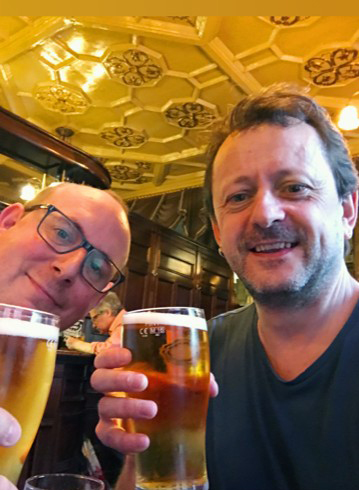
Dave with BF Editor-in-Chief Andy Oliver after the ELCAF portfolio review sessions, circa 2017 – cheers, Dave!
AO: Thinking more widely how has UK comics changed in the time you’ve been part of AHP?
WHITE: On the plus side, there are more and more UK creators coming out all the time, finding different ways to get their work to their audience without having to rely on publishers, which is massively important. On the downside, it feels like there are less and less publishers available for creators who do want to go that route. For a few years after we started in earnest there were a group of similar new smaller-press publishers looking to work with emerging creators. They seemed to drop away over time (which we completely get, having been on that journey ourselves) without being replaced, leaving a gap that’s proving difficult to fill.
AO: And, finally Dave, what are you looking forward to the most now you’ll be interacting with comics from a very different perspective?
WHITE: It will definitely feel weird being on the other side of the table after so long – but I’m also looking forward to just being a comics fan and supporter, and celebrating Avery Hill‘s success for another decade-plus. I’m not going to miss those early starts on a Sunday at Thought Bubble, though…
Visit the Avery Hill Publishing online store here
Interview by Andy Oliver