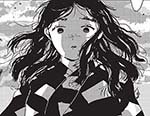



ANNA TRENCH: I’ve always loved the interaction of words and pictures, working together, playing shifting roles. In my late teens and during my Art Foundation at Falmouth I discovered more comics and graphic novels aimed at adults. Then I read English at King’s College, Cambridge, during which I continued to write and draw, including political cartoons, then spent a year as artist in residence at Christ’s College, Cambridge, where I worked on my illustration and comics practice. Many cartoonists and graphic novelists have had a big influence on me, such as Edward Gorey, Posy Simmonds and Alison Bechdel. I didn’t really know other people making comics personally though until I did a course with Emily Haworth-Booth about ten years ago and that was a great chance to meet others. Since then I’ve loved discovering more and more people’s work.
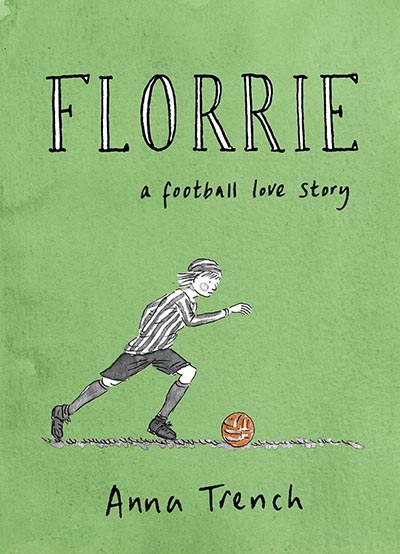
AO: Your debut graphic novel Florrie: A Football Love Story was shortlisted for both the First Graphic Novel Award and the LDComics Prize. How much of a boost to your confidence was that level of recognition? How important are opportunities like both competitions in providing a springboard for emerging voices?
TRENCH: To have Florrie shortlisted for both the First Graphic Novel Award and the LDComics Prize was a massive boost to my confidence and I’m hugely grateful to all the people involved for the work they put in to promote comics. It was amazing to read all the long-listed works for both prizes, too. These opportunities are vital in providing exposure for creators and raising the profile of the form. I was thrilled earlier this year to win the East Anglian Book of the Year Award and the Fiction Prize, and it’s hopefully an uplifting sign of the times that the judges included a graphic novel in a literary award.
AO: Can you tell us about the background of Florrie, the forgotten and erased period of sporting history it covers, and the themes you explore in the book?
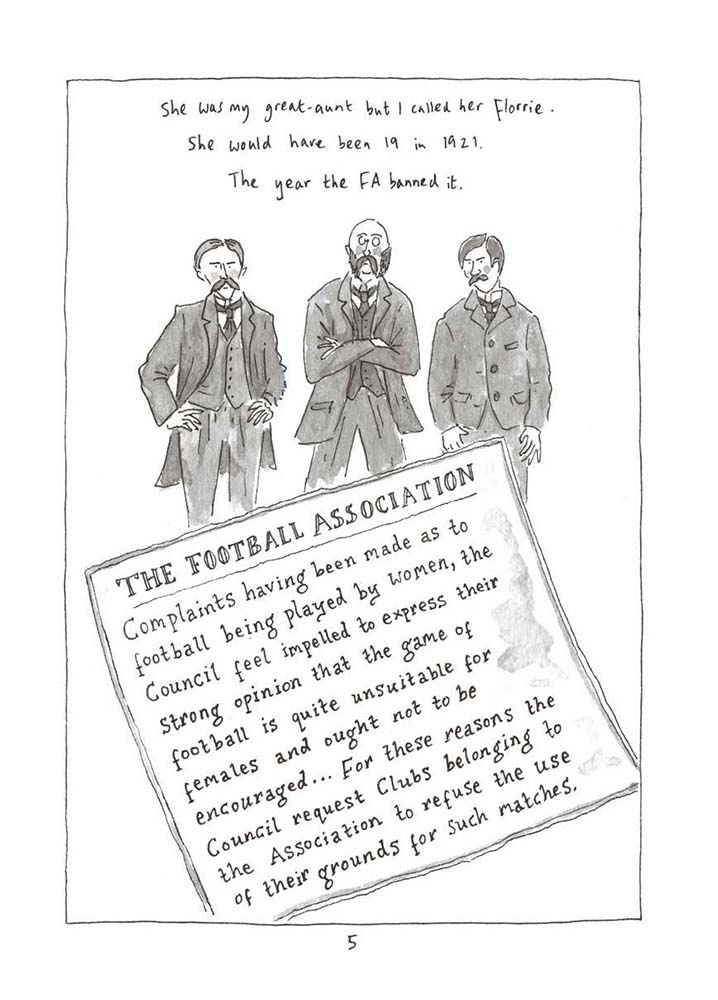
TRENCH: Florrie: A Football Love Story is mainly set in the early twentieth century when women’s football was hugely popular. Having started in WW1 munitions factories, by 1920 there were over 150 teams. There were enormous crowds: over 53,000 people watched Dick, Kerr’s Ladies play St Helen’s. Then, in 1921, the FA banned women from using their pitches, essentially stopping them playing, and that ban lasted for 50 years. I wanted to tell a story about some of those early players who had so many possibilities opened up to them – only to be shut down.
Florrie is also a love story: she falls for another female footballer. It’s great to see the history of women’s sport reaching a wider audience, and the history of the LGBTQ+ community. But these stories still aren’t told enough – which is why I created Florrie.
AO: What first drew you to creating a story like Florrie and convinced you to tackle it in comics form?
TRENCH: Since I was a little I was obsessed with football, and I still play today, so creating a graphic novel about it was really special for me. Around the centenary of the ban I was looking at team photos from that time. I found them incredibly moving and wondered what happened to all those players. A name that often came up on team sheets was ‘Florrie’.
The Florrie I created is fictional, but her adventures touch on real events: huge crowds at matches in London and Preston, international fixtures, dances at lesbian clubs in Paris and the devastating consequences of a ban on women playing a game deemed ‘unsuitable for females’. Florrie’s experiences – being part of a team, self-discovery – also has some overlap with my story, and with that of many other players I know.
AO: What did the research process for the book entail?
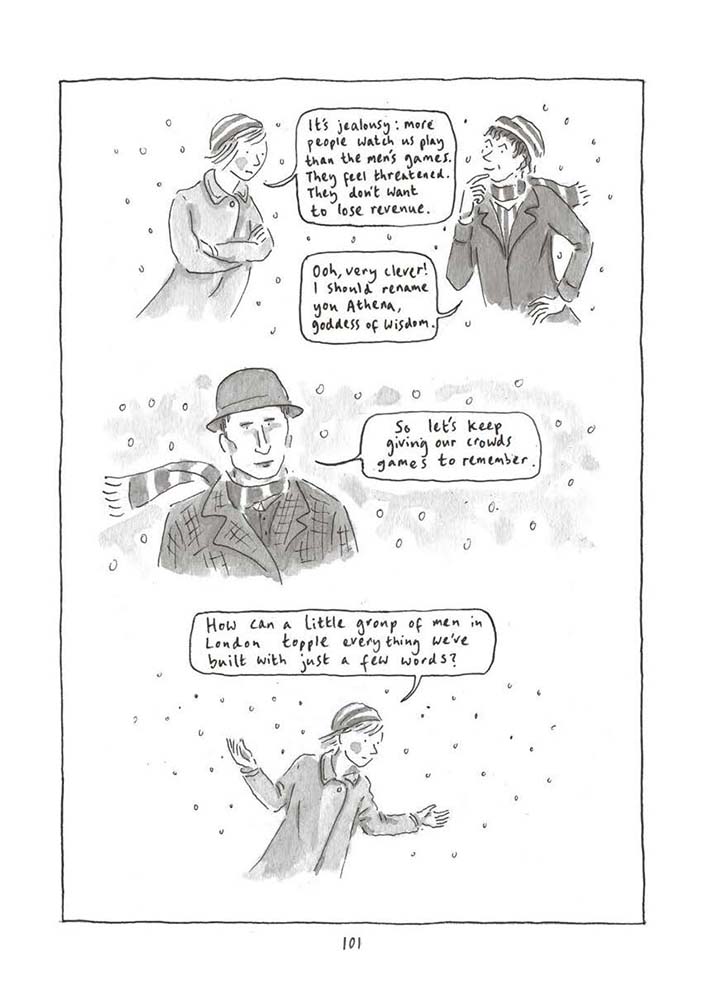
TRENCH: As well as reading books and looking at old photos, I discovered the BFI’s archive footage of female footballers. I loved researching: ensuring the kit (berets for the French players!) reflected the period, finding out what vehicles characters would have travelled in, checking the exact rides on Blackpool pleasure beach in 1921, replicating the right stamps for post from Berlin in 1924, and knowing what specific places like Stade Élisabeth stadium, Le Monocle club and Shakespeare and Company would have looked like.
I trawled through newspaper archives and copied reports verbatim, using the actual words of the men on the FA committee in December 1921 and the articles that argued football was ‘far too strenuous’ for a woman’s delicate frame.
There’s lots in Florrie that’s inspired by facts. The football team names are real, except Holt Ladies and Dieppe Dames. The hugely successful Dick Kerr Ladies really did go on a tour of the USA. Although my characters’ first names – Lily, Alice, Florrie – cropped up on lots of team sheets that I looked at, my characters themselves are all made up. I really enjoyed the research process but, of course, it’s a novel, so what’s fun is knowing that you can play with the truth and your characters do what they decide to do.
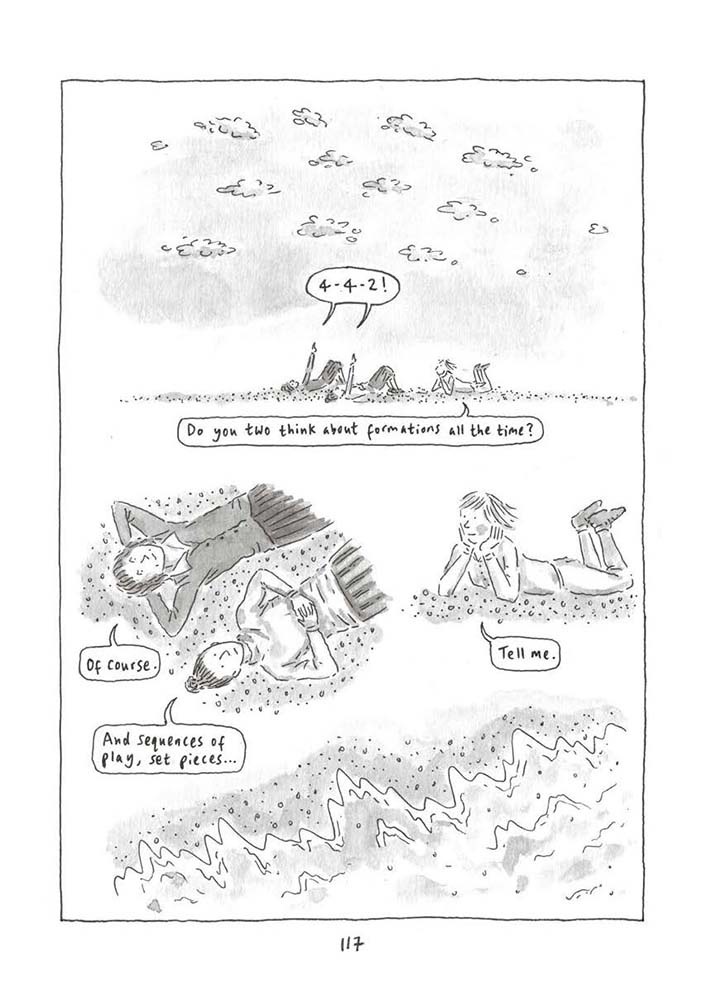
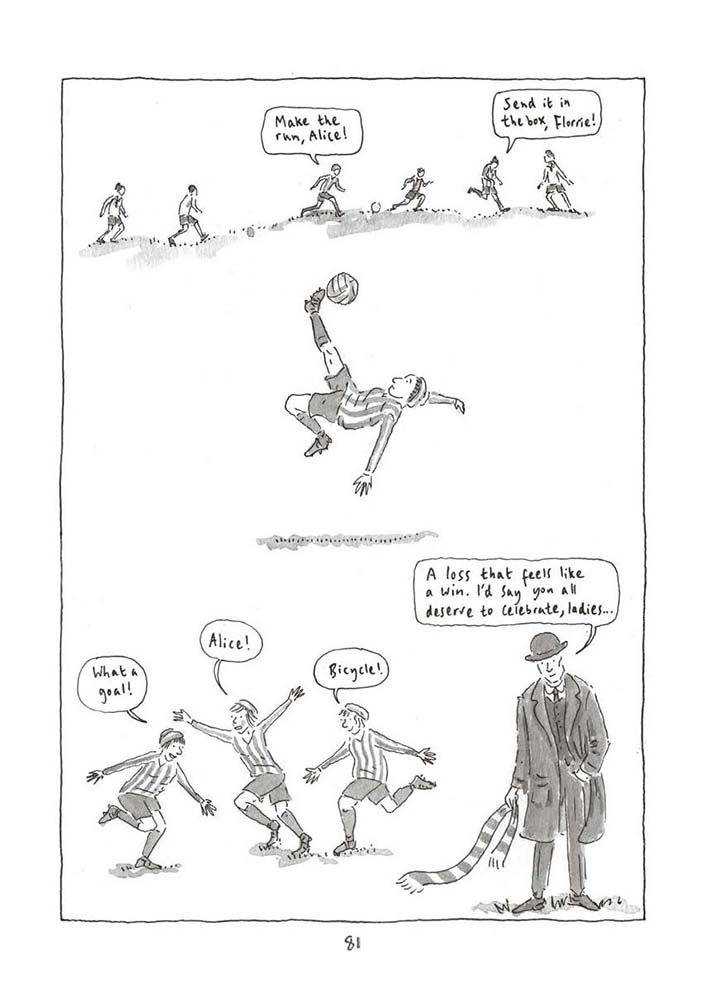
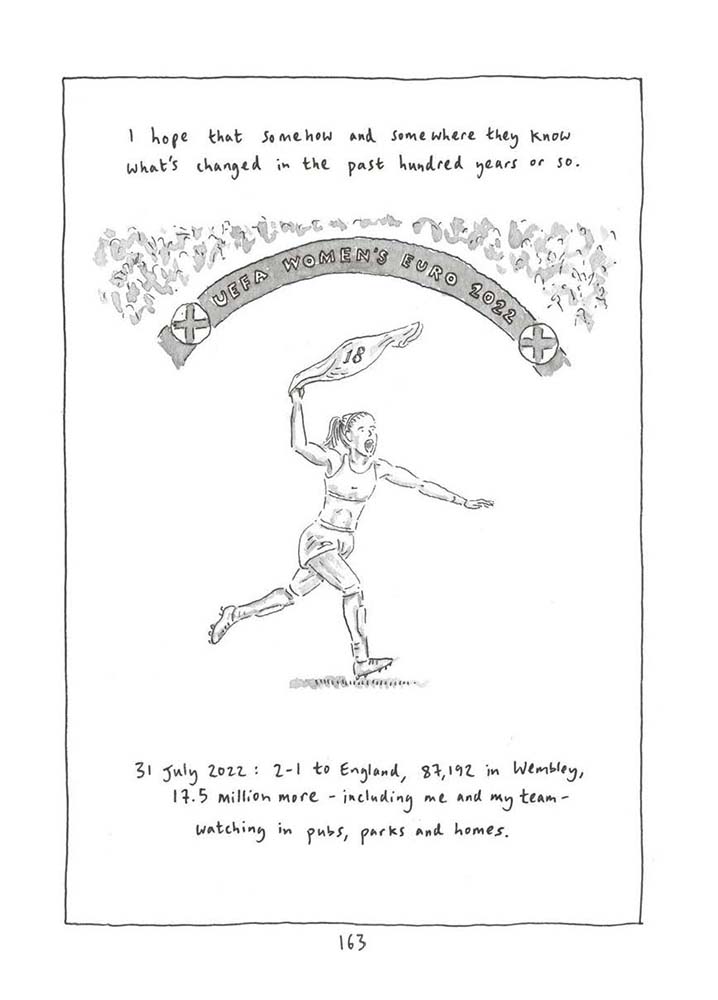
I also thought about my own experience playing, and what feelings and interactions I wanted to show. On a couple of occasions I used contemporary references too, for example the composition of Florrie’s first goal at the start of the book is inspired by Chloe Kelly’s Euros 2022 winner, which is also referenced at the end with her iconic celebration.
AO: There’s obviously that conjectural element to the book. How did you approach that in terms of creative responsibility to the subject?
TRENCH: Florrie is a historical graphic novel and it’s not about a real Florrie. There is lots that is based on archival research, but there is even more that is made up. For example, most of the teams that played at the time were in the north of England, but Florrie’s team is in Norfolk. The novel is inspired by some real events and set in real places, but the characters are all invented, so I felt I had a lot of freedom there.
AO: Talk us through your creative process. What mediums did you work in to bring Florrie’s story to the page?
TRENCH: I draw in pencil, go over in ink (0.2 or 0.3 black pens), then rub out the pencil and add a wash. I only use the computer for scanning and very minor changes. Florrie was all drawn in A4 sketchbooks. Two of my sketchbooks are currently in the Quentin Blake Centre for Illustration’s Queer as Comics exhibition and I didn’t realise before then that the way I drew the pages chronologically in a book is quite unusual. I liked not using panels for Florrie, I felt quite liberated in terms of space and being able to move things around. I like working in black and white but this was also important to reflect the time period. The writing and drawing were quite interwoven from the start. I had a rough plan written but it changed a lot. Sometimes the writing took more of a lead, as I worked out narration and dialogue, and made notes on page composition, but it’s really not until I was sketching each page that I knew exactly how the story would go and precisely how the characters would speak and behave.
AO: Finally, are there any other comics projects you’re working on that you can tell us about?
TRENCH: I’m in the very early stages of another graphic novel. It has a historical setting, a queer love story and a little bit of sport…
Buy Florrie: A Football Love Story online here
Interview by Andy Oliver